
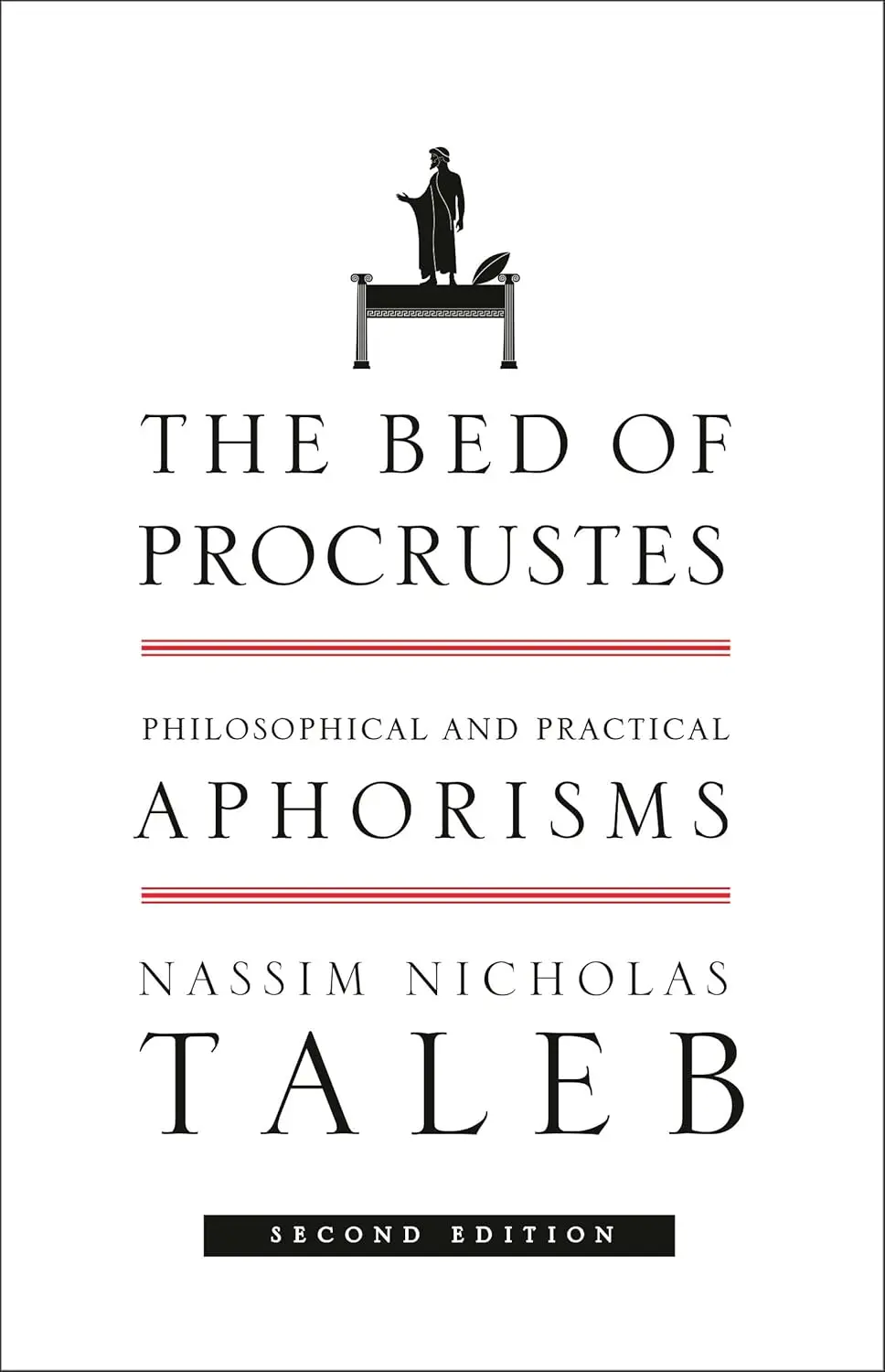
The Bed of Procrustes is the most compressed of Nassim Taleb’s books. Where The Black Swan and Antifragile develop their arguments over hundreds of pages, this book delivers Taleb’s thinking in the form of aphorisms, individual sentences or short paragraphs that are meant to be read slowly, one at a time, and thought about rather than consumed.
The title refers to the Greek myth of Procrustes, who offered travelers a bed for the night and then either stretched them or cut off their legs to make them fit it. Taleb uses this as a metaphor for what humans do with reality: we distort facts, ideas, and people to fit the frameworks we’ve already built, rather than adjusting our frameworks to fit reality. The aphorisms are organized into loose categories: knowledge, success, ethics, health, human nature, and personal conduct.
Some examples give the flavor. On success: “The three most harmful addictions are heroin, carbohydrates, and a monthly salary.” On ethics: “If you see fraud and do not say fraud, you are a fraud.” On knowledge: “An erudite is someone who displays less than he knows; a journalist or consultant, the opposite.” The tone is sharp and deliberately provocative. Taleb is not trying to make you comfortable; he’s trying to make you think.
For founders, the aphorisms on risk, decision-making, and success are the most directly applicable. Taleb’s perspective, shaped by his career as a trader and his study of probability, is that most people systematically misjudge risk and attribute too much of success to skill and too little to luck. These are useful correctives for anyone building a company in an environment where the difference between success and failure often comes down to factors outside your control.
The book is very short and can be read in an hour, but it’s designed to be reread. Many aphorisms hit differently depending on what you’re going through when you encounter them. Some readers find the format fragmentary and unsatisfying, preferring Taleb’s longer works. Others find this the best entry point into his thinking because it strips away the digressions and leaves only the sharpest ideas. Either way, keep a pen nearby: you’ll want to mark the ones that land.
