
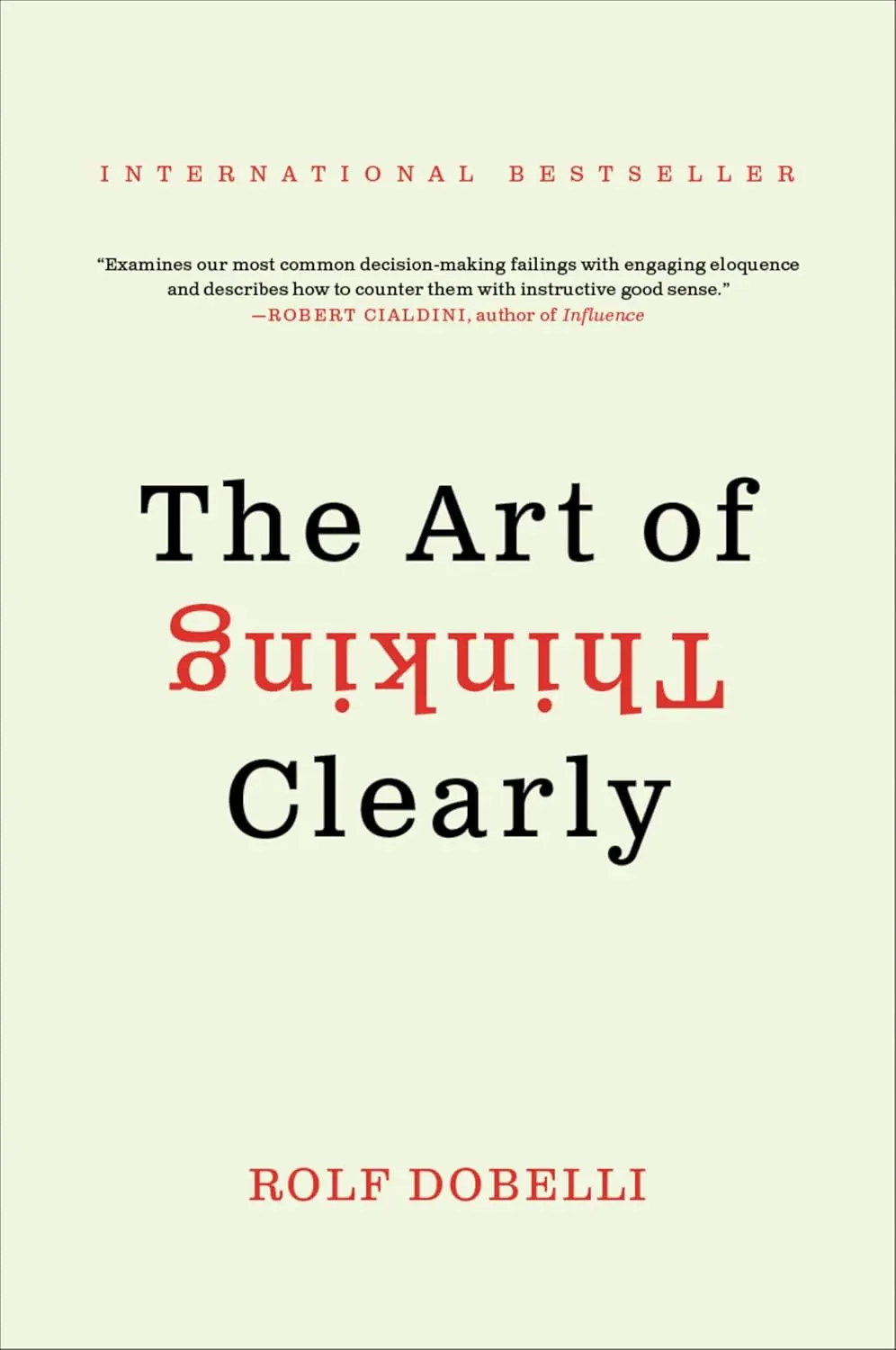
Each chapter in The Art of Thinking Clearly covers one cognitive error. Survivorship bias (we study winners and ignore the far larger number of losers, which distorts our understanding of what caused success). Sunk cost fallacy (continuing to invest in something because of what you have already spent rather than what you will gain). Confirmation bias (seeking information that supports what you already believe). Authority bias (trusting someone’s opinion because of their title rather than their argument). And 95 others.
The format is the book’s strength. Each chapter is roughly three pages: a description of the bias, an example or two, and a brief suggestion for how to counteract it. This makes the book work as a reference you can open to any page, read for five minutes, and walk away with something useful. It does not build a sustained argument, and it does not need to.
Dobelli draws on the same research base as Kahneman (Thinking, Fast and Slow), Ariely (Predictably Irrational), and Cialdini (Influence). The difference is format: where those books develop ideas at length, Dobelli compresses each one into a few pages. The trade-off is depth for breadth. If you have already read the deeper treatments, Dobelli offers a useful refresher. If you have not, he offers a map of the territory.
The writing is clean, direct, and occasionally dry. Dobelli is a Swiss novelist and essayist, and his style is European rather than American: less anecdotal, more analytical, with fewer emotional stories and more logical structure.
For founders, the value is in the density. Having 99 cognitive biases cataloged in one place means you can scan for the ones most relevant to a decision you are making right now. Are you continuing a project because of sunk costs? Are you evaluating a hire based on authority bias? Is your market research contaminated by confirmation bias?
At about 300 pages, the book moves fast because of the short-chapter format. It works best kept on a desk rather than read cover to cover in a sitting.
