
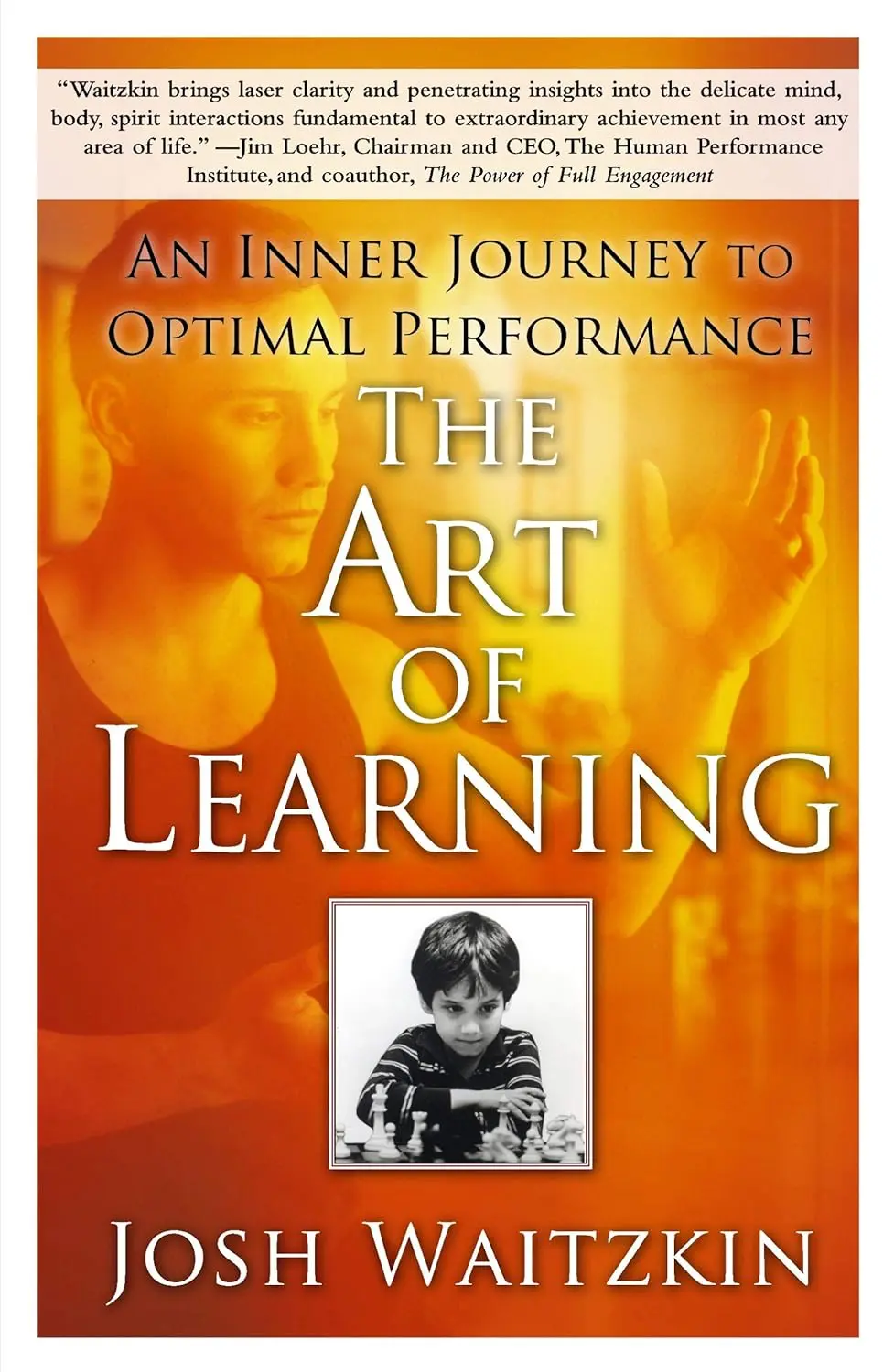
Waitzkin’s unusual background gives him credibility few authors on learning can match. He became a national chess champion as a child, then walked away from competitive chess and started over in tai chi push hands, eventually winning a world championship in that discipline too. The book is his attempt to describe the meta-skill underneath both achievements: how to get good at getting good at things.
The approach is personal rather than academic. Waitzkin describes specific moments from his chess and martial arts careers: losing a critical tournament because he could not handle the pressure, discovering that slowing down improved his performance more than speeding up, learning to use mistakes as information rather than treating them as failures.
Several concepts recur. “Investment in loss” means deliberately putting yourself in positions where you will fail, because that is where the fastest learning happens. “Making smaller circles” means mastering a simple version of a technique so thoroughly that it becomes instinctive, then building complexity on top of that solid base. “The soft zone” is a state of relaxed concentration where you can respond to unexpected situations without freezing.
The book is not a step-by-step learning system. It is more like a memoir filtered through the lens of what worked and what did not. Waitzkin is reflective about his own process, including the periods where his approach broke down and he had to rebuild from scratch.
For founders, the relevant parallel is that building a company is a learning problem. You are constantly encountering situations you have never dealt with before: hiring, fundraising, managing conflict, making product decisions under uncertainty. The question is not whether you will make mistakes but how quickly you can extract useful information from them.
Tim Ferriss, who wrote the foreword, has called Waitzkin one of the best learning practitioners alive. James Clear and Naval Ravikant have also recommended the book. At about 290 pages, it reads quickly. The chess and martial arts stories are genuinely engaging even if you have no interest in either discipline.
