
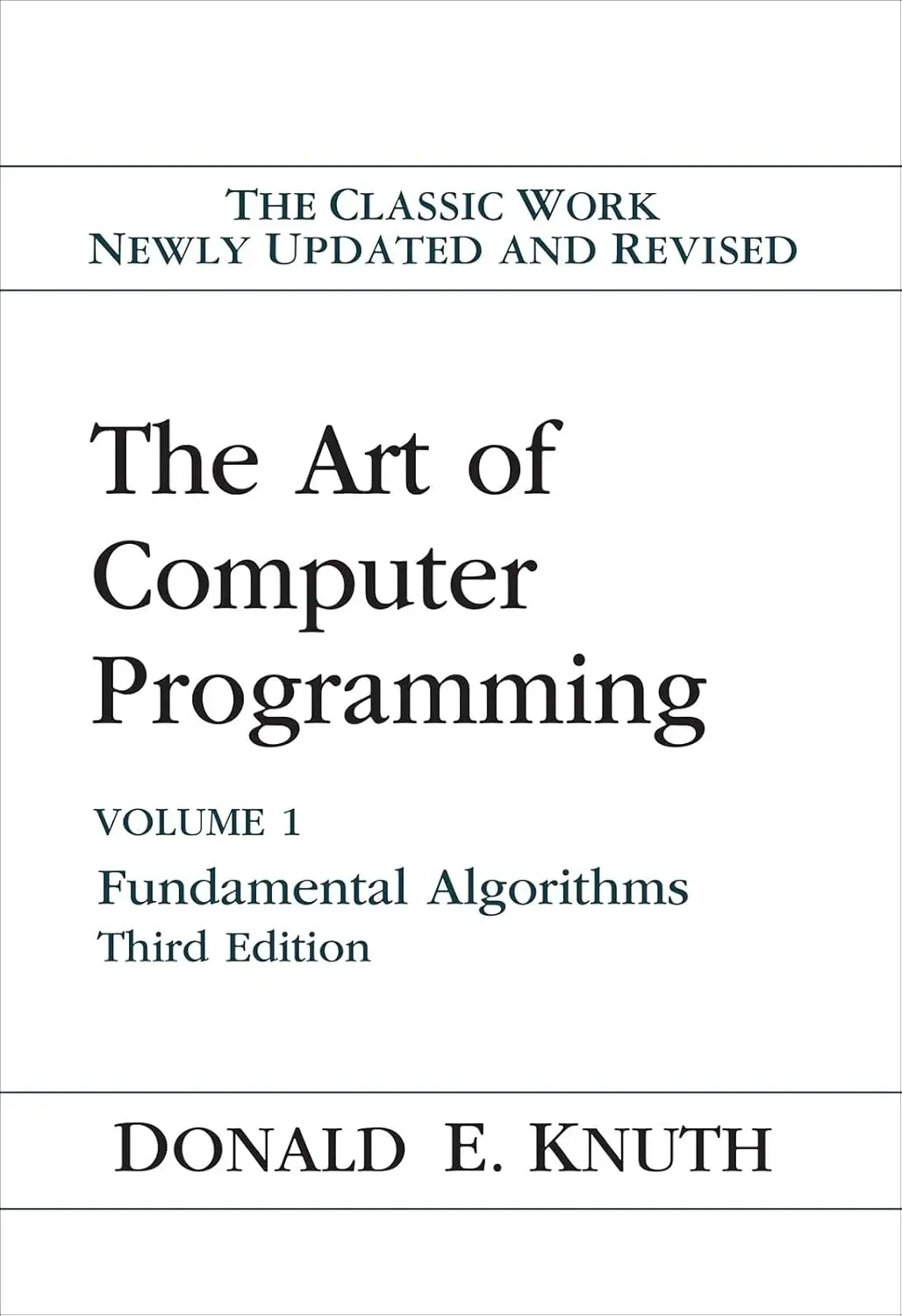
Donald Knuth started writing The Art of Computer Programming in 1962 as a single book. It expanded. Then it expanded again. Decades later, it has grown to four published volumes, with three more planned, and Knuth, born in 1938, is still working on it. The project has consumed most of his professional life and has produced what is widely considered the most important work in computer science.
Volume 1, Fundamental Algorithms, covers the basics: data structures (linked lists, trees, multilinked structures), mathematical foundations (combinatorics, probability), and algorithms for sorting and searching at a level of rigor that most textbooks do not attempt. Knuth does not just describe algorithms. He analyzes them mathematically, proving their correctness and calculating their performance characteristics with a precision that set the standard for the field.
The book is written in a mix of mathematical notation and MIX assembly language, a fictional computer architecture that Knuth designed specifically for the series. This is simultaneously the book’s greatest strength and its highest barrier to entry. The MIX language forces the reader to think about algorithms at the machine level, which produces a depth of understanding that higher-level languages cannot. It also means that casual readers will hit a wall within the first fifty pages.
Bill Gates said in 2016 that if you could read the whole thing, you should send him your resume. This is usually quoted as a recommendation but is more accurately understood as an acknowledgment that very few people can actually read it. The book assumes comfort with mathematics at a level that excludes most working programmers. It is used primarily in graduate courses and by researchers who need its results as reference material.
Knuth is also responsible for TeX, the typesetting system he created in the late 1970s because he was dissatisfied with how his publisher was typesetting the mathematical notation in his books. TeX became the standard typesetting tool for scientific and mathematical publishing worldwide. The fact that he built an entire typesetting system as a side project while writing his magnum opus says something about the kind of mind involved.
The Art of Computer Programming is not a book most people will read. It is a book that shaped the field, trained several generations of computer scientists, and continues to be the reference that other references refer to. Knowing it exists, and knowing what it represents about the depth available in computing, is itself worth something.
