
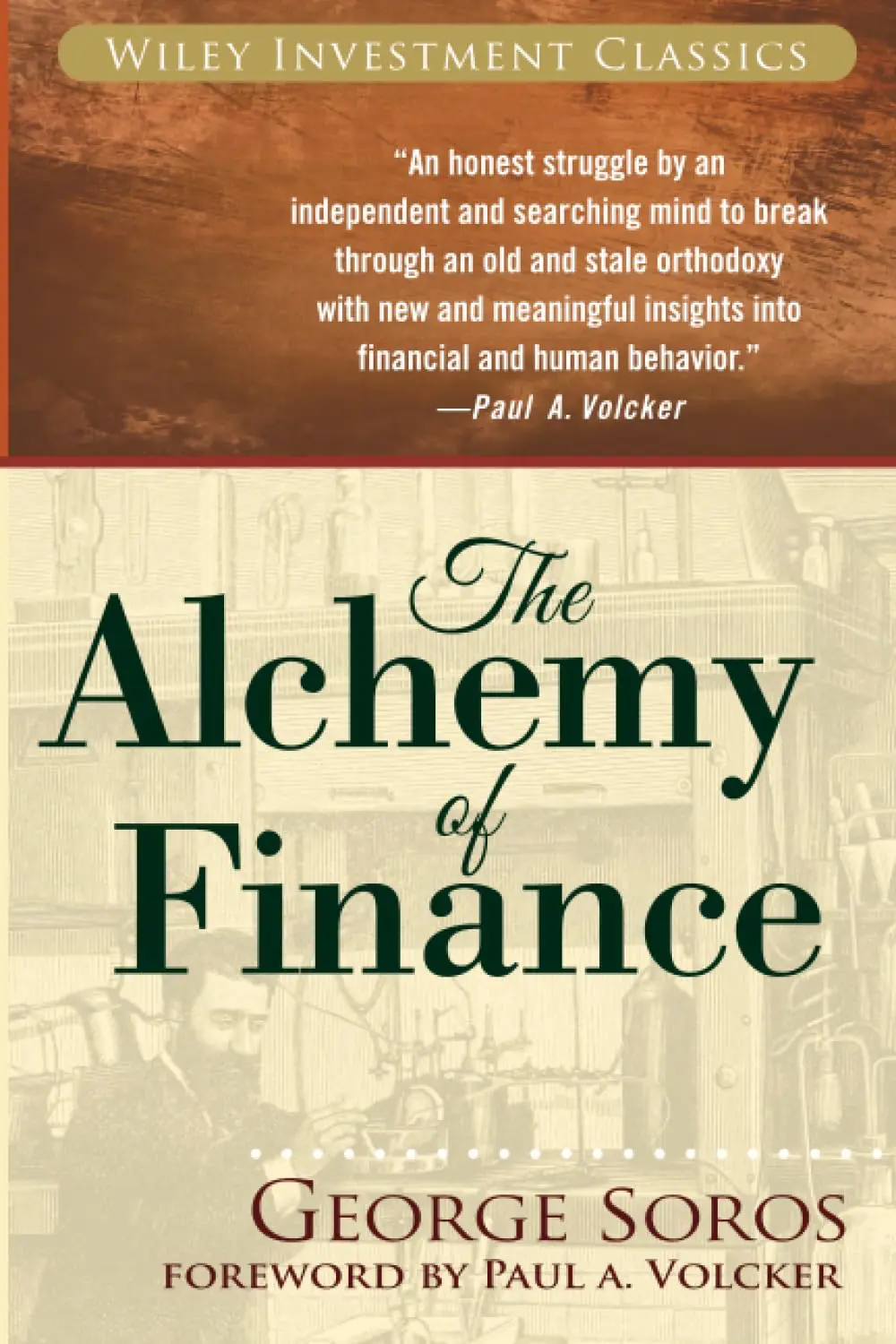
The Alchemy of Finance is George Soros’s attempt to articulate the theory behind his investment success. The central concept is reflexivity: the idea that in financial markets, the act of observing and acting on beliefs about the market changes the market itself. When investors believe a stock is going up, they buy it, which pushes the price up, which confirms their belief, which attracts more buyers. The process works in reverse during sell-offs. This creates feedback loops that standard efficient-market theory doesn’t account for.
Soros argues that reflexivity means markets are inherently unstable and that the equilibrium models taught in economics textbooks are misleading. Markets don’t converge toward a correct price through rational calculation. They oscillate between boom and bust as beliefs and reality chase each other in circles. The investor who understands this, who can identify where a reflexive feedback loop is forming and which direction it’s heading, has an advantage over investors who rely on fundamentals alone.
The most unusual section is the “real-time experiment,” where Soros documented his investment decisions as he was making them over several months. He wrote down his reasoning before each trade and then recorded what happened. The section reads like an investor’s diary and gives a rare window into how a great trader actually thinks, including the mistakes and the second-guessing.
For founders, the reflexivity concept applies beyond financial markets. Customer perception of a startup can create its own reality: a company that is perceived as winning attracts better employees, more press coverage, and more investment, which makes it actually win. Understanding reflexive dynamics helps you think about momentum, perception management, and the difference between genuine progress and self-reinforcing narrative.
The writing is dense and assumes some familiarity with economics and financial markets. Soros is writing as a philosopher as much as an investor, and some passages read more like academic philosophy than investment advice. The real-time experiment is the most accessible section. The book rewards multiple readings, as the reflexivity concept is simple to state but subtle in its implications.
