
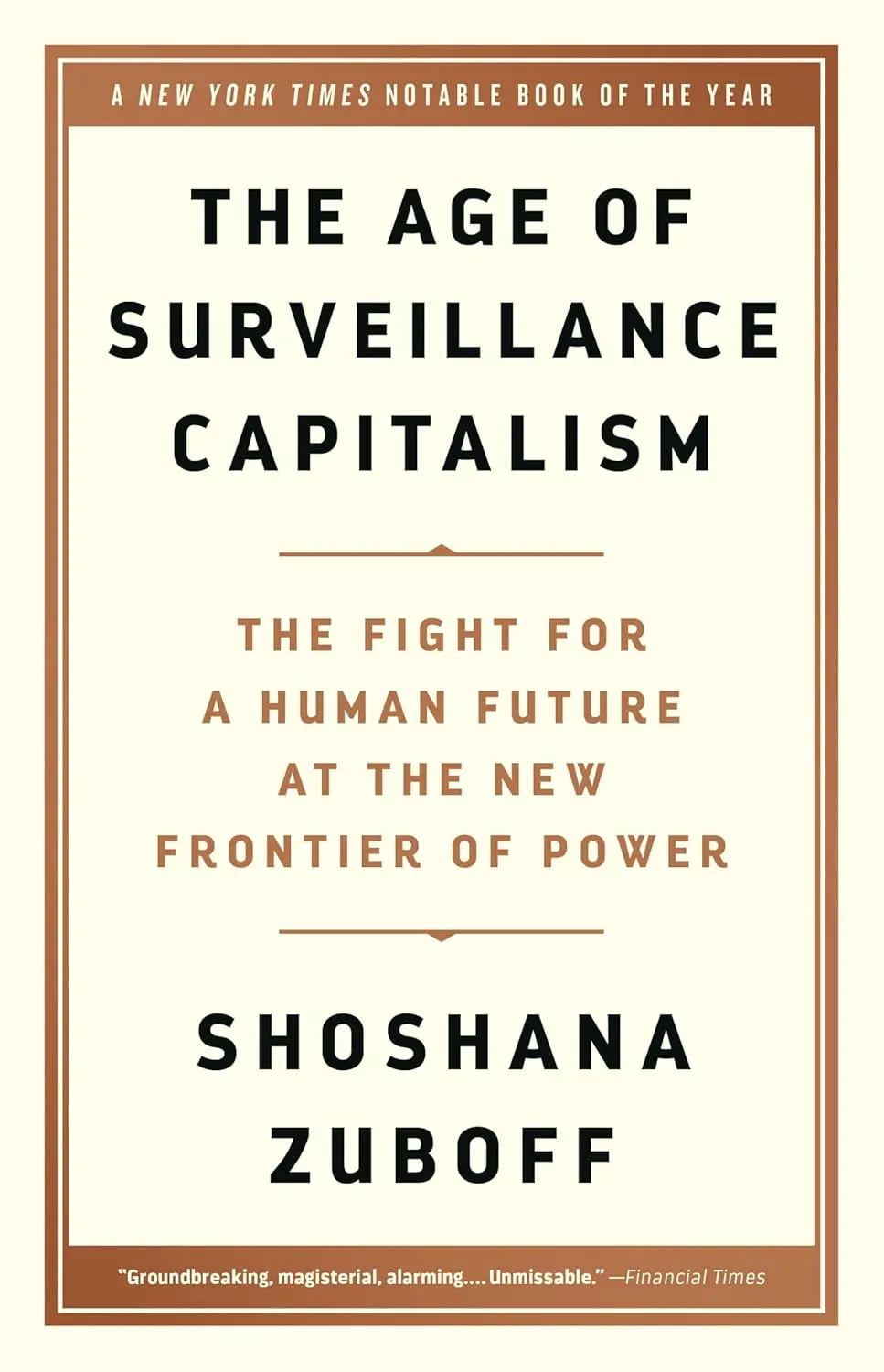
The Age of Surveillance Capitalism is Shoshana Zuboff’s analysis of how the largest technology companies have built their business models around extracting data from human behavior, processing it into predictions, and selling those predictions to advertisers and other buyers. Zuboff, a professor emerita at Harvard Business School, argues that this is not just a new business model but a new form of capitalism that operates on fundamentally different principles from either industrial capitalism or information capitalism.
Zuboff traces the origin of surveillance capitalism to Google’s discovery, around 2001, that the “behavioral surplus” generated by user searches (the data beyond what was needed to improve the search engine) could be used to predict and target advertising with extraordinary precision. This insight, that human experience could be treated as free raw material for prediction products, became the template for Facebook, and eventually for dozens of other companies across every industry that touches digital behavior.
The book’s central concern is not privacy in the traditional sense but autonomy. Zuboff argues that as prediction systems become more sophisticated, they begin to modify behavior rather than just predict it. The shift from “we know what you’re likely to do” to “we can shape what you’re likely to do” is, in her view, the most dangerous development, because it undermines the individual’s capacity for independent choice.
For founders, the book raises uncomfortable questions about business models that depend on user data. If your company collects behavioral data, Zuboff’s framework forces you to think about where the line is between using data to improve the product and using it to extract value from the user. The book also provides useful context for understanding the regulatory environment around data and privacy, which increasingly affects how tech companies can operate.
The writing is academic and the book is long, over 700 pages. Zuboff is thorough and occasionally repetitive, returning to her core arguments from multiple angles. Some sections could be shorter without losing substance. But the argument itself is original, well-researched, and important for anyone building or investing in technology businesses. It is one of the few books that treats the tech industry’s data practices as a systemic issue rather than a series of isolated privacy violations.
