
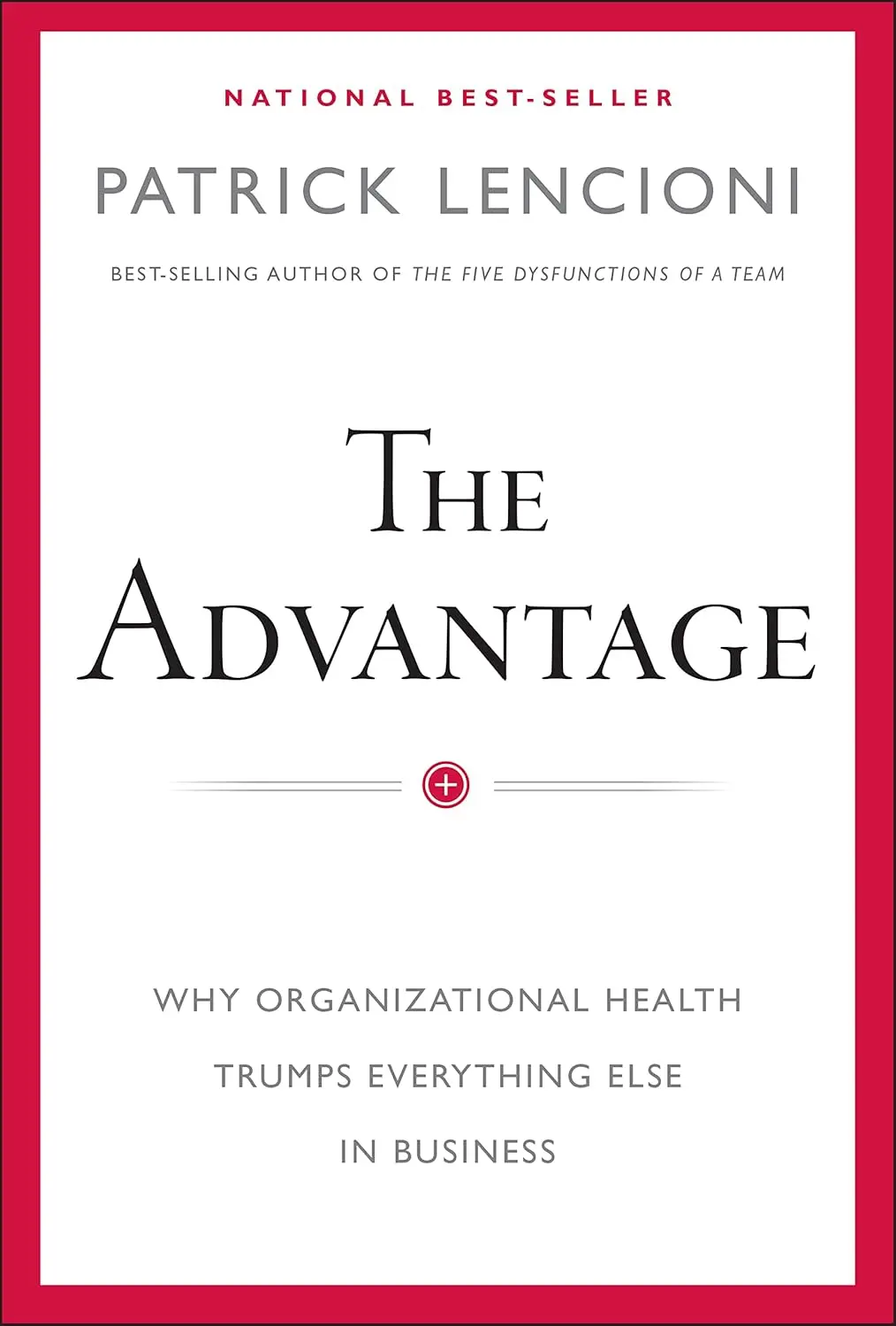
The Advantage is Lencioni’s attempt to pull together everything he’s written across his previous books into one coherent argument. His thesis is that the biggest untapped competitive advantage for any company is not strategy, technology, or talent, but organizational health: having a leadership team that trusts each other, a strategy that everyone understands the same way, and communication that actually reinforces what matters.
The book lays out four disciplines. First, build a cohesive leadership team (drawing from The Five Dysfunctions of a Team). Second, create clarity by answering six questions that define the organization’s identity and direction. Third, over-communicate that clarity until people are sick of hearing it. Fourth, reinforce clarity through every human system: hiring, firing, performance reviews, meetings, and compensation.
The six questions at the heart of the framework are deceptively simple. Why do we exist? How do we behave? What do we do? How will we succeed? What is most important right now? Who must do what? Lencioni argues that if the leadership team can’t answer these questions consistently, meaning each person gives roughly the same answer independently, then the organization has a clarity problem that will show up everywhere.
For founders, the book is relevant at the point where you start building a team beyond yourself. Once you have five or ten people, the things Lencioni describes start to matter: are you all aligned on what the company is actually trying to do? Do people know what to prioritize when priorities conflict? Can you have honest conversations about problems?
The writing is less story-driven than his fable books and more direct. Some readers find this a relief; others miss the narrative format. The practical sections, especially the meeting cadence model and the thematic goal framework, are immediately applicable. If you only read one Lencioni book, this is probably the right one because it covers ground from all the others.
