
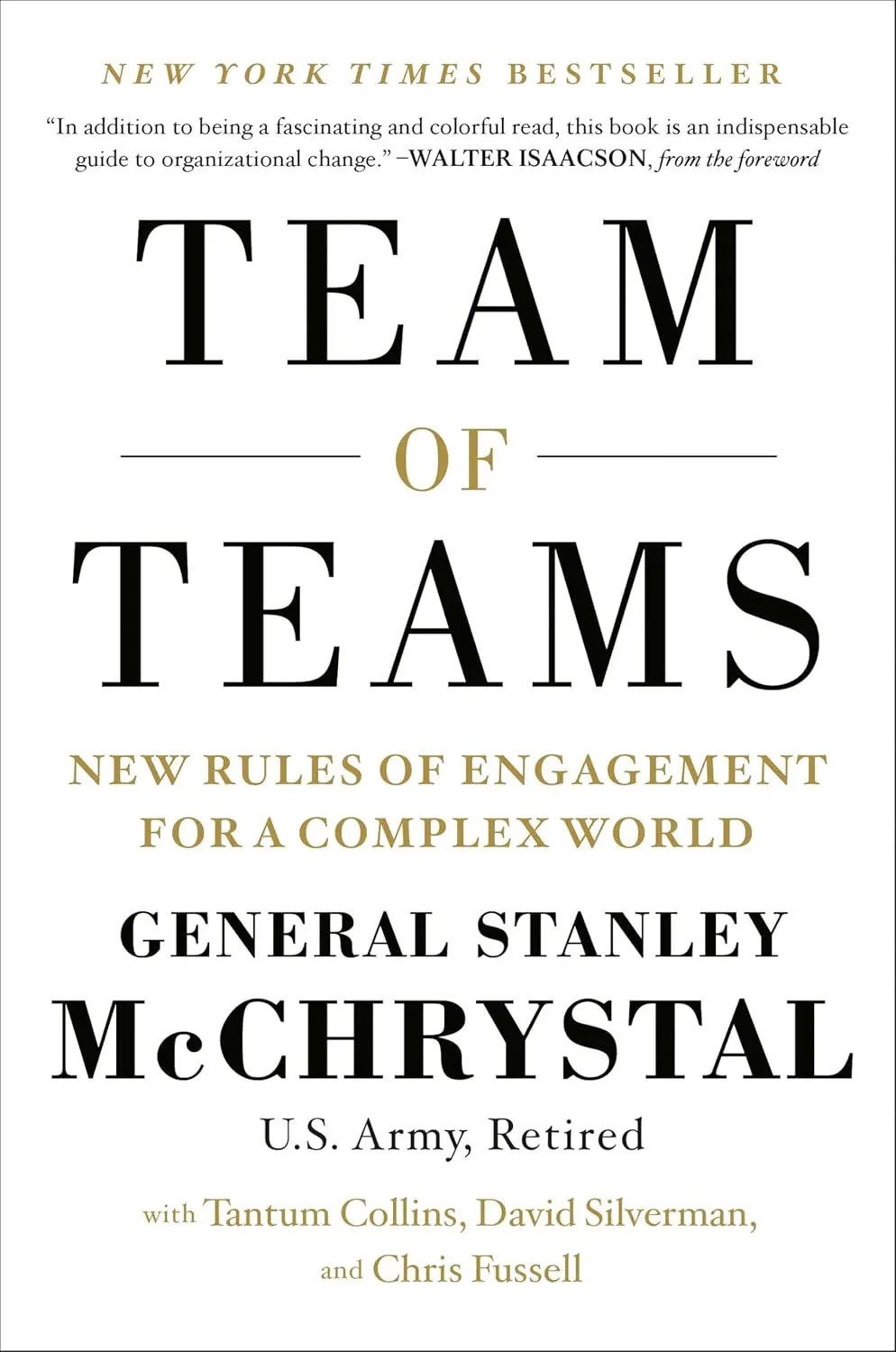
When McChrystal took command of Joint Special Operations in Iraq in 2003, his forces were the best-trained and best-equipped military units in the world. And they were losing. Al-Qaeda in Iraq, a decentralized network with no headquarters and no chain of command, was moving faster than the American military could react.
The problem was not capability. It was structure. The U.S. military was organized for efficiency in predictable environments: clear chains of command, specialized units, information flowing up and decisions flowing down. But the Iraq war was not predictable. By the time intelligence moved through the hierarchy, analyzed at each level, it was outdated. By the time orders came back down, the situation had changed.
McChrystal’s solution was to rebuild the organization as a “team of teams.” Small units were given the authority to act on local intelligence without waiting for approval from above. Information was shared broadly rather than restricted by clearance levels. Liaison officers were embedded between units that had never talked to each other. The result was an organization that could execute at the speed of the network it was fighting.
The book frames these changes using concepts from complexity theory: the difference between complicated systems (which have many parts but are predictable, like a watch) and complex systems (which have many interacting parts and are unpredictable, like a war). The military hierarchy was built for complicated problems. Iraq presented a complex one.
For founders, the framework is useful for any fast-growing company where centralized decision-making is creating bottlenecks. As companies scale, the natural instinct is to add management layers and approval processes. McChrystal’s experience shows that in rapidly changing environments, pushing decision-making authority to the edges, where the information actually is, produces better outcomes than routing everything through the top.
Reed Hastings has recommended it. At about 290 pages, the book balances military narrative with organizational theory. McChrystal writes clearly, and the Iraq sections are gripping enough to carry the more conceptual chapters.
