
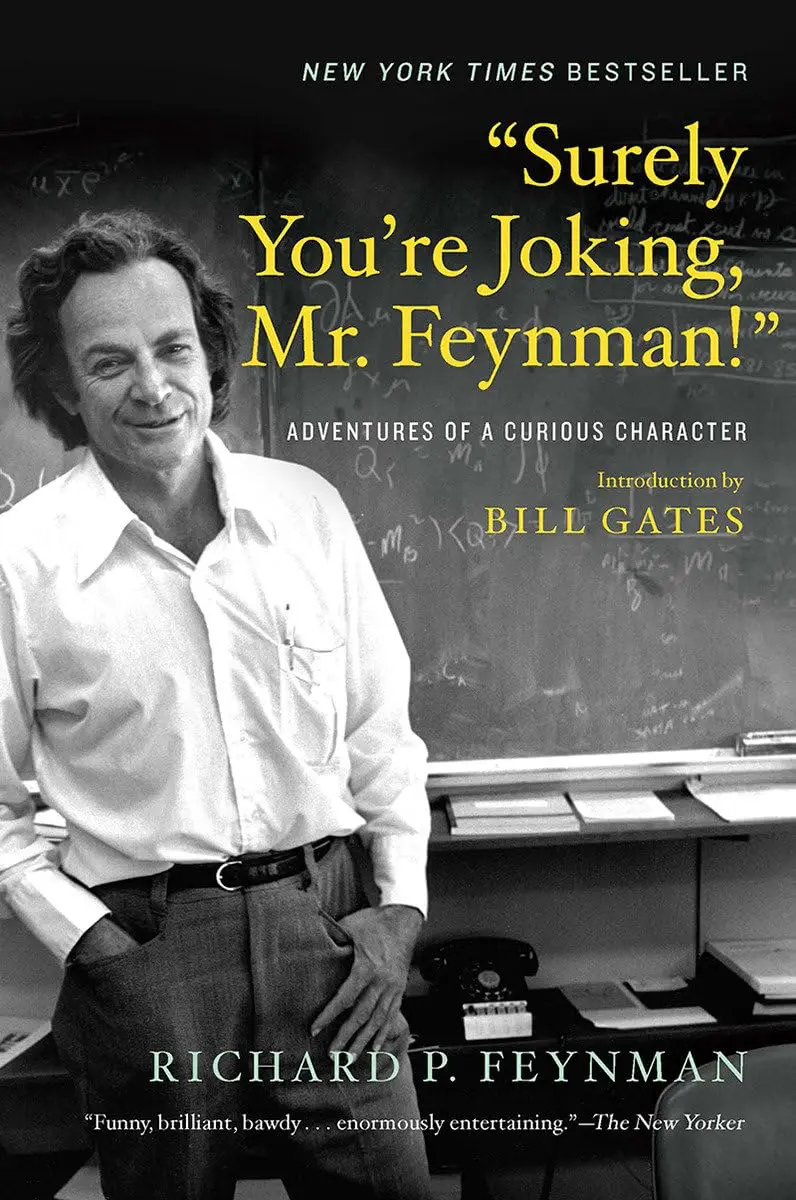
This book is a collection of stories Feynman told to his friend Ralph Leighton, transcribed and lightly edited. They are not organized chronologically or thematically. One chapter is about picking locks at the Manhattan Project. The next is about learning Portuguese to give lectures in Brazil. Another is about his experiments with sensory deprivation tanks in the 1960s.
What ties the stories together is Feynman’s approach to the world. He was pathologically curious and completely uninterested in credentials or authority. If something puzzled him, he figured it out, whether it was quantum electrodynamics or how ants navigate to a sugar bowl. He treated every problem, trivial or serious, with the same intensity.
The book is funny. Feynman was a natural storyteller with excellent comic timing, and the stories are full of absurd situations: convincing a biology class that his cat was trained, pretending to be an undergraduate to crash freshman physics classes at a different university, being recruited by a Las Vegas hotel to figure out their odds.
But underneath the humor, there is a serious philosophy. Feynman distrusted expertise that could not be explained simply. He rejected pretension. He was relentlessly empirical, testing ideas against reality rather than accepting them because an authority said so. His famous commencement address at Caltech, included in the book, warns against “cargo cult science,” research that follows the superficial forms of real science without the substance.
For founders and builders, Feynman’s appeal is his first-principles thinking. He did not accept standard explanations; he rebuilt his understanding from the ground up. This is the same approach that Patrick Collison, Elon Musk, and other tech founders have described as central to how they solve problems.
The book is light and fast, around 350 pages of short chapters. It works well as a bedside read because you can pick it up and put it down without losing a thread. Feynman died in 1988, and the book was first published in 1985. A sequel, “What Do You Care What Other People Think?”, covers more of the same territory, including his work on the Challenger disaster investigation.
