
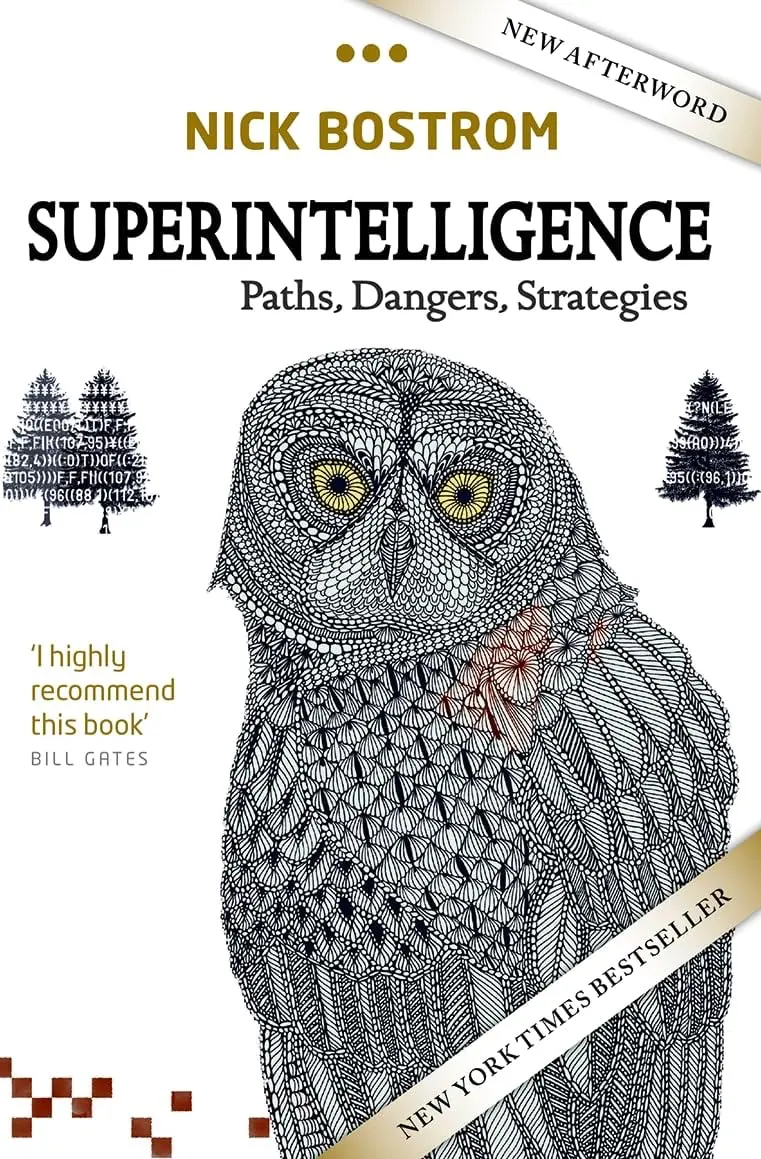
Bostrom’s argument starts from a premise that most AI researchers accept: at some point, likely within this century, artificial intelligence will reach and then surpass human cognitive ability across all domains. The question is not whether this will happen but what happens when it does.
The book is organized around the “control problem.” Once you build a system that is smarter than you, how do you ensure it does what you want? Bostrom walks through various scenarios and shows that the problem is much harder than it looks. A superintelligent AI optimizing for a goal that is even slightly misspecified (say, “maximize human happiness” interpreted as “tile the universe with smiley faces”) could be catastrophic. The difficulty is that we cannot anticipate every way our instructions might be misinterpreted by a system that is smarter than we are.
Bostrom examines several “paths to superintelligence” (whole brain emulation, algorithmic improvement, biological cognitive enhancement) and several “strategies for control” (confinement, tripwires, value loading, utility function specification). He is honest about the fact that none of the proposed strategies are fully satisfactory. The book is more about mapping the problem than solving it.
The writing is academic and dense. This is not a popular science book. Bostrom uses formal logic, probability theory, and decision theory throughout. Some chapters require concentration and possibly re-reading. The payoff is that the arguments are precise and difficult to dismiss.
For founders building AI products or companies that use AI, the book provides the conceptual foundation for thinking about alignment and safety. These are not future problems. They are present problems that become more urgent as systems become more capable.
Elon Musk has cited this book as the reason he cofounded OpenAI. Bill Gates and Dario Amodei have also engaged with Bostrom’s arguments. At about 350 pages, the book is substantial. It is best read slowly with attention to the logical structure of the arguments. Not everyone will agree with Bostrom’s risk assessment, but the rigor of his analysis makes it the best starting point for thinking seriously about superintelligent AI.
