
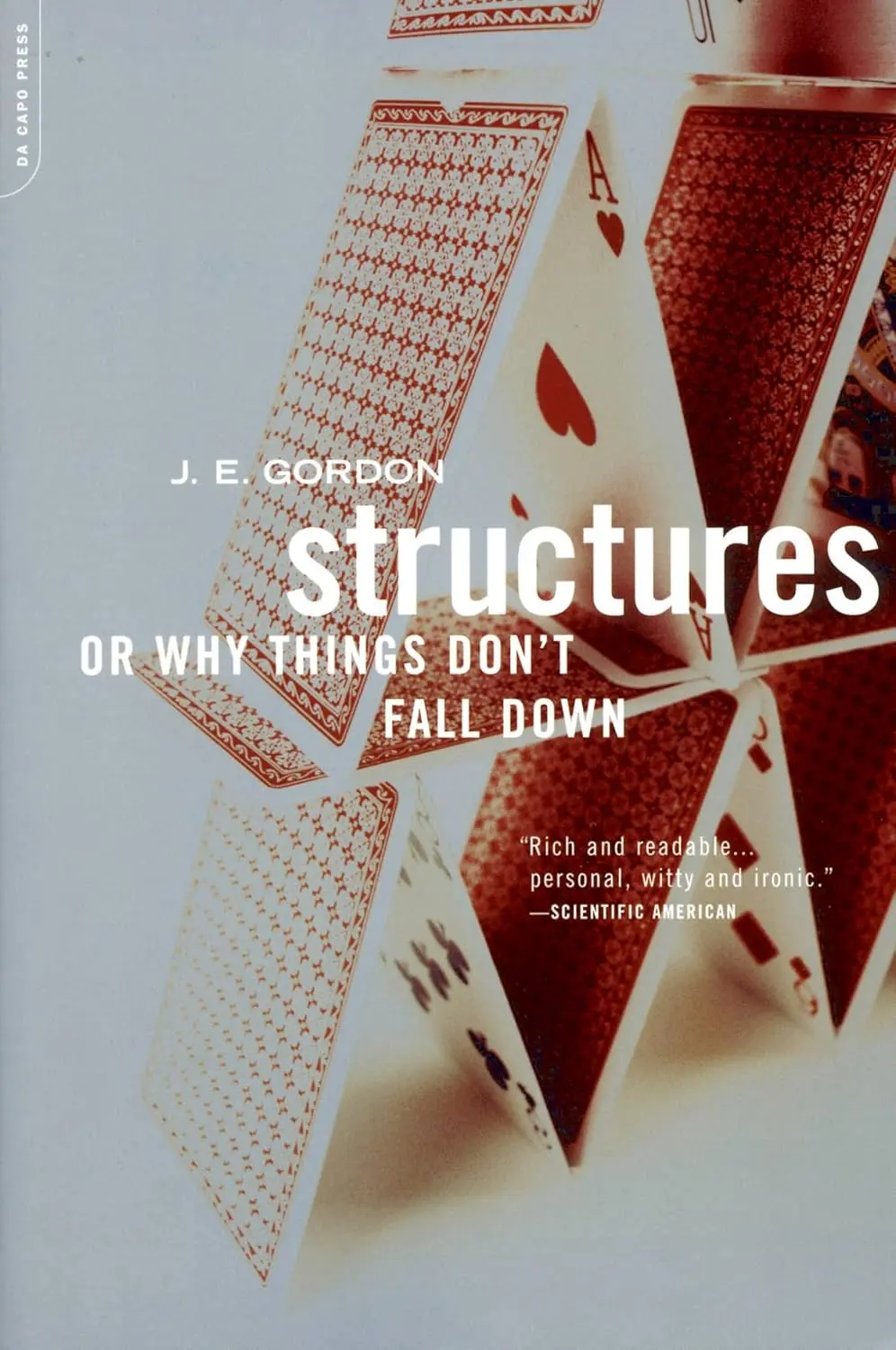
Gordon was a materials scientist who spent his career studying how structures bear loads and why they fail. This book, first published in 1978, explains those principles to a general reader without requiring any math beyond arithmetic.
The coverage is broad. Gordon explains tension and compression (why a rope works differently from a column), shear and torsion (why beams twist and how to stop them), stress concentration (why cracks propagate and how to design around them), and the properties of different materials (why steel, wood, bone, and spider silk each have strengths that suit specific applications).
Gordon writes with dry British humor and an engineer’s appreciation for things that work well. He admires Gothic cathedrals for their structural logic, explains why biological structures (bones, shells, tendons) are often better designed than human ones, and describes several spectacular engineering failures with the clinical interest of someone who wants to understand what went wrong.
The book is not about formulas. It is about intuition. After reading it, you start noticing structural principles everywhere: why a cardboard box is strong when closed but weak when open, why an egg resists crushing from the ends but cracks easily from the side, why aircraft wings flex instead of staying rigid.
Elon Musk has cited this book as an influence on how he thinks about engineering at SpaceX. For founders who are not engineers, the book provides enough structural intuition to have informed conversations with people who are. For founders who are engineers, it is a refreshingly readable treatment of fundamentals that textbooks make unnecessarily dry.
At about 390 pages, the book is well-paced. The diagrams are simple and helpful. Gordon’s writing style carries you through material that could otherwise be intimidating. It is one of those books that makes you smarter about the physical world without requiring any effort to enjoy.
