
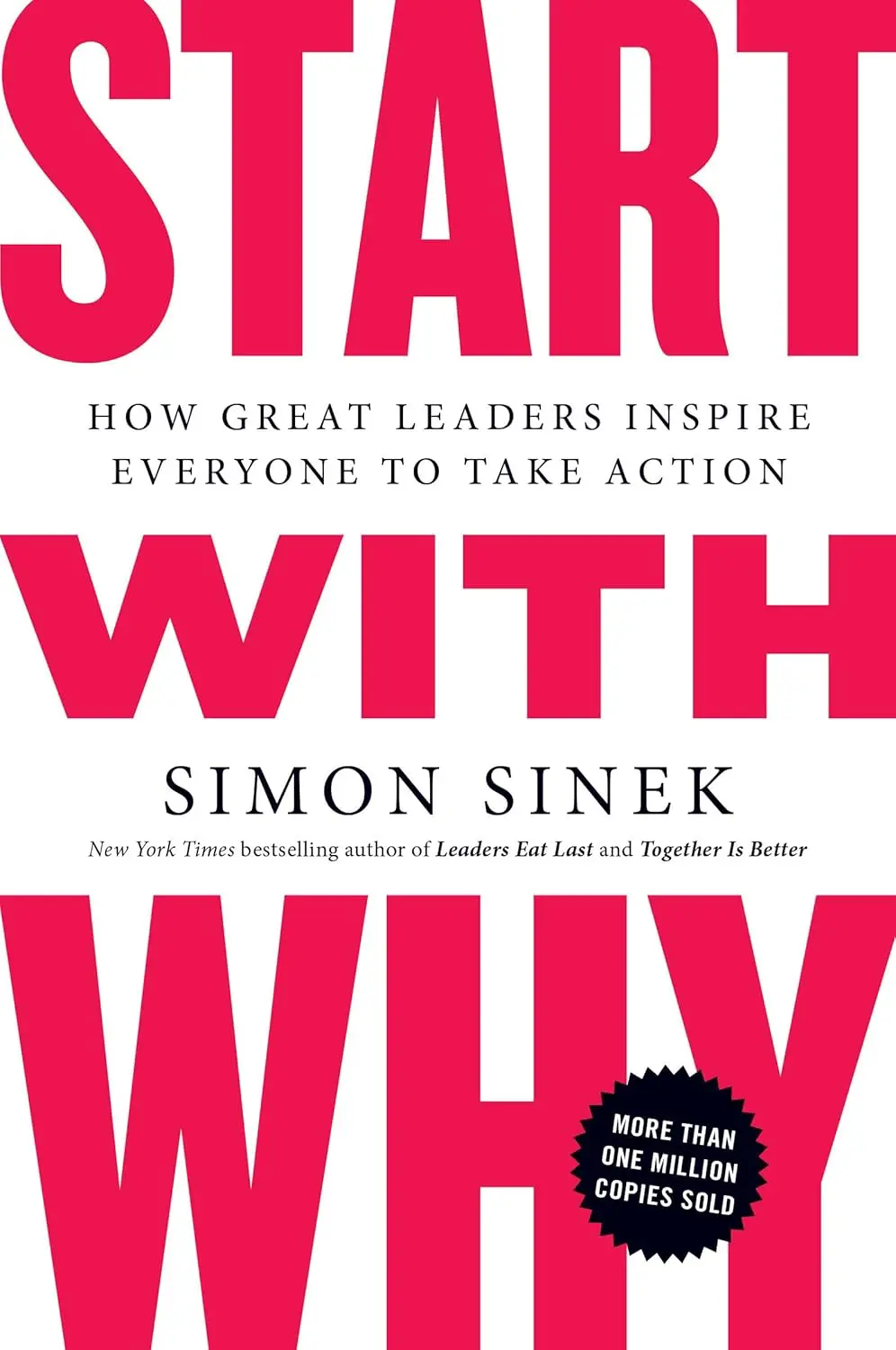
Start with Why grew out of Sinek’s TED talk, which became one of the most-viewed TED talks in history. The book expands on a single idea: people do not buy what you do, they buy why you do it.
Sinek organizes this around what he calls the Golden Circle, three concentric rings. The outer ring is WHAT (the products or services a company offers). The middle ring is HOW (the processes or values that differentiate them). The inner ring is WHY (the purpose, cause, or belief that drives the organization). Most companies communicate from the outside in: here is what we make, here is why it is good, would you like to buy it? The most inspiring companies communicate from the inside out: here is what we believe, here is how we act on that belief, and oh by the way, here is what we make.
Sinek’s primary example is Apple. He argues that Apple’s marketing succeeds not because their products are technically superior (often they are not) but because they communicate a clear belief about challenging the status quo and thinking differently. Customers who share that belief become loyal in a way that transcends product features.
The book also covers the biology behind this idea. Sinek connects the Golden Circle to brain structure: the outer ring (what) corresponds to the neocortex (rational thought and language), while the inner rings (how and why) correspond to the limbic brain (feelings, trust, decision-making). This is why gut feelings about brands are hard to articulate but strongly influence purchasing decisions.
For founders, the practical application is in hiring, marketing, and company culture. If you can clearly articulate why your company exists beyond making money, you attract employees who share that belief and customers who become advocates rather than just buyers.
The book is about 250 pages. The core idea is strong but the execution is uneven. Some readers find that the same examples are recycled too many times, and the later chapters stretch the framework beyond where it naturally applies. But the central question, “why does your company exist?”, is one that every founder should answer clearly. Richard Branson, Adam Grant, and Arianna Huffington have recommended it.
