
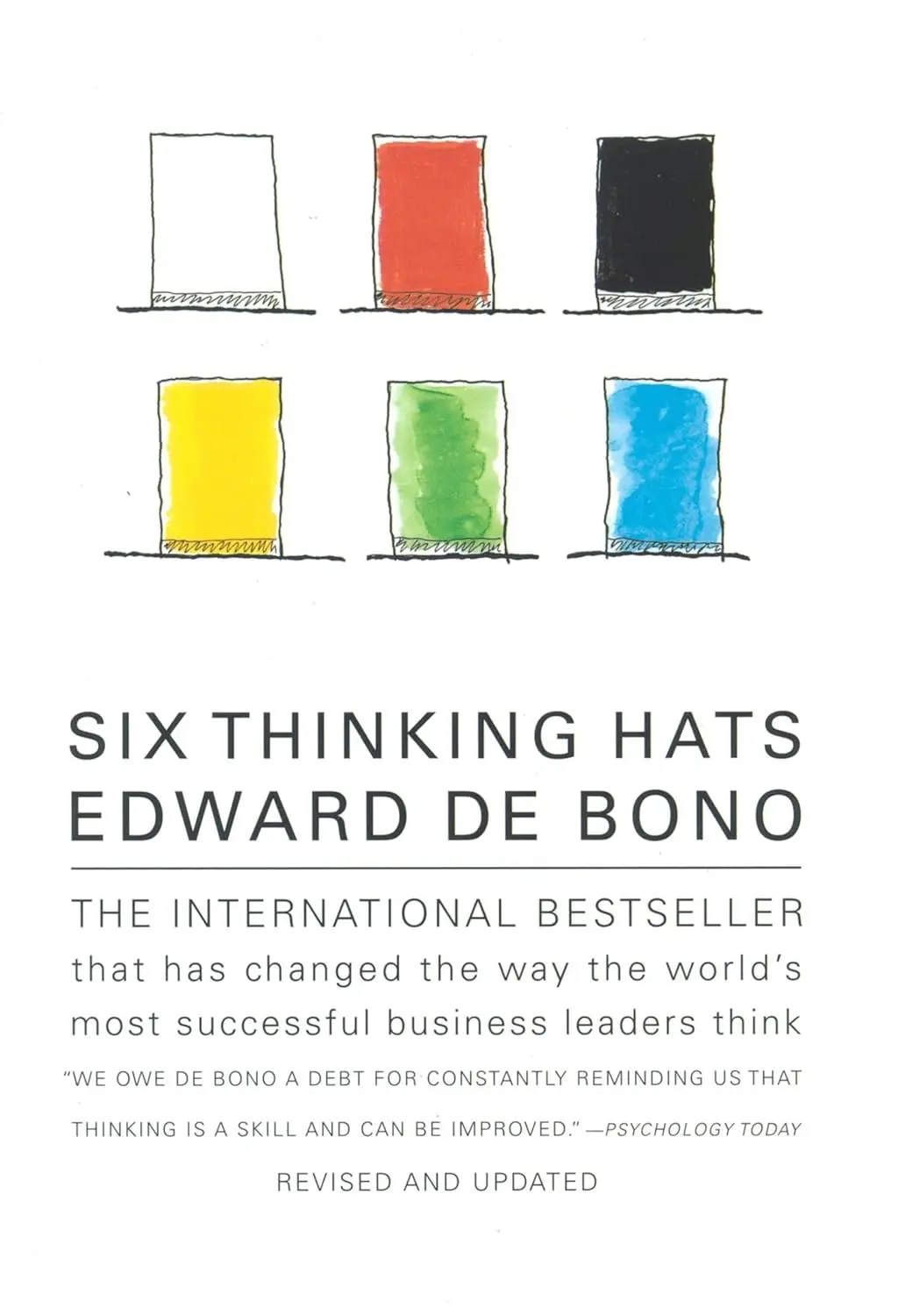
Six Thinking Hats is Edward de Bono’s framework for structured thinking, designed to replace the adversarial style of most meetings with a parallel thinking approach where everyone looks at the problem from the same direction at the same time. Instead of people arguing for their positions, the group moves through six modes of thinking together, one at a time.
Each hat represents a different mode. The White Hat is for facts and data: what do we know, what information is missing? The Red Hat is for feelings and intuition: what is your gut reaction, without needing to justify it? The Black Hat is for critical judgment: what are the risks, what could go wrong? The Yellow Hat is for optimism: what are the benefits, what’s the best-case scenario? The Green Hat is for creative thinking: what are the alternatives, what new ideas can we generate? The Blue Hat is for process control: what mode should we be in, what should we do next?
The value of the system is in the separation. Most discussions mix all six modes simultaneously, which creates confusion and conflict. Someone presents an idea (Green Hat thinking), someone else immediately criticizes it (Black Hat), someone gets emotional (Red Hat), and the conversation becomes an argument rather than an exploration. By wearing one hat at a time, the group can explore each dimension fully before moving to the next.
For founders running team meetings, the framework is practical and easy to implement. You don’t need formal training. You just need to tell the group: “Let’s spend five minutes on Yellow Hat thinking. What are all the reasons this could work?” Then: “Now let’s do five minutes of Black Hat. What could go wrong?” This simple structure improves the quality of group decisions because it ensures that criticism doesn’t kill ideas before they’ve been fully explored, and optimism doesn’t blind the group to real risks.
The book is short and clearly written. De Bono explains each hat with examples and then shows how to use them in sequence for different types of decisions. Some readers find the hat metaphor simplistic, but that simplicity is what makes it stick. Teams that adopt the vocabulary find themselves referencing the hats in normal conversation, which is a sign the framework has actually been absorbed.
