
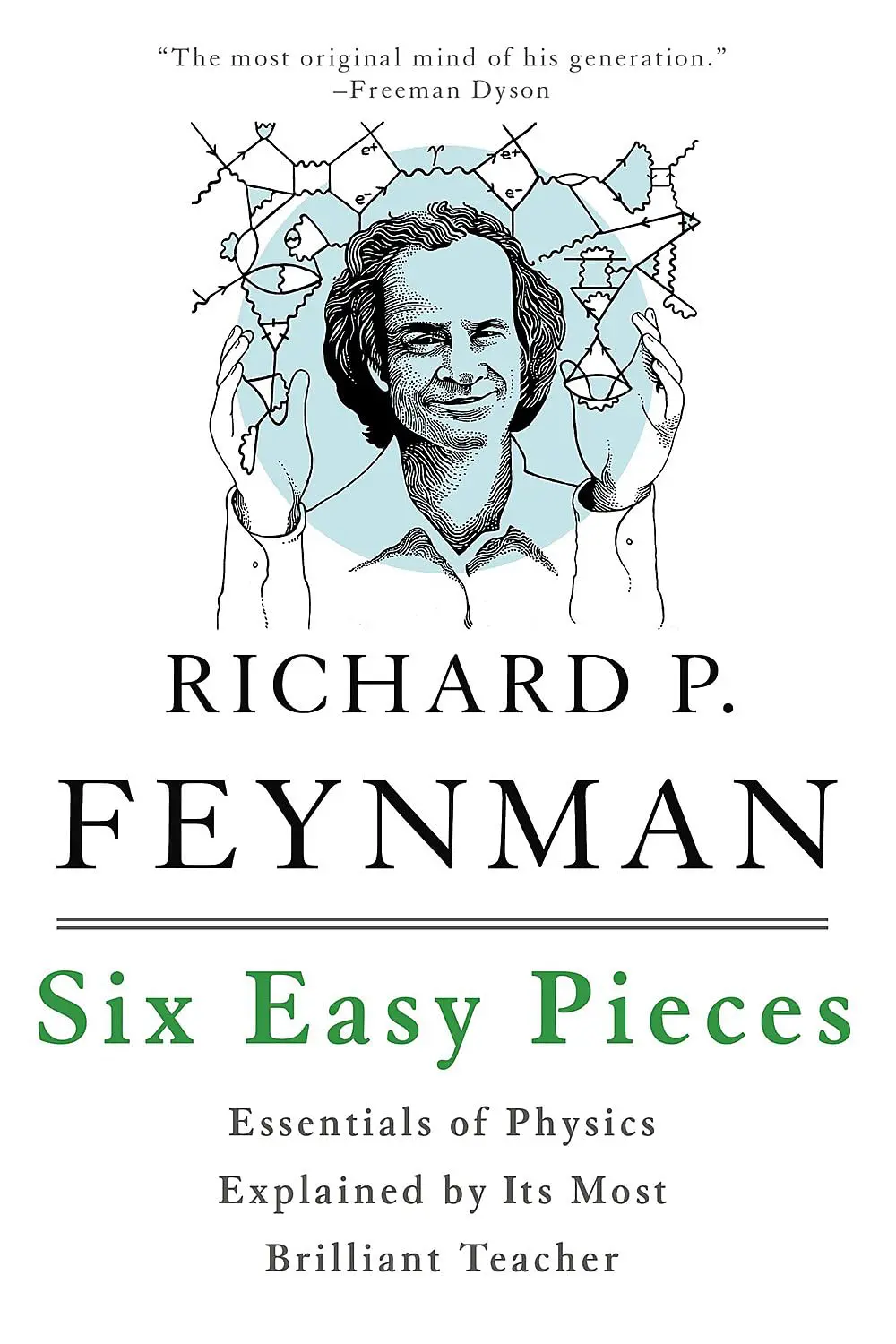
Six Easy Pieces is a selection of six introductory lectures from Richard Feynman’s legendary three-year physics course at Caltech in the early 1960s. The lectures were originally published as part of The Feynman Lectures on Physics, a three-volume set that became one of the most respected physics textbooks of the 20th century. This smaller book pulls out the six most accessible lectures for a general audience.
The topics covered are: atoms in motion, basic physics, the relationship of physics to other sciences, conservation of energy, the theory of gravitation, and quantum behavior. Feynman moves through each topic with a combination of precision and accessibility that very few scientists have ever matched. He has a gift for explaining difficult ideas using everyday language and concrete analogies, without sacrificing accuracy.
The quantum behavior chapter is particularly notable. Feynman explains the double-slit experiment and the fundamental strangeness of quantum mechanics in a way that is both honest about how weird it is and clear enough for a reader with no physics background to follow. He doesn’t pretend to resolve the paradoxes; he just presents them as they are.
For founders and non-scientists, the value of the book goes beyond physics education. Feynman’s approach to explaining things, starting from first principles, building ideas step by step, and refusing to hide behind jargon, is a model for clear communication in any field. His lectures also demonstrate a way of thinking: always ask “what do we actually know?” and “how do we know it?” rather than accepting received wisdom.
The book is short, under 200 pages, and reads quickly. It works well as a standalone introduction to physics for curious readers, or as a gateway to the full Feynman Lectures for those who want to go deeper. The audio versions, featuring Feynman’s actual voice, add another dimension if you can find them.
