
Here is what we know about Gregory David Roberts, or at least what he has said: he was a heroin addict in Melbourne who turned to armed robbery to fund his habit. He was sentenced to nineteen years in prison. He escaped. He obtained a fake passport and flew to Bombay, where he lived in a slum, ran a free health clinic, worked for the local mafia, fought in the Afghan war against the Soviets, and fell in love. Whether all of this is true, partially true, or heavily embellished has been debated since the book was published in 2003.
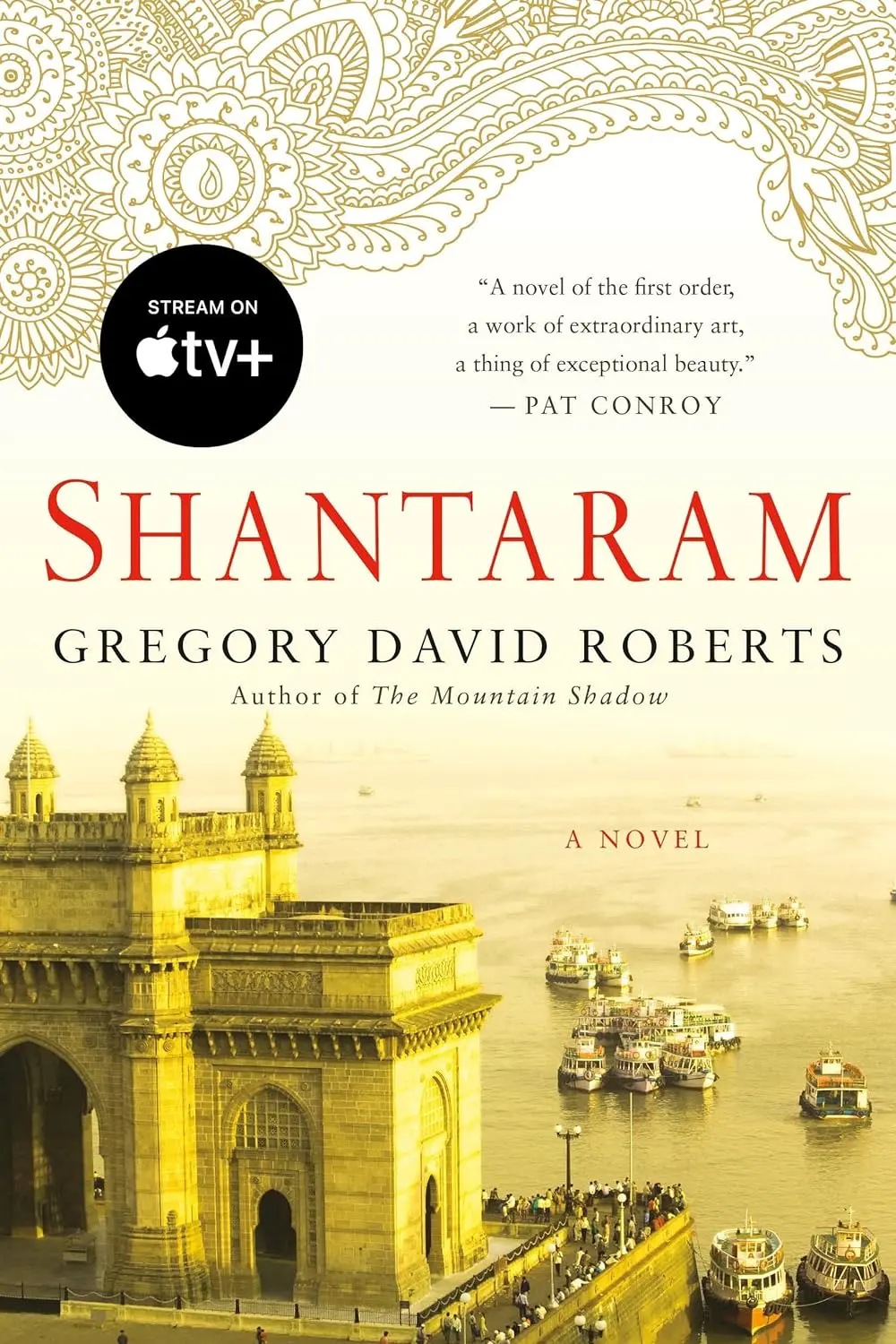
Shantaram is the novel he constructed from this material. The narrator, Lin, arrives in Bombay with nothing and is immediately absorbed into the city’s chaos. His guide is Prabaker, a street hustler with a generous heart, who takes Lin to a slum where he ends up living for months. Lin sets up a makeshift clinic treating infections and injuries. He learns Hindi and Marathi. He earns the trust of the community. He gets pulled into the orbit of Khaderbhai, a crime boss with philosophical pretensions, and Karla, a mysterious European woman who is probably not who she claims to be.
The book is enormous. Nearly a thousand pages. Roberts writes in long, rolling sentences that stack metaphor on top of metaphor. Some of these passages are genuinely beautiful. Others read like someone who has never had an editor tell him to cut. The novel could probably lose three hundred pages without losing anything essential. But the excess is also the point. Bombay, as Roberts describes it, is excessive: the density, the noise, the heat, the smell, the constant collision of wealth and poverty, cruelty and tenderness.
The philosophical sections, mostly delivered through Khaderbhai’s speeches, will either pull you in or push you out. Khaderbhai talks about the nature of the universe, the meaning of suffering, the relationship between justice and power. These speeches are earnest, sometimes overwrought, and occasionally genuinely moving. They are also long.
The book has sold millions of copies and has a devoted following. Some readers describe it as the most immersive novel they have ever read, a book that drops you into Bombay so completely that you feel the heat on your skin. Others find it self-indulgent and question how much of the autobiography is real. The truth probably matters less than the experience of reading it.
Apple TV+ produced a television adaptation in 2022. Roberts wrote a sequel, The Mountain Shadow, published in 2015.
