
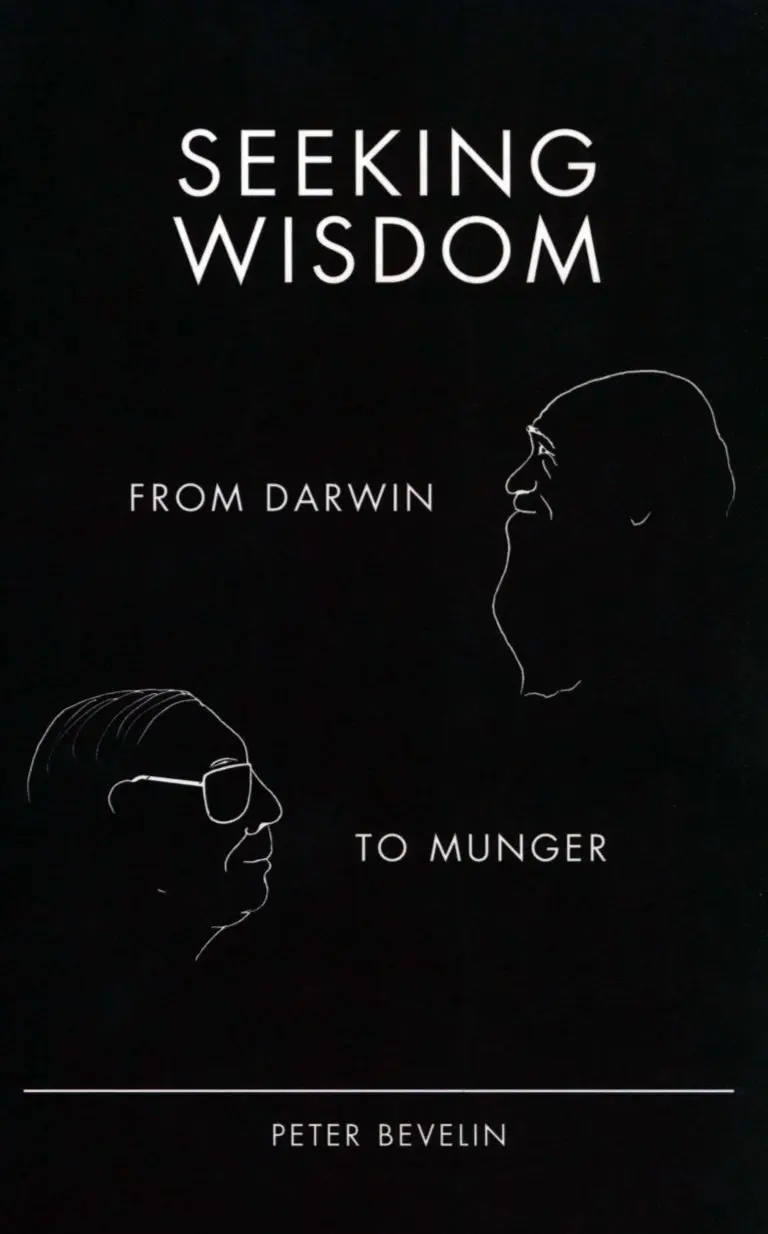
Seeking Wisdom is organized around a question Charlie Munger asks frequently: what can I do to avoid being stupid? Bevelin takes this question seriously and builds a book around the accumulated knowledge from multiple disciplines about why humans make bad decisions and how to make better ones.
The first section covers the biological and psychological reasons humans think poorly. Evolution optimized us for survival in small groups on the savanna, not for making complex decisions about investments, organizations, and strategy. The mismatches between our evolved instincts and modern requirements produce predictable errors: loss aversion, status seeking, pattern matching where no pattern exists, and a dozen others.
The second section covers how to think better. Bevelin draws heavily on Munger’s “multiple mental models” approach: learn the big ideas from psychology, biology, physics, economics, mathematics, and engineering, and apply whichever combination is relevant to the problem at hand. The idea is that any single discipline gives you a distorted view, but combining perspectives from several produces a more accurate picture.
The third section is an extended compilation of Munger’s wisdom, organized by topic: investing, decision-making, business, and life. Bevelin includes direct quotes, paraphrased ideas, and commentary that connects Munger’s thinking to the research covered earlier in the book.
The writing is dense and reference-like. Bevelin is not a storyteller. He is a compiler and organizer of other people’s best thinking, and the result reads more like a textbook than a narrative. This is not a criticism. The book’s value is in its compression: hundreds of insights from dozens of sources, organized for practical use.
For founders, the mental models approach is directly applicable to the multi-domain decision-making that running a company requires. Derek Sivers, Charlie Munger (by endorsement), and various investors have recommended it. At about 320 pages, the book is dense. Most readers keep it as a reference rather than reading it once.
