
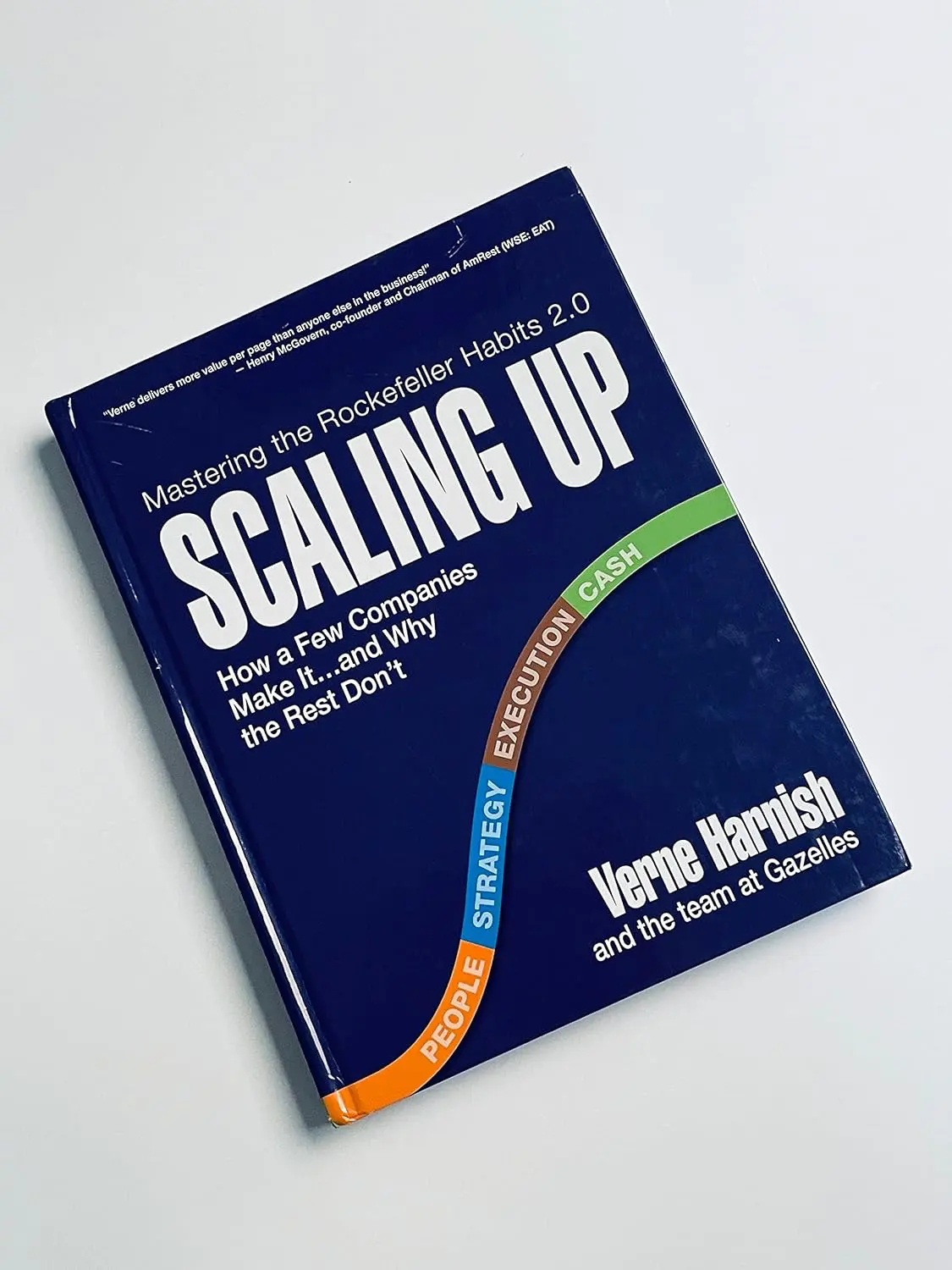
Scaling Up is the expanded version of Harnish’s earlier book, Mastering the Rockefeller Habits. It is organized around four decisions every growing company must get right: People (who is on the team and are they in the right seats?), Strategy (are you differentiated and focused?), Execution (are you disciplined in your daily and weekly rhythms?), and Cash (do you have enough and are you generating it efficiently?).
The People section covers building a leadership team, creating accountability structures, and establishing a hiring process that filters for cultural fit and capability. The Strategy section provides a one-page strategic plan template that forces clarity about your core customer, brand promise, and profit-per-X metric. The Execution section describes meeting rhythms (daily huddles, weekly team meetings, monthly management reviews, quarterly off-sites) that keep everyone aligned without drowning in meetings. The Cash section covers cash conversion cycles, the Power of One (how small improvements in price, volume, cost, and accounts receivable compound into significant cash improvement), and how to avoid the growth trap where revenue increases but cash decreases.
The book is dense with tools: worksheets, checklists, one-page plans, and diagnostic questionnaires. It is designed to be used, not just read. Many companies that adopt the Scaling Up framework use the one-page strategic plan as their primary planning document.
For founders who are past the initial scramble and dealing with the challenges of 20-200 employees, this book fills a gap. Most startup books cover getting started. Most corporate management books assume you already have hundreds of people and established processes. Scaling Up addresses the messy middle where you are growing fast enough that informal processes break but too small for corporate-style management.
At about 480 pages, the book is long. The format is practical rather than narrative: more workbook than story. Harnish writes clearly, and the frameworks are specific enough to implement. Some founders find the level of structure too rigid, while others find it exactly the scaffolding they need.
