
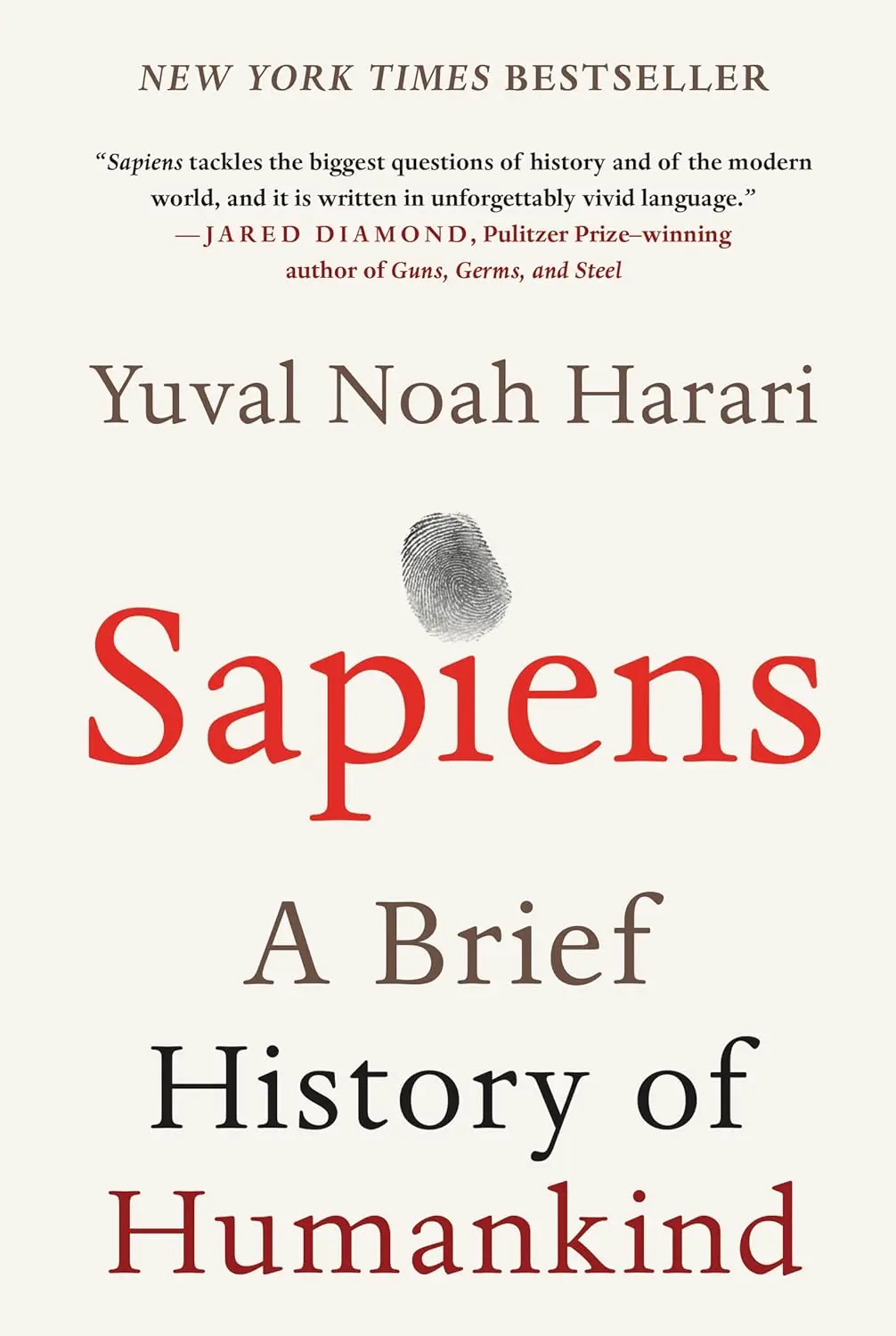
Sapiens covers the entire arc of human history in about 450 pages. Harari organizes this around three revolutions: the Cognitive Revolution (roughly 70,000 years ago, when Homo sapiens developed language and abstract thought), the Agricultural Revolution (about 12,000 years ago), and the Scientific Revolution (about 500 years ago). Each one changed how humans live, cooperate, and think about themselves.
One of Harari’s central arguments is that humans dominate the planet not because of physical strength or individual intelligence, but because of our ability to believe in shared fictions: money, nations, religions, corporations, human rights. These fictions allow millions of strangers to cooperate toward common goals. No other species can do this. A chimpanzee cannot convince another chimpanzee to hand over a banana by promising him unlimited bananas in chimpanzee heaven.
The book’s treatment of the Agricultural Revolution is particularly contrarian. Harari argues that farming was, from the perspective of individual human welfare, a step backward. Hunter-gatherers worked fewer hours, ate a more varied diet, and suffered from fewer diseases. Farming enabled larger populations but made most individuals worse off. He calls it history’s biggest fraud.
For business readers, Sapiens is less a how-to and more a how-did-we-get-here. It reframes markets, corporations, and money as collective belief systems rather than natural laws. That reframing is useful when you are building a company, because it reveals that brands, currencies, and institutions only have power because enough people agree they do. Understanding that mechanism is understanding the foundation of commerce.
The book has been recommended by Bill Gates, Barack Obama, and Mark Zuckerberg, among others. It reads more like a long, opinionated essay than an academic text. Harari has a talent for making complex ideas accessible, though some historians have criticized the book for oversimplifying. Whether you agree with all his arguments or not, it will almost certainly change how you think about at least one topic you thought you understood.
