
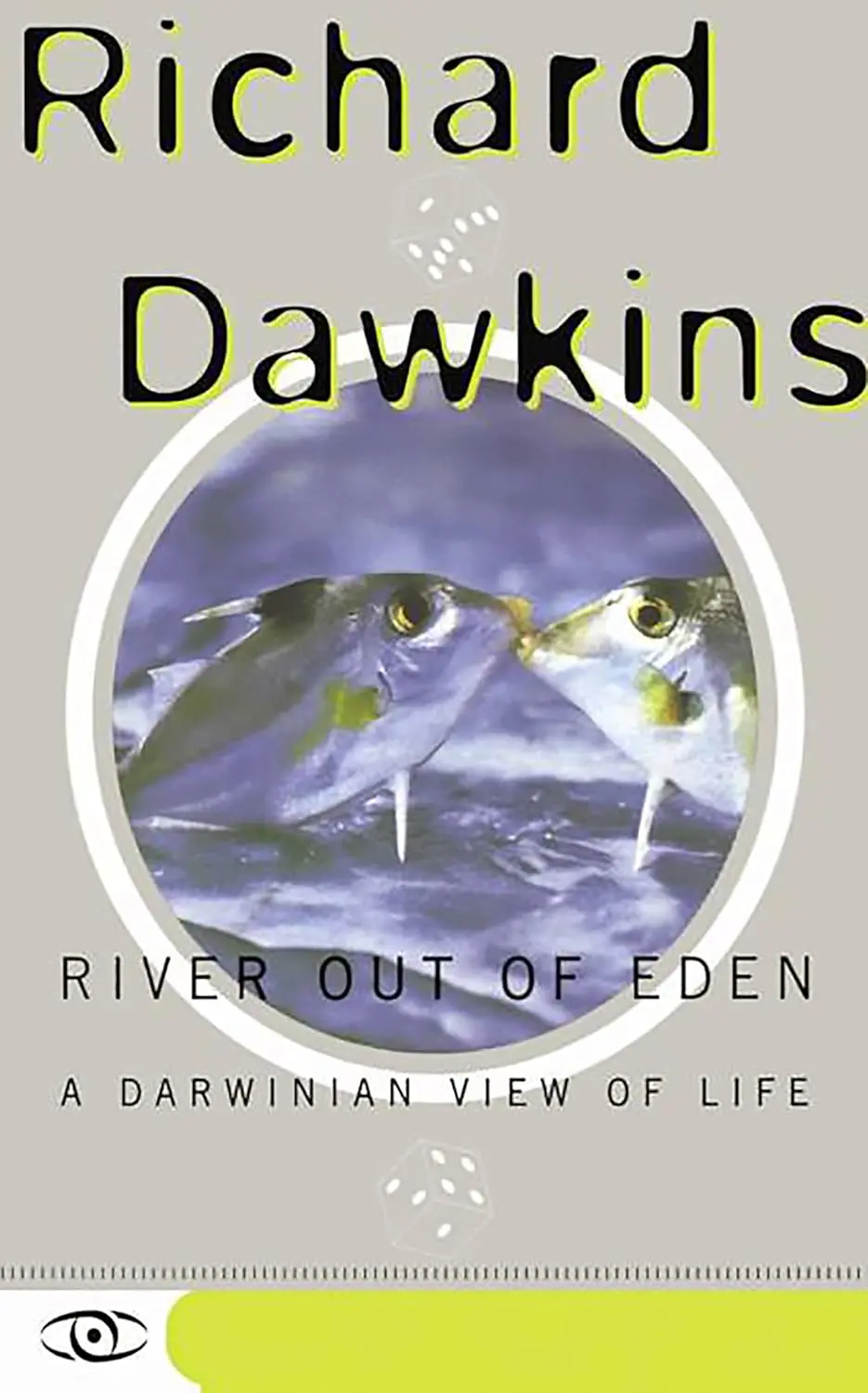
River Out of Eden is one of Dawkins’s shortest books, and it may be his most concentrated. Where The Selfish Gene took 350 pages to develop its argument, this book covers similar territory in about 170 pages, focusing on the logic of evolution rather than its applications.
The central metaphor is the river of DNA that flows from generation to generation, branching when species diverge and merging when genes are exchanged through sexual reproduction. Every living thing on Earth shares a common ancestor, which means all DNA traces back to a single river that has been flowing for roughly four billion years. The diversity of life is the branching of that river over time.
Dawkins covers several topics efficiently. The chapter on the “utility function” of DNA argues that genes have only one purpose: to make copies of themselves. Everything else, bodies, brains, behaviors, is machinery genes build for that purpose. The chapter on the “barrel of luck” explains why some species go extinct while others survive: it is not a matter of being “better” but of being lucky enough, across millions of generations, to avoid the statistical outcomes that end most lineages.
The chapter on the “40-watt computer” (the human brain) discusses how evolution produced an organ that consumes only 40 watts of power but can understand the universe, compose music, and build rockets. Dawkins does not pretend to explain consciousness. He uses the brain as an example of what natural selection can produce given enough time.
The writing is crisp and occasionally lyrical. Dawkins has a gift for metaphor, and in a short book, every metaphor has to earn its place. The book assumes basic familiarity with evolution but does not require specialized knowledge.
For founders, the book provides a compressed course in evolutionary thinking that applies to markets, products, and organizations. Competition, selection, adaptation, and extinction follow similar dynamics in biology and business.
Ray Dalio and Naval Ravikant have both recommended Dawkins’s work. At about 170 pages, this is a book you can read in an afternoon. It is the fastest way to get Dawkins’s perspective on how life works.
