
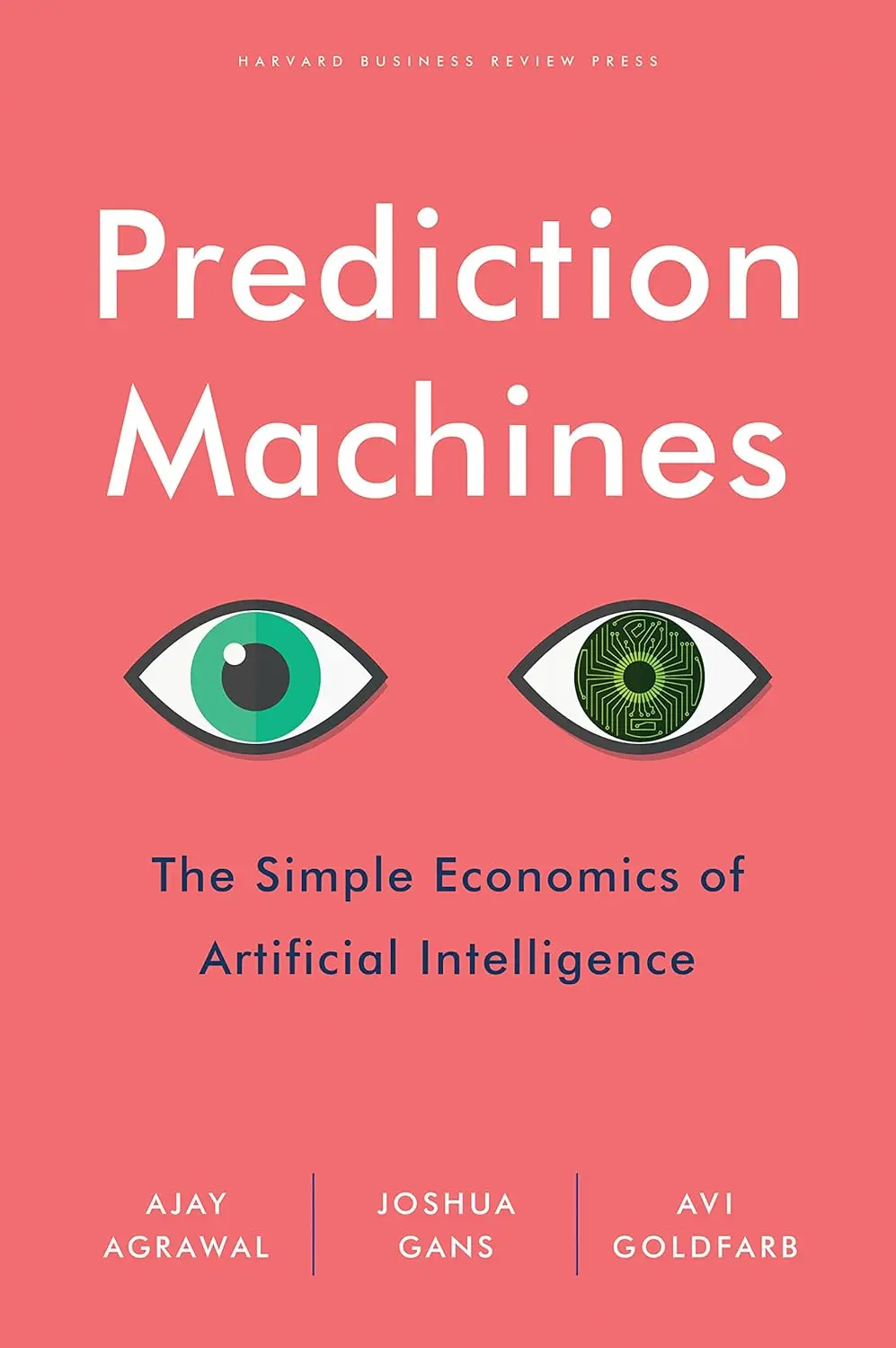
Prediction Machines takes a single economic insight and runs it to its logical conclusions. The insight: AI is best understood as a technology that makes prediction cheap. Prediction, in the economists’ definition, is the process of filling in missing information. Diagnosing a disease is prediction (what condition does this patient have?). Recommending a product is prediction (what will this customer want?). Driving a car is prediction (what will happen next on the road?). As AI makes prediction cheaper, it becomes economical to use it in places where prediction was previously too expensive or too slow.
Agrawal, Gans, and Goldfarb, all economists at the University of Toronto’s Rotman School, apply standard economic logic to work out what happens when the cost of prediction drops. When the price of something falls, you use more of it. Cheap prediction means more decisions can be automated. It also changes the relative value of other things: data (the input to prediction) becomes more valuable, and human judgment (what to do with the prediction) becomes more valuable too, since prediction without judgment is useless.
The book covers how to evaluate AI opportunities for a business. The authors introduce a framework called the “anatomy of a task” that breaks any decision into prediction, judgment, action, and outcome. If AI can handle the prediction part cheaply and accurately, and if judgment can be standardized or delegated, then the task is a good candidate for automation. If judgment is complex and context-dependent, AI becomes a tool that assists humans rather than replacing them.
For founders, the framework is immediately practical. Instead of asking “can AI do this?” you ask “what is the prediction component of this task, and can AI do that part well enough to be useful?” This reframing cuts through the hype and helps you evaluate where AI actually fits in your business.
The writing is precise and the argument is well-structured. The book is short by academic standards and avoids unnecessary jargon. Some readers will find the economic framework too simplified for the complexity of real AI implementation. But as a thinking tool for business strategy around AI, it is one of the clearest books available.
