
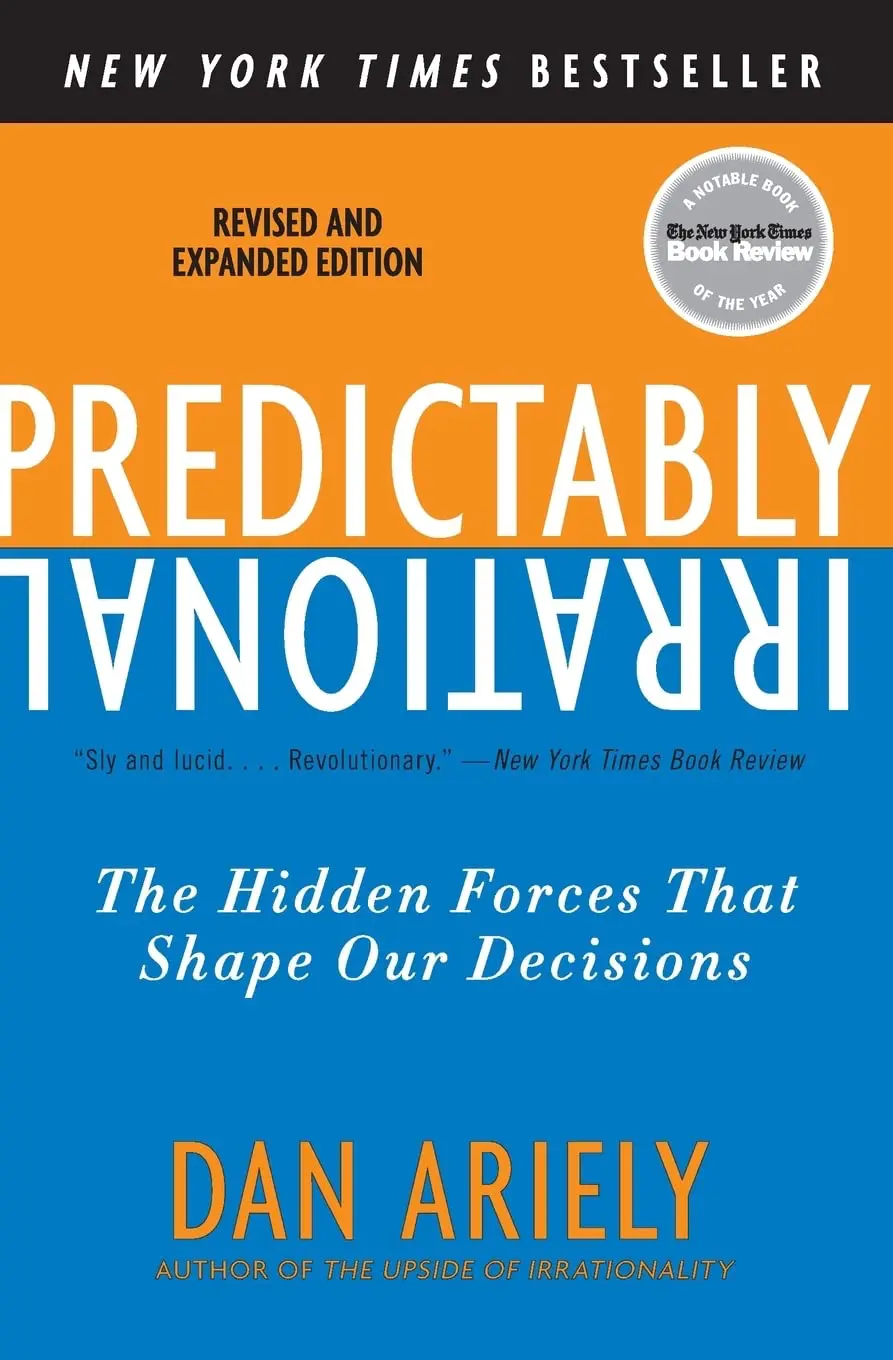
Ariely is a behavioral economist at Duke who designs experiments to reveal how people actually make decisions, as opposed to how economic theory says they should. Predictably Irrational collects his most interesting findings into a readable tour of human irrationality.
Each chapter covers a different bias or pattern. The effect of “free” is one of the most striking: when something is offered for free, people choose it even when a slightly better option costs almost nothing. Amazon saw this with free shipping promotions that dramatically changed purchasing behavior. The role of expectations is another: wine tastes better when people are told it is expensive, and painkillers work better when patients believe they are costly. Ariely demonstrates these effects with controlled experiments, not just anecdotes.
Other chapters cover: why we overvalue things we already own (the endowment effect), why we cannot keep our options open without sacrificing focus, why we are honest in some situations and dishonest in others (often depending on trivial cues), and why our first decisions anchor all subsequent ones.
Ariely writes with humor and tells the stories behind his experiments, including how a severe burn injury early in his life led him to study how people experience pain and make choices. The personal angle gives the book warmth that many behavioral economics books lack.
For founders, the applications are immediate. Pricing decisions, product positioning, free trials, bundling, and customer behavior are all shaped by the biases Ariely describes. Understanding why people overvalue “free,” why they compare options in predictable but illogical ways, and why they anchor on the first number they see gives you a practical edge in product design and marketing.
The book is about 350 pages. Patrick Campbell, Tim Ferriss, and James Clear have recommended it. Ariely’s work overlaps with Kahneman’s Thinking, Fast and Slow, but the presentation is lighter and more experiment-focused. If Kahneman gives you the theory, Ariely gives you the demonstrations.
