
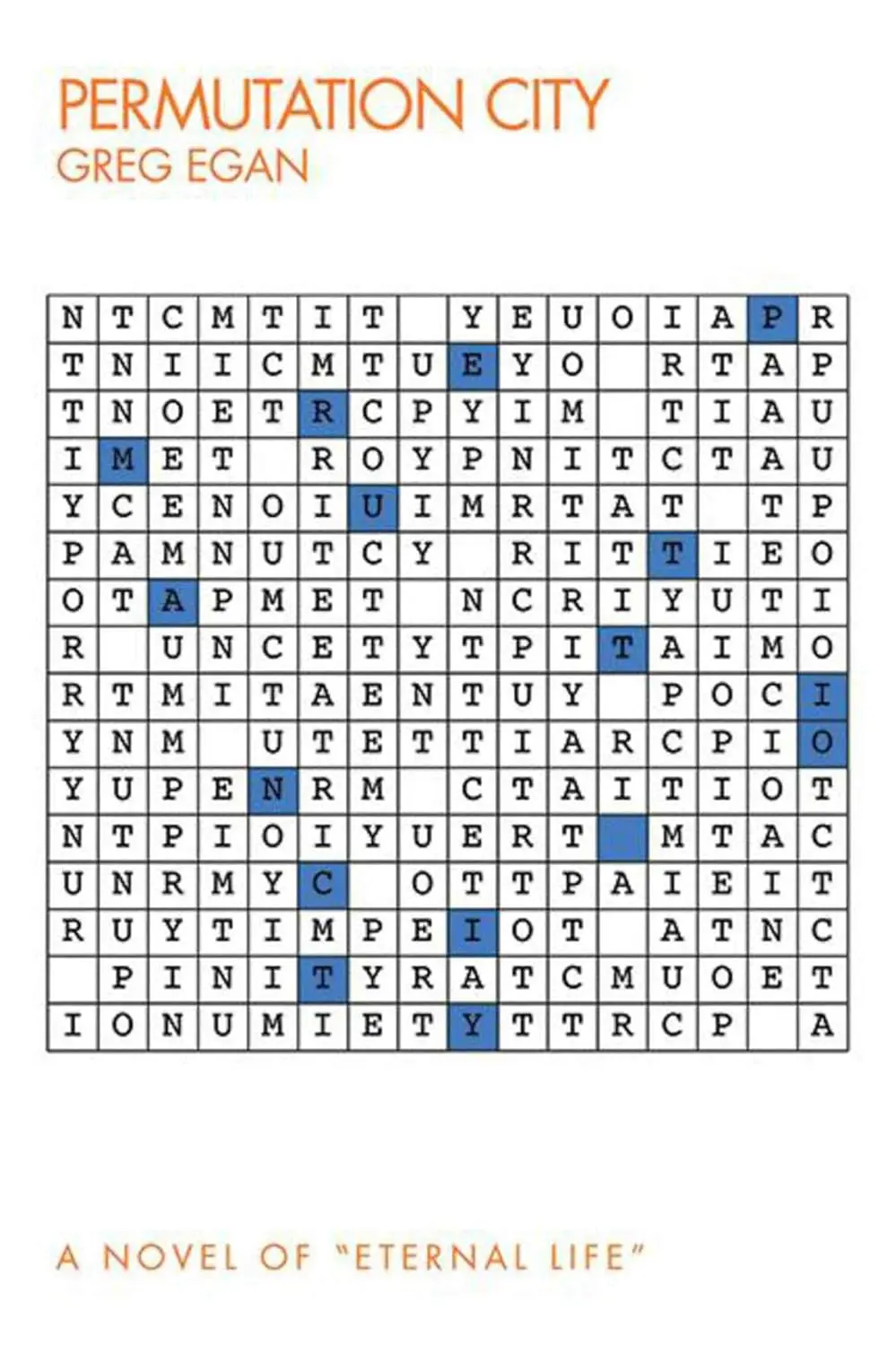
Paul Durham is rich and obsessed with a question: if you scan a human brain and run it as a simulation, is the resulting copy a person? Does it have experiences? Does it matter if the simulation runs at half speed, or in fragments, or stops and restarts? If consciousness is a pattern, not a substance, then maybe the pattern is enough regardless of how it is implemented.
Greg Egan, an Australian writer with a background in mathematics, uses this premise to build one of the strangest and most intellectually demanding science fiction novels ever published. Permutation City is not interested in the usual questions about uploaded minds. It is interested in the ontological questions: what is the relationship between a pattern and the substrate that runs it? Can a universe exist solely as a mathematical object, without any physical computer to simulate it?
The novel follows several characters in the mid-twenty-first century, where brain scanning technology allows wealthy individuals to upload copies of themselves into virtual environments. These copies, called Copies, live in simulated worlds that run on purchased computing time. They can be paused, slowed down, or accelerated. Some of them have existential crises. Others adjust. Durham is building something called the Autoverse, an artificial universe with its own physics, and he believes that once set in motion, it will sustain itself without any external hardware. The universe, he argues, exists because the mathematical relationships that define it are real, regardless of whether anyone is computing them.
This is a novel of ideas, and the ideas are hard. Egan does not simplify for the reader. He expects you to follow arguments about cellular automata, about the dust theory of consciousness (the idea that any pattern exists somewhere in the mathematical structure of reality), and about what it means for a universe to be “real.” The characters serve the concepts more than the other way around, which means the emotional texture is thinner than in more conventional science fiction.
The novel won the John W. Campbell Memorial Award in 1995. It has developed a cult following among readers interested in philosophy of mind, simulation theory, and the implications of digital consciousness. Its relevance has only grown as real-world discussions about brain emulation, digital afterlives, and the nature of AI consciousness have moved from speculation to active research.
Egan has written many other novels and short stories exploring similar territory, including Diaspora and Schild’s Ladder. Permutation City remains the most focused and the most unsettling. It asks questions that do not have comfortable answers and does not pretend otherwise.
