
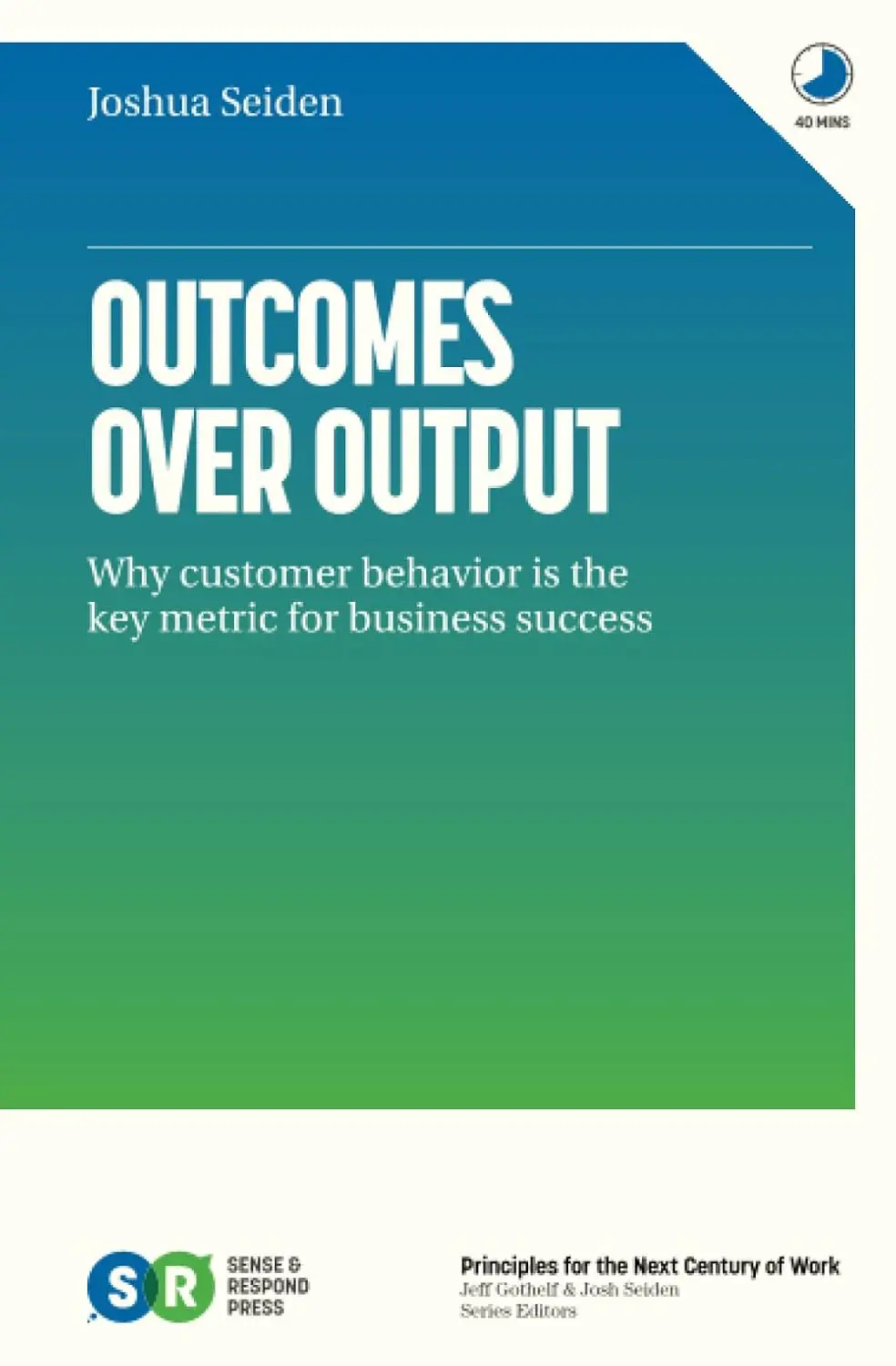
Outcomes Over Output is a very short book, under 100 pages, that makes a single argument and makes it well. Josh Seiden, co-author of Lean UX, argues that most organizations measure product teams by output: how many features they shipped, how many story points they completed, how many projects they delivered on time. This is backwards. What matters is outcomes: did customer behavior change in a way that creates business value?
The distinction is simple but has large implications. A team that ships 50 features but doesn’t change any customer behavior has produced a lot of output and zero outcomes. A team that ships one small change that causes a measurable shift in how customers use the product has produced one output and a real outcome. Measuring output rewards busy teams. Measuring outcomes rewards effective teams.
Seiden explains how to define good outcomes. They should describe a change in human behavior, not a business metric (revenue or NPS are lagging indicators, not outcomes) and not a feature (a feature is output, not an outcome). “Customers complete the checkout process in under 2 minutes” is an outcome. “Ship the new checkout flow” is an output. “Increase revenue by 10%” is a business result that depends on outcomes but is too far removed to guide a product team’s daily decisions.
For founders, the framework is useful for setting goals and evaluating work. If you’re leading a product team or working with one, switching from “what did we ship?” to “what behavior did we change?” reframes every conversation. It also helps with prioritization: when you evaluate a potential feature by asking “what customer behavior will this change and how much does that behavior matter?” you get a much better signal than when you ask “how many customers requested this?”
The writing is concise and direct. Seiden makes his point quickly, supports it with clear examples, and doesn’t pad the book to reach a larger page count. Some readers will finish it in under an hour. That brevity is a feature, not a bug: the idea is simple enough to not need 300 pages, and Seiden respects your time by not pretending otherwise.
