
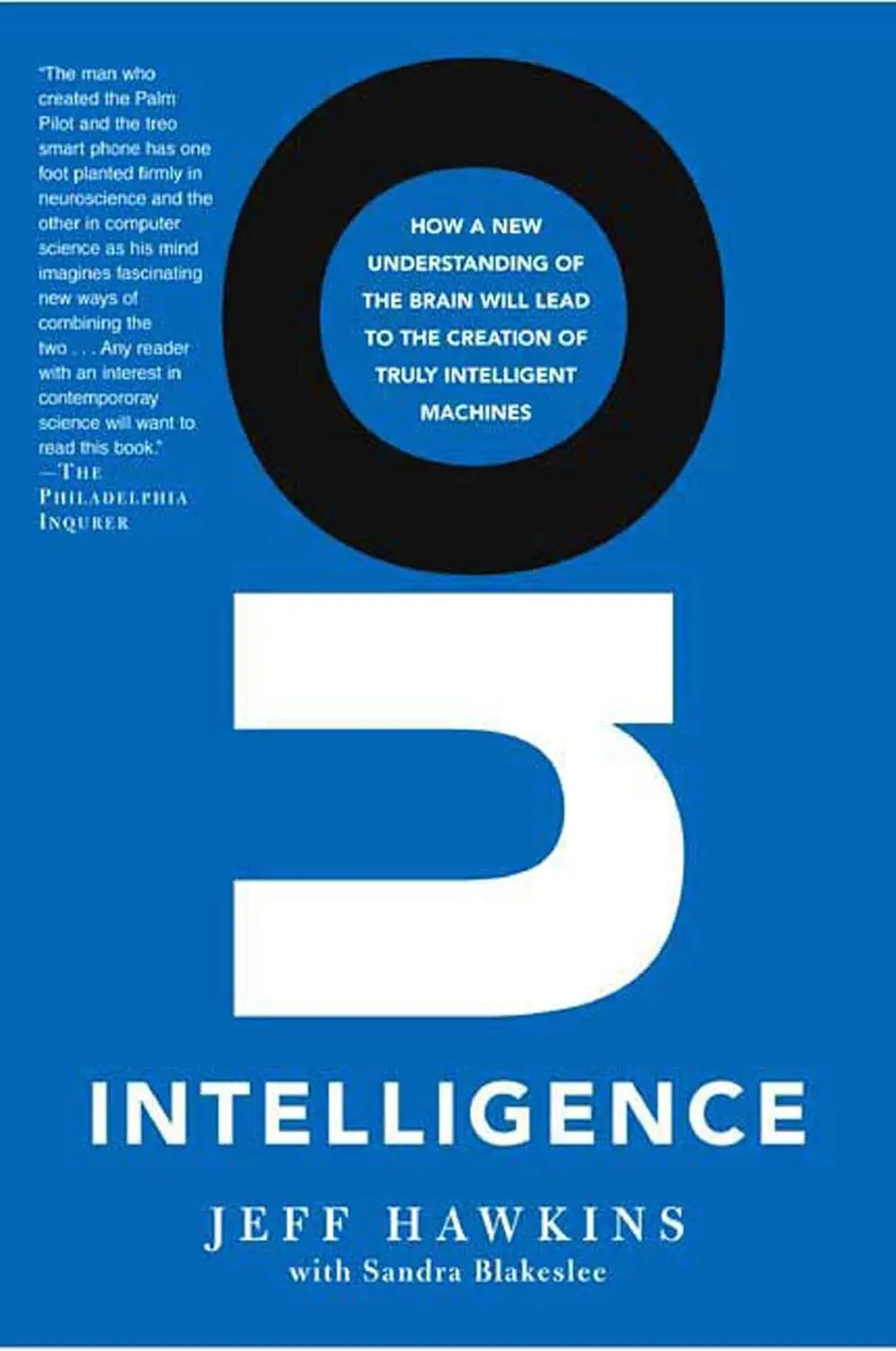
Jeff Hawkins made his fortune building handheld computers. Then he walked away from Silicon Valley and enrolled in a neuroscience program at Berkeley. His professors thought he was strange. A successful tech entrepreneur wanting to study brains? Hawkins thought the field of artificial intelligence had gone wrong by trying to make computers behave intelligently without understanding how intelligence actually works in biological systems.
On Intelligence is the book he wrote to explain what he learned. The central idea: the neocortex, the wrinkled outer layer of the brain that handles higher cognitive functions, is essentially a prediction machine. It does not react to the world. It predicts what will happen next, compares the prediction to what actually happens, and updates its model when the prediction is wrong. This happens constantly, unconsciously, and at every level of perception.
Hawkins calls his framework Hierarchical Temporal Memory. The neocortex is organized in a hierarchy of regions, each one processing increasingly abstract patterns. Lower regions detect edges and textures. Higher regions recognize objects and concepts. Each region stores sequences of patterns over time and uses those sequences to predict the next input. When you walk into your kitchen and immediately notice that something is wrong, even before you can identify what, that is your neocortex detecting a failed prediction.
The book is accessible to readers without a neuroscience background. Hawkins writes with the clarity of an engineer explaining a system he has spent years thinking about. He uses concrete examples: how you can read sloppy handwriting, how you navigate a familiar building in the dark, how a song sounds wrong when a note is changed. Each example illustrates the prediction framework.
The AI sections have aged in interesting ways. Hawkins argued in 2004 that neural networks as they existed then were not a path to true intelligence because they did not incorporate temporal patterns or hierarchical prediction. Since then, deep learning has achieved results that Hawkins did not anticipate, though his critique that these systems do not understand anything in the way brains do remains relevant. Hawkins went on to found Numenta, a company dedicated to building machine intelligence based on his neocortical theory.
The book was co-written with Sandra Blakeslee, a New York Times science writer. It reads quickly, under 250 pages, and remains one of the most thought-provoking books about the brain and AI written by someone who has built products in both domains.
