
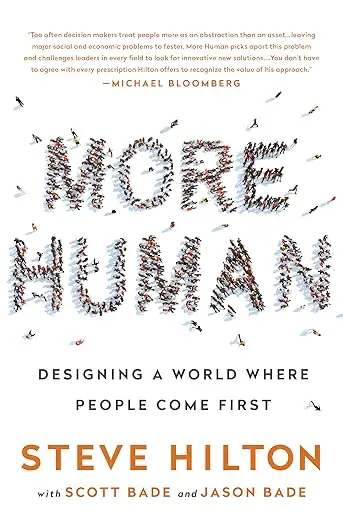
Steve Hilton has an unusual vantage point. He was David Cameron’s director of strategy in Downing Street, where he saw how government institutions operate at national scale. He then moved to Stanford, where he taught a course on technology and politics. He started a technology company. He hosted a show on Fox News. The combination of experiences gives him a perspective that is harder to categorize politically than most authors in this space.
More Human starts from a premise that crosses party lines: the systems and institutions that govern daily life, from schools to hospitals to corporations to government agencies, have grown so large and so process-driven that they regularly fail the people they are supposed to serve. A parent trying to navigate the school system. A patient waiting months for a specialist. A small business drowning in regulatory compliance. Hilton argues that the problem is not bad intentions but bad design: systems built for scale rather than for the humans inside them.
The book moves through sectors. Education: Hilton advocates smaller schools, more autonomy for teachers, and curricula that teach practical skills alongside academic ones. Food: he describes the industrial food system and argues for local production and transparent labeling. Healthcare: he pushes for decentralization and preventive care over the factory model of hospitals. Business: he argues that companies that treat employees as whole people rather than units of productivity outperform those that do not.
The proposals range from moderate (more transparency in food labeling) to radical (restructuring public education around apprenticeship models). Hilton draws on examples from multiple countries, including Denmark’s approach to education, Switzerland’s political decentralization, and various Silicon Valley experiments in organizational design.
The tone is energetic and occasionally preachy. Hilton writes like someone who has been in the rooms where decisions are made and is frustrated by how slowly those rooms move. He is not an academic building a careful case. He is a practitioner making an argument for action.
The book has been criticized from the left for not addressing the structural inequalities that make human-scaled solutions easier for wealthy communities to implement, and from the right for being too willing to use government intervention to achieve human-centered outcomes. Hilton would probably consider both criticisms evidence that he is somewhere near the right answer.
More Human was published in 2015 and reads as both a policy book and a personal manifesto from someone who spent time inside the machine and came out wanting to redesign it.
