
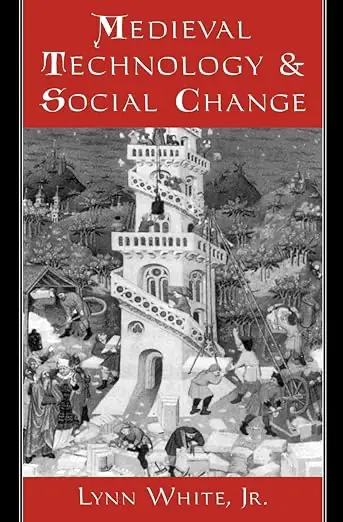
Lynn White’s thesis is simple and radical: technology changes society more than philosophy, religion, or politics do. He makes the case with three examples from medieval Europe, each one tracing how a specific invention reshaped social organization.
The stirrup arrived in Europe from Central Asia sometime around the eighth century. Before the stirrup, a mounted warrior could be knocked off his horse by a foot soldier with a spear. After the stirrup, a horseman could brace himself and deliver a lance charge that foot soldiers could not withstand. This gave cavalry a decisive advantage. But maintaining a mounted knight, with armor, weapons, warhorses, and training, was expensive. The cost required large land grants, which required a system of vassalage and feudal obligation. White argues that the stirrup did not just change warfare. It created feudalism.
The heavy plow arrived in northern Europe around the sixth or seventh century. The light scratch plow used in Mediterranean agriculture could not turn the heavy, wet soils of northern Europe. The heavy plow, with its coulter, plowshare, and moldboard, could. But it required eight oxen to pull, which meant individual farmers had to pool their animals and work collectively. This promoted the open-field system, where strips of land were farmed communally. White traces this change in plow technology to the reorganization of European village life.
The mechanical clock appeared in the thirteenth century and gradually replaced the seasonal, agricultural sense of time with an abstract, uniform one. Monasteries used clocks to regulate prayer schedules. Towns used them to regulate markets and work hours. The shift from natural time to mechanical time, White argues, changed how Europeans thought about productivity, efficiency, and the organization of labor.
The book has been debated intensely since its publication in 1962. Some historians argue that White oversimplifies causal chains. The relationship between the stirrup and feudalism, in particular, has been challenged by scholars who point to other factors. But the book’s larger argument, that historians should pay more attention to technology as a driver of social change, has been widely accepted and has influenced how medieval history is studied.
White was a professor at UCLA and later at Stanford. The book is short, dense, and written for an academic audience, but it is clear enough for any careful reader. It remains one of the most cited works in the history of technology.
