
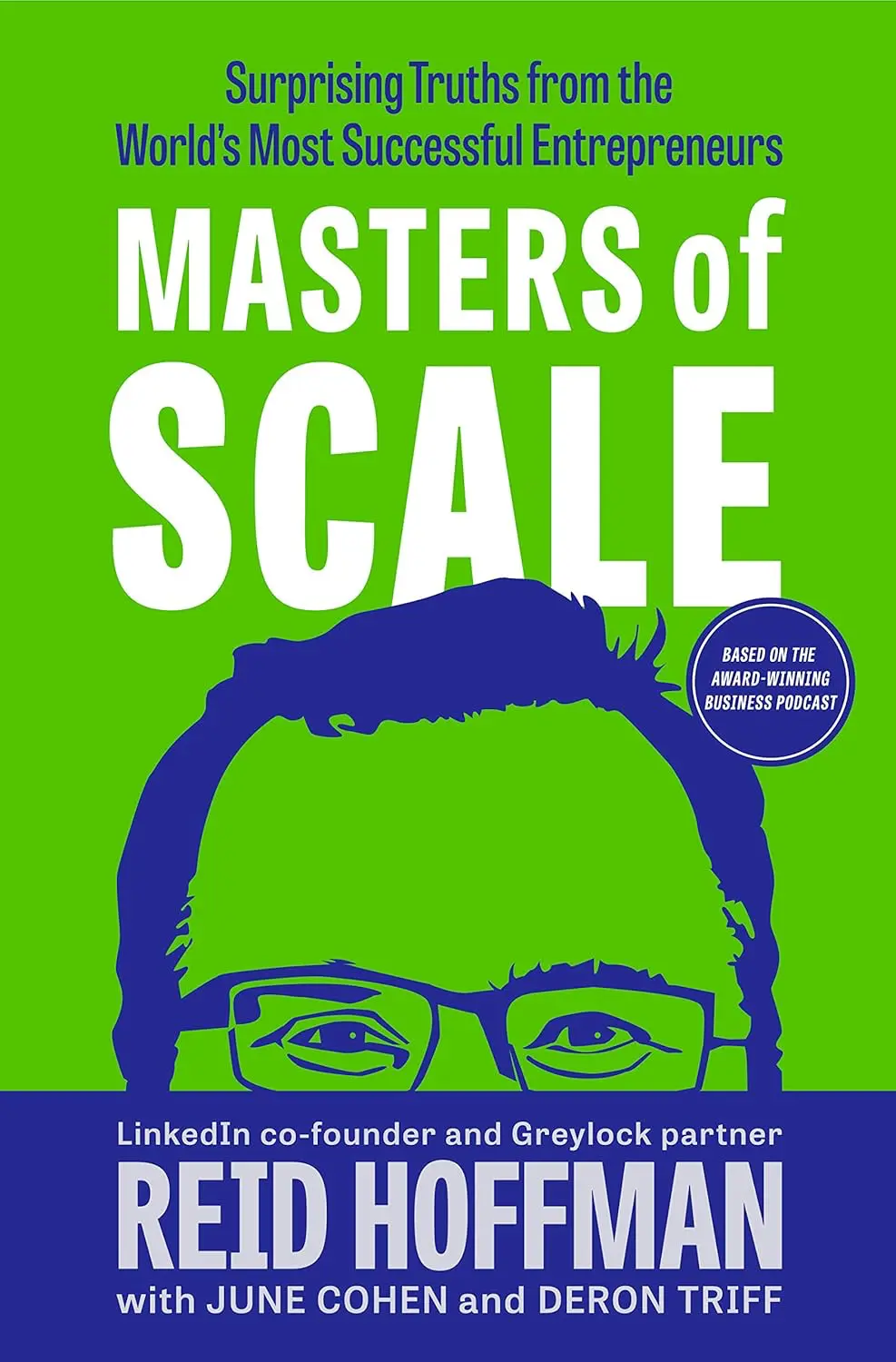
Reid Hoffman has been inside the scaling process multiple times. He co-founded LinkedIn, was an early board member at PayPal, and invested early in Facebook, Airbnb, and dozens of other companies through Greylock Partners. His podcast, Masters of Scale, has featured hundreds of interviews with founders about how they grew their companies past the early stages. This book pulls from those conversations.
The structure follows a set of principles, each one framed as a counterintuitive truth. “Do things that don’t scale” is the first. Hoffman argues, drawing on examples from Airbnb’s early days (the founders personally photographed listings and sometimes stayed with hosts), that the scrappy, unscalable work of the early days is what tells you whether you have something worth scaling at all.
Other chapters cover when to let fires burn (not every problem needs to be solved immediately), why speed matters more than certainty (a decision made at 70% confidence and acted on fast beats a decision made at 95% confidence and acted on slowly), and how culture gets encoded through the first hires rather than through mission statements written later.
The interviews are the book’s strongest asset. Hoffman is a good interviewer because he has built companies himself and can push back rather than just nodding along. Sara Blakely talks about launching Spanx with $5,000 and no outside funding. Reed Hastings describes Netflix’s decision to split its DVD and streaming businesses, which initially looked like a disaster and turned out to be the move that saved the company. Howard Schultz talks about Starbucks’ early years and the decision to expand beyond Seattle.
The writing, co-authored with June Cohen and Deron Triff, is clean and readable. The book does not try to be a memoir or a theoretical treatise. It is organized around practical lessons, illustrated by specific stories, and designed to be useful rather than impressive.
The book was published in 2021 and functions as a companion to the podcast rather than a replacement for it. If you have already listened to every episode, you will recognize many of the stories. If you have not, the book is a curated starting point.
It will be most useful to founders who are past the idea stage and starting to think about growth. The early-stage survival material is covered better elsewhere. What this book does well is describe the specific decisions that separate companies that grow from companies that stall.
