
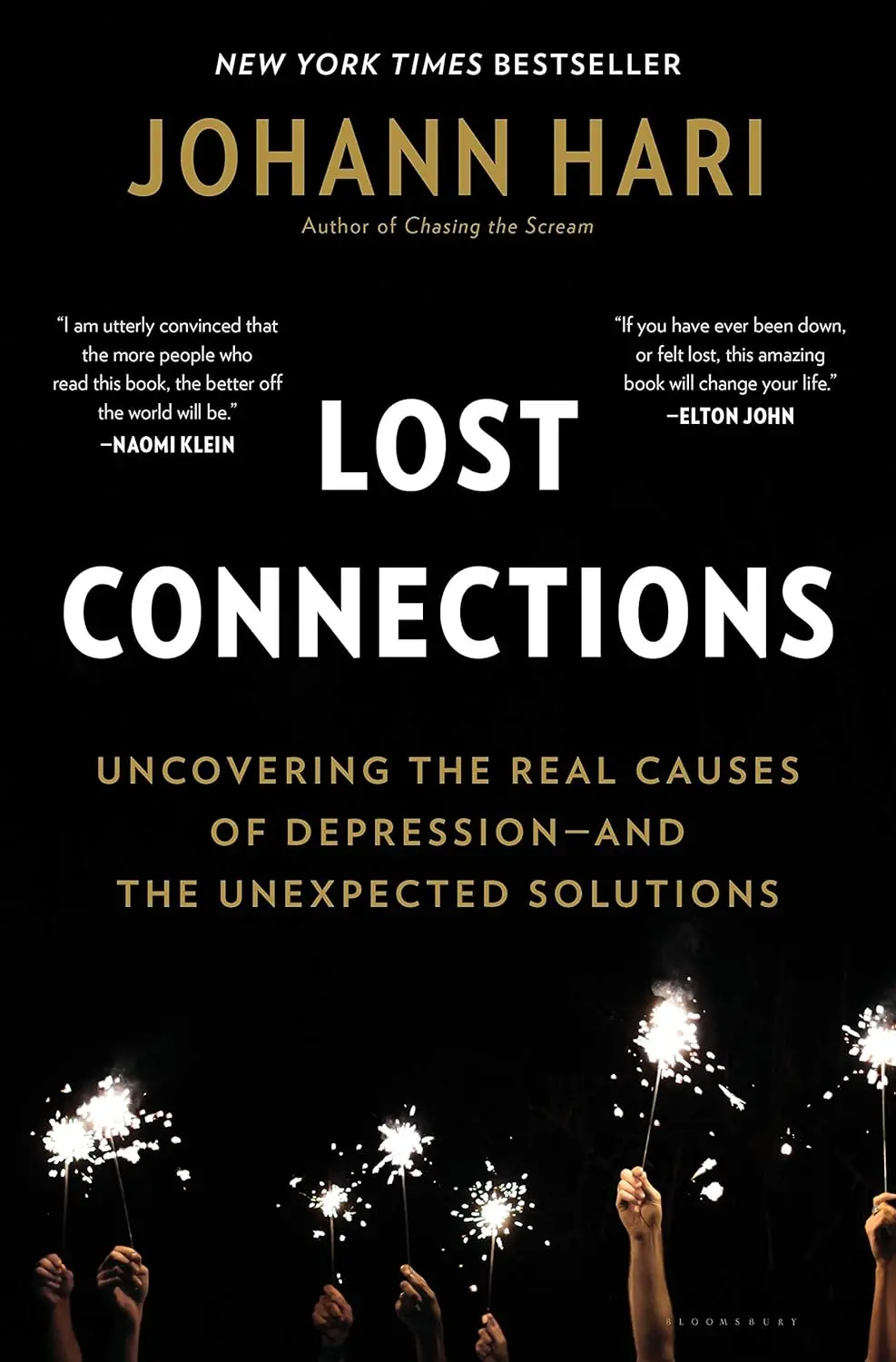
Johann Hari took his first antidepressant at eighteen. His doctor told him his brain was not producing enough serotonin, and that medication would fix the chemical imbalance. The pills helped, for a while. Then the dose went up, and up again, and eventually they stopped working entirely. Hari wanted to understand why.
He spent three years interviewing researchers, psychiatrists, and depressed people in multiple countries. The conclusion he reached goes against the story most people have been told about depression: that it is primarily a chemical malfunction in the brain that medication corrects. Hari argues, drawing on a substantial body of research, that depression and anxiety are more often responses to the way we live than malfunctions in our biology.
He identifies nine causes of depression, and only two of them are biological. The other seven are forms of disconnection: from meaningful work, from other people, from status and respect, from the natural world, from a hopeful future, from childhood trauma, and from a sense of control over one’s life. In each case, he interviews researchers who have studied the connection and presents their findings.
The chapters on disconnection from meaningful work are particularly sharp. Hari cites Gallup data showing that the majority of workers worldwide feel disengaged from their jobs. He visits a Baltimore bicycle cooperative where depressed people improved dramatically after being given meaningful work with real autonomy. He profiles a community in Berlin that redesigned its housing to increase social contact, with measurable effects on residents’ mental health.
Hari is careful to say that biology plays a role. He is not arguing that antidepressants never work or that nobody needs them. He is arguing that treating depression primarily as a chemical problem, rather than examining the social and environmental conditions that produce it, has led to a situation where millions of people are medicated without addressing the actual sources of their distress.
The book is not without controversy. Some critics have pointed out that Hari’s earlier journalism was plagued by fabrication scandals, and they argue this should affect how readers weigh his claims. The research he cites, however, comes from published, peer-reviewed sources that can be evaluated independently.
Hari writes accessibly and with obvious personal investment. The book does not read like a medical text. It reads like a person trying to understand his own suffering, discovering that it connects to something much larger, and wanting to share what he found.
