
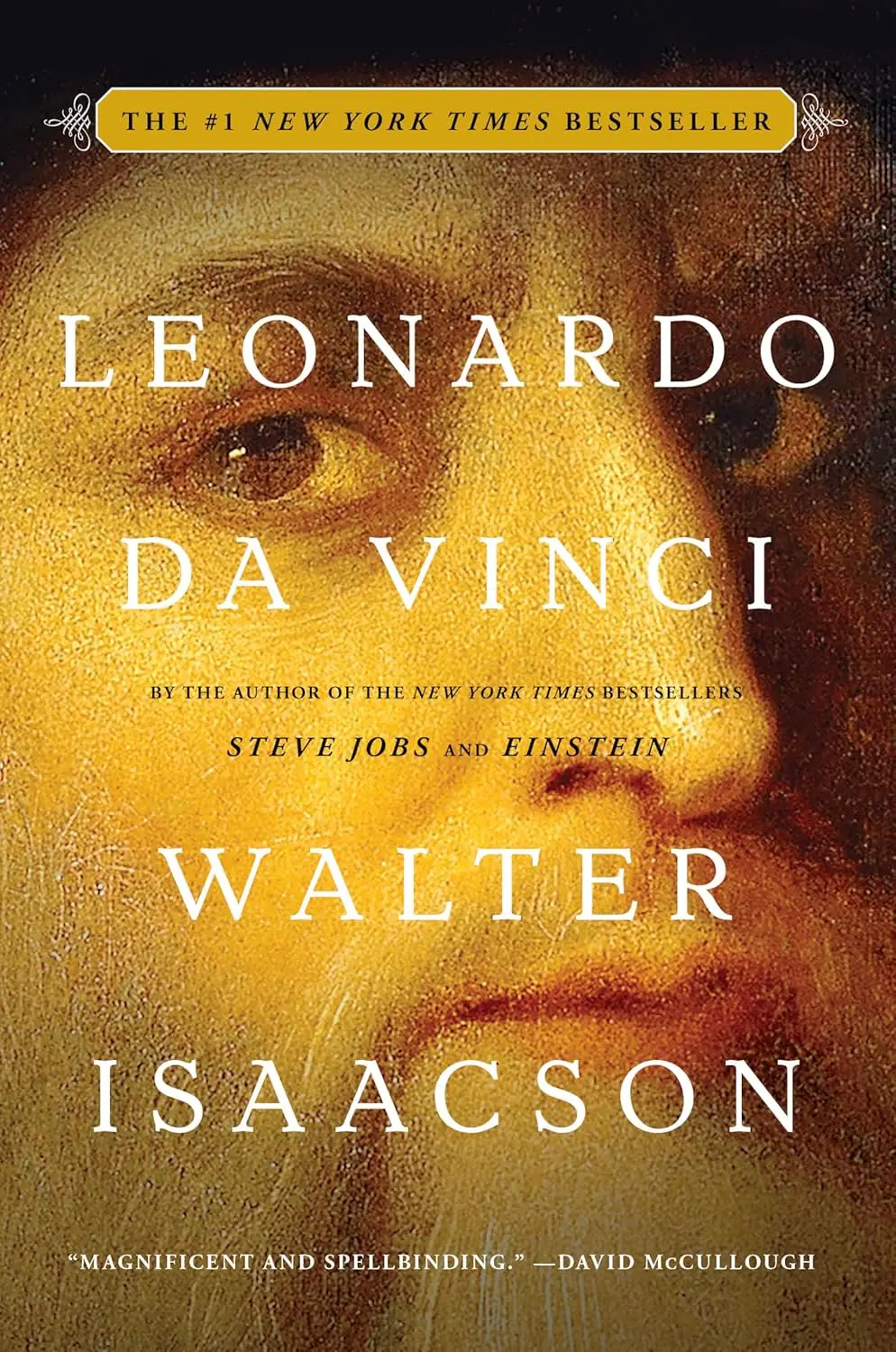
Leonardo left behind roughly 7,200 pages of notebooks filled with drawings, observations, to-do lists, and ideas. Isaacson uses these notebooks as the primary source for a biography that treats Leonardo not as an unreachable genius but as someone whose habits of mind are worth studying and, in some cases, imitating.
The picture that emerges is of a man who was obsessively curious about everything. Leonardo studied the flow of water, the flight of birds, the anatomy of cadavers, the geometry of light, and the mechanics of machines, all while painting some of the most famous works in art history. He moved between disciplines without any sense that boundaries existed between them. The same notebook might contain a drawing of a human heart next to a design for a flying machine next to a study of how light falls on a curved surface.
Isaacson argues that this interdisciplinary approach was not a distraction from Leonardo’s art. It was what made his art possible. The Mona Lisa’s smile works because Leonardo had spent years studying the muscles of the human face. The Last Supper’s composition works because he understood perspective, optics, and how the brain processes visual information.
The biography also covers Leonardo’s weaknesses: he was a chronic procrastinator who left many works unfinished, he was easily distracted by new interests, and he sometimes overcomplicated projects to the point of failure. These are not minor footnotes. They are as much a part of his story as the masterpieces.
For founders, the relevant lesson is about the value of curiosity that crosses boundaries. The most interesting products and companies tend to come from people who combine knowledge from fields that do not usually talk to each other. Leonardo is the extreme case, but the principle scales down.
Bill Gates and Jeff Bezos have recommended it. At about 600 pages, the book is substantial but Isaacson’s narrative style keeps it moving. The color illustrations of Leonardo’s notebook pages are a genuine addition to the text.
