
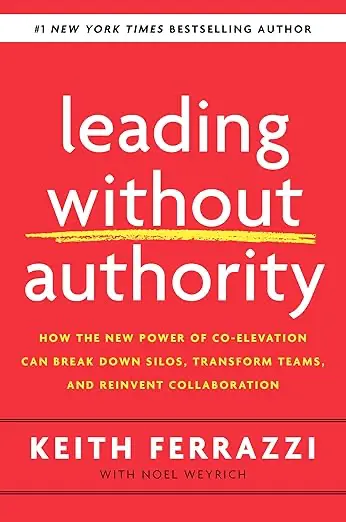
Keith Ferrazzi made his name with Never Eat Alone, a book about relationship-building that became a staple of the business networking genre. Leading Without Authority applies a similar sensibility to a different problem: how do you lead when you do not have formal authority over the people you need to move?
The answer, Ferrazzi argues, is co-elevation, a practice where you commit to the success of your colleagues and teammates regardless of whether they report to you, sit on your team, or even work at your company. In exchange, you earn their commitment to your success. The relationship is mutual, ongoing, and independent of the org chart.
The practical advice covers specific situations. How to influence a peer who controls resources you need. How to get buy-in from a stakeholder who has no incentive to help you. How to build alliances across departments that operate as silos. How to make yourself indispensable to people who have no obligation to care about your priorities. Ferrazzi breaks each situation into steps: identify who matters, understand what they need, offer value before asking for anything, and build the relationship so that cooperation becomes the default rather than the exception.
Ferrazzi writes with the energy of someone who has spent decades in rooms full of executives and has seen what works. The examples are drawn from corporate environments, and the language is business-friendly. If you have worked in a large organization where getting things done requires coordinating with people who have different priorities, different incentives, and different bosses, the scenarios will feel familiar.
The framework has limits. Co-elevation works best in environments where reciprocity is valued and relationships are durable. In highly political organizations where trust is low and people are primarily looking out for themselves, the approach may produce vulnerability rather than influence. Ferrazzi touches on this but tends toward optimism about human nature in professional settings.
The book was published in 2020, just as remote work became the norm for millions of knowledge workers. The timing was fortunate. Leading without authority becomes more necessary when you cannot walk down the hall to someone’s office, when meetings are on Zoom, and when the informal interactions that build relationships have to be designed rather than left to chance.
