
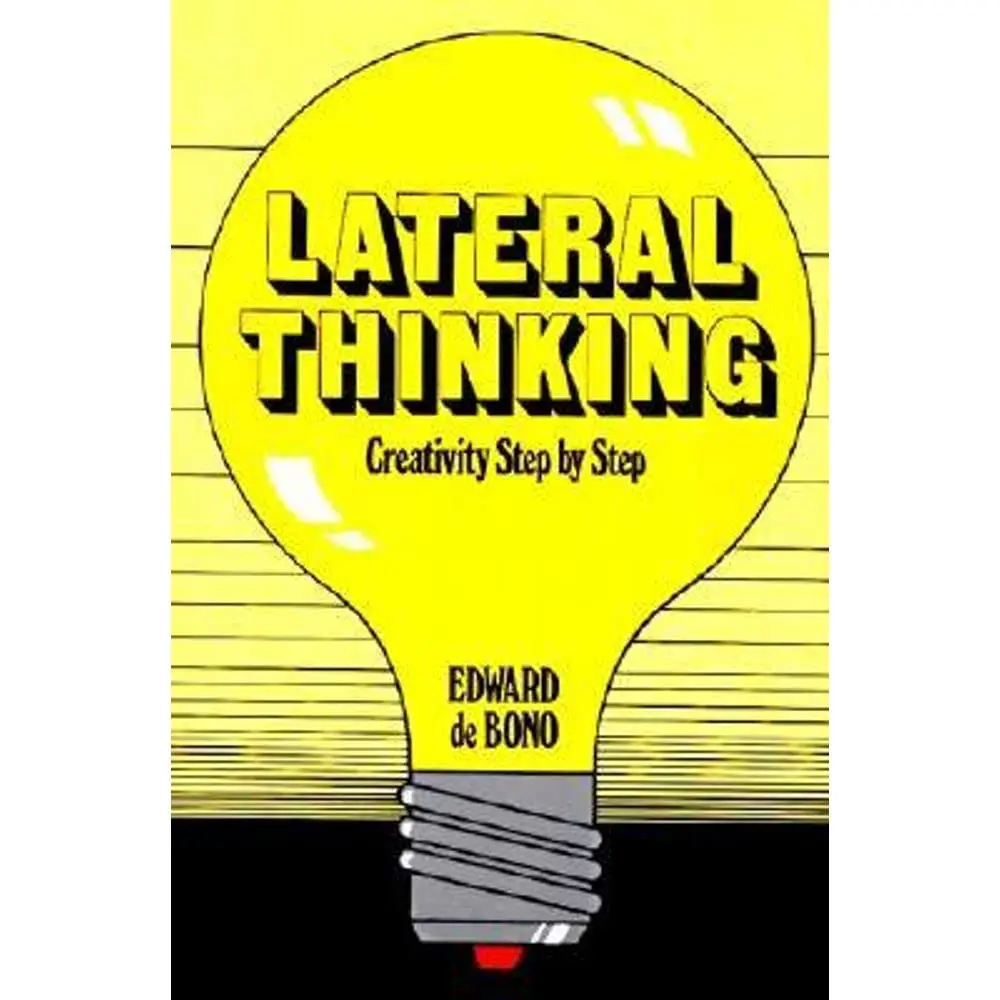
Lateral Thinking is Edward de Bono’s original 1970 book on the concept he invented and named. The core idea is that our brains naturally organize information into patterns, and once a pattern is established, we tend to follow it automatically. This is efficient for most situations but terrible for creative problem-solving, because the obvious path is usually the conventional one. Lateral thinking is the deliberate effort to step off the obvious path and approach a problem from a direction that the established pattern wouldn’t suggest.
De Bono distinguishes lateral thinking from vertical thinking. Vertical thinking digs deeper into an existing idea: it’s logical, sequential, and focused on being right at each step. Lateral thinking moves sideways: it generates alternatives, challenges assumptions, and uses deliberate randomness to break patterns. You need both, but most education and most business culture reward vertical thinking almost exclusively.
The book provides specific techniques. Random entry (choosing an unrelated word and forcing connections to your problem) breaks you out of familiar thinking paths. Reversal (deliberately stating the opposite of what you believe) surfaces hidden assumptions. Fractionation (breaking a concept into its parts and reassembling them differently) produces new combinations. Analogy (finding parallels in unrelated fields) imports solutions from other domains. Each technique is explained with examples and exercises.
For founders, the techniques are useful when you’re stuck on a problem and the obvious approaches aren’t working. The random entry technique, in particular, is fast and surprisingly effective: pick a word from a dictionary, list its associations, and force connections to your problem. It sounds silly, but it reliably produces angles you wouldn’t have found by thinking harder about the problem in the conventional way.
The writing is clear and somewhat academic in tone. De Bono wrote over 80 books in his career, and this one has the feel of a textbook rather than a popular business book. Some readers find the style dry. Others appreciate the precision. The concepts have been widely adopted, often without credit, and if you’ve encountered brainstorming techniques or creativity exercises in a corporate setting, many of them trace back to this book.
