
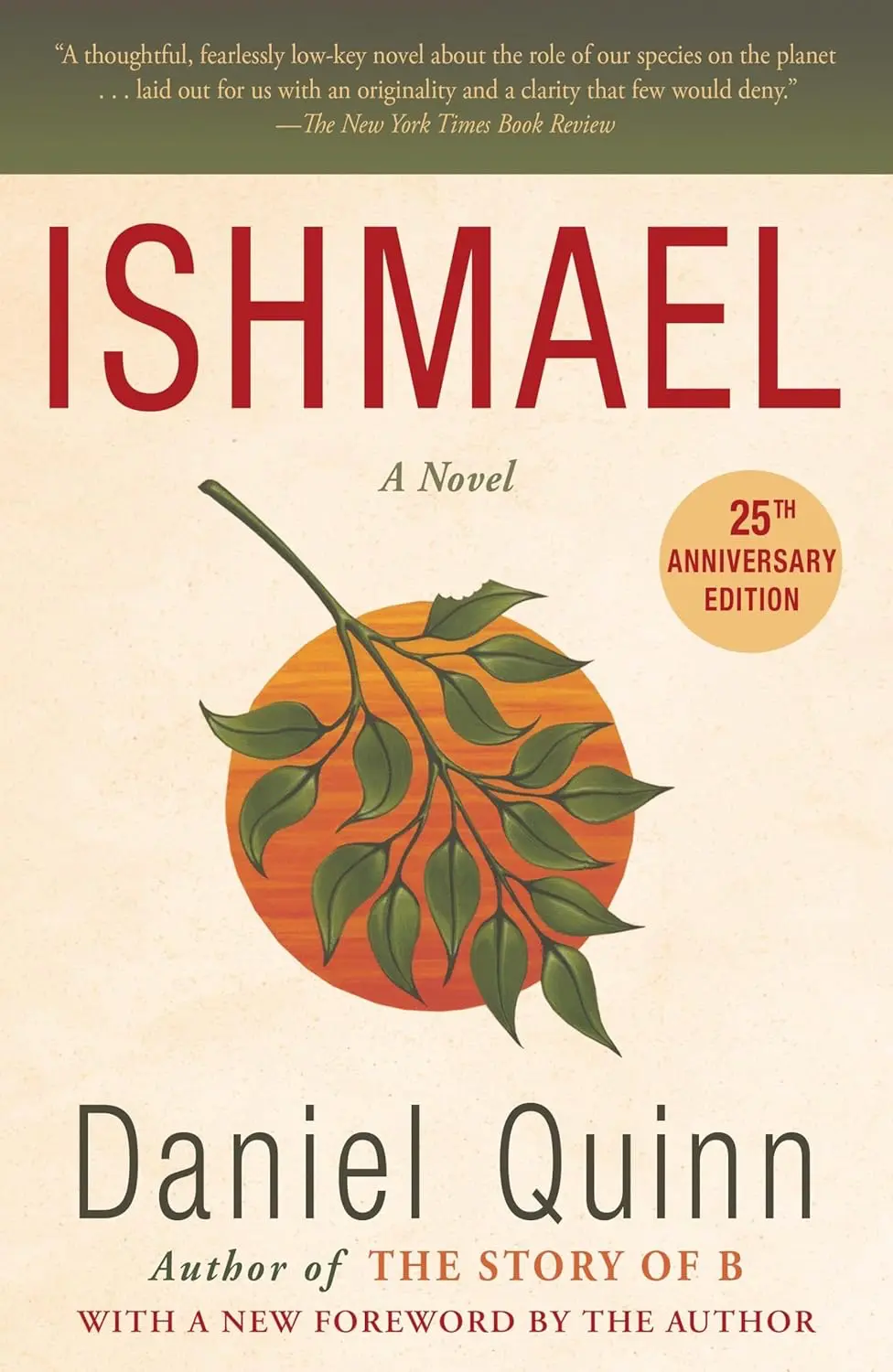
The setup is deliberately strange. A nameless narrator answers a classified ad and finds himself in a room with a gorilla who can communicate through telepathy. The gorilla’s name is Ishmael. He has spent decades in captivity, observing human behavior, and has developed a theory about why human civilization is destroying the planet.
Ishmael’s method is Socratic. He asks questions. The narrator answers. Ishmael pushes back. Over a series of conversations, they work through the story humanity tells itself about its place in the world: that the earth was made for humans, that civilization is the peak of evolution, that growth is always good, and that the rules governing every other species do not apply to us.
Ishmael calls this the story of the Takers. It is the story of agricultural civilization, which began roughly 10,000 years ago and has been expanding ever since, converting wild land into farmland, wild animals into livestock, and wild humans into workers. Before the Takers, there were the Leavers, the hunter-gatherer cultures that lived within the ecological limits of their environments for hundreds of thousands of years without destroying them.
Quinn’s argument, delivered through the gorilla, is that the Taker story is not a truth about human nature. It is a myth, and a recent one. For most of human history, people lived differently. The crisis of the modern world, environmental destruction, species extinction, climate instability, is not the result of human nature. It is the result of a specific cultural story that one branch of humanity adopted and then imposed on the rest.
The novel won the Turner Tomorrow Fellowship in 1991, a $500,000 prize created by Ted Turner for fiction offering positive solutions to global problems. It has been widely adopted in environmental studies courses and has a loyal following among readers who found it at the right moment in their lives.
The criticisms are predictable and partly fair. The novel simplifies a complex history. Hunter-gatherer societies were not uniformly sustainable. Agricultural civilization has produced things, including medicine, literature, and the abolition of slavery, that most people would not want to give up. Quinn would likely respond that acknowledging these benefits does not require accepting the Taker story as inevitable or permanent.
Ishmael is a short book with a long afterlife. Quinn wrote two sequels, My Ishmael and The Story of B, but the original stands on its own and is the one most people read.
