
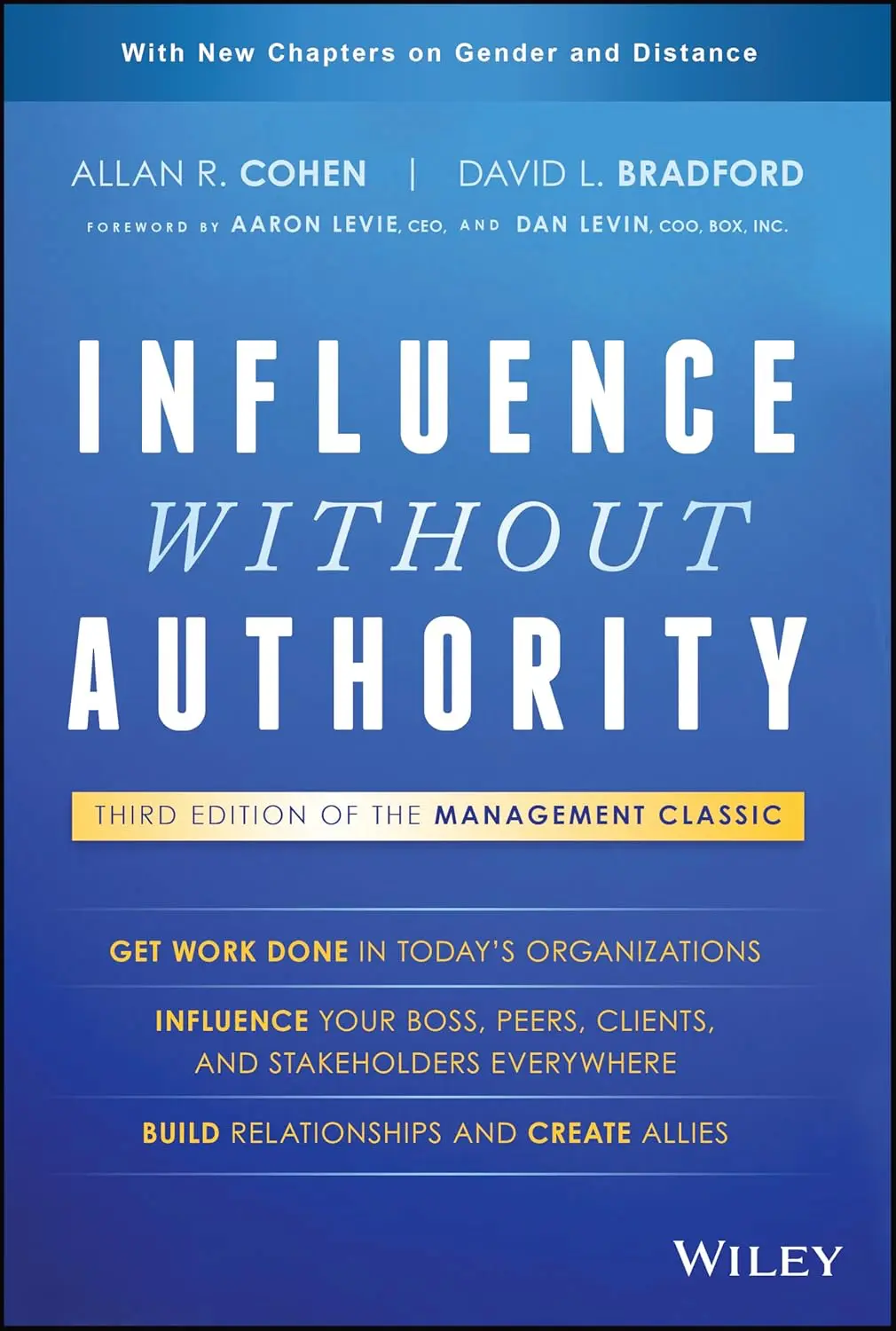
Influence Without Authority addresses a problem that nearly everyone in an organization faces: you need someone’s cooperation, but you don’t have the authority to demand it. Maybe they’re in a different department. Maybe they report to someone else. Maybe they’re more senior than you. Cohen and Bradford’s solution is to think about influence as exchange: figure out what the other person values (their “currencies”) and find a way to provide it in return for the cooperation you need.
The currencies framework is the book’s main contribution. Cohen and Bradford identify several categories of things people value at work: task-related currencies (resources, assistance, information), position-related currencies (recognition, visibility, reputation), relationship-related currencies (understanding, personal support, acceptance), and personal currencies (self-concept, purpose, comfort). Understanding which currencies matter to a specific person tells you how to approach them.
The process works in three steps. First, understand the other person’s world: what are they trying to accomplish, what pressures are they under, what do they care about? Second, identify what you have to offer that they would value. Third, make the exchange, either explicitly (“I’ll help you with X if you’ll support me on Y”) or implicitly (by being consistently helpful until reciprocity kicks in naturally).
For founders, who spend a large portion of their time trying to influence people they don’t control, from investors to partners to employees who could leave, the framework is directly applicable. The exercise of mapping each stakeholder’s currencies, what they value, what pressures they face, what you can offer them, changes how you approach every relationship.
The writing is practical and organized around case studies. The academic roots show in the tone, which is more textbook than narrative, but the frameworks are clear and the examples illustrate the principles well. The third edition includes updated material on remote collaboration and cross-functional teams. If you regularly need to get things done through people who don’t report to you, this is one of the more useful books on the subject.
