
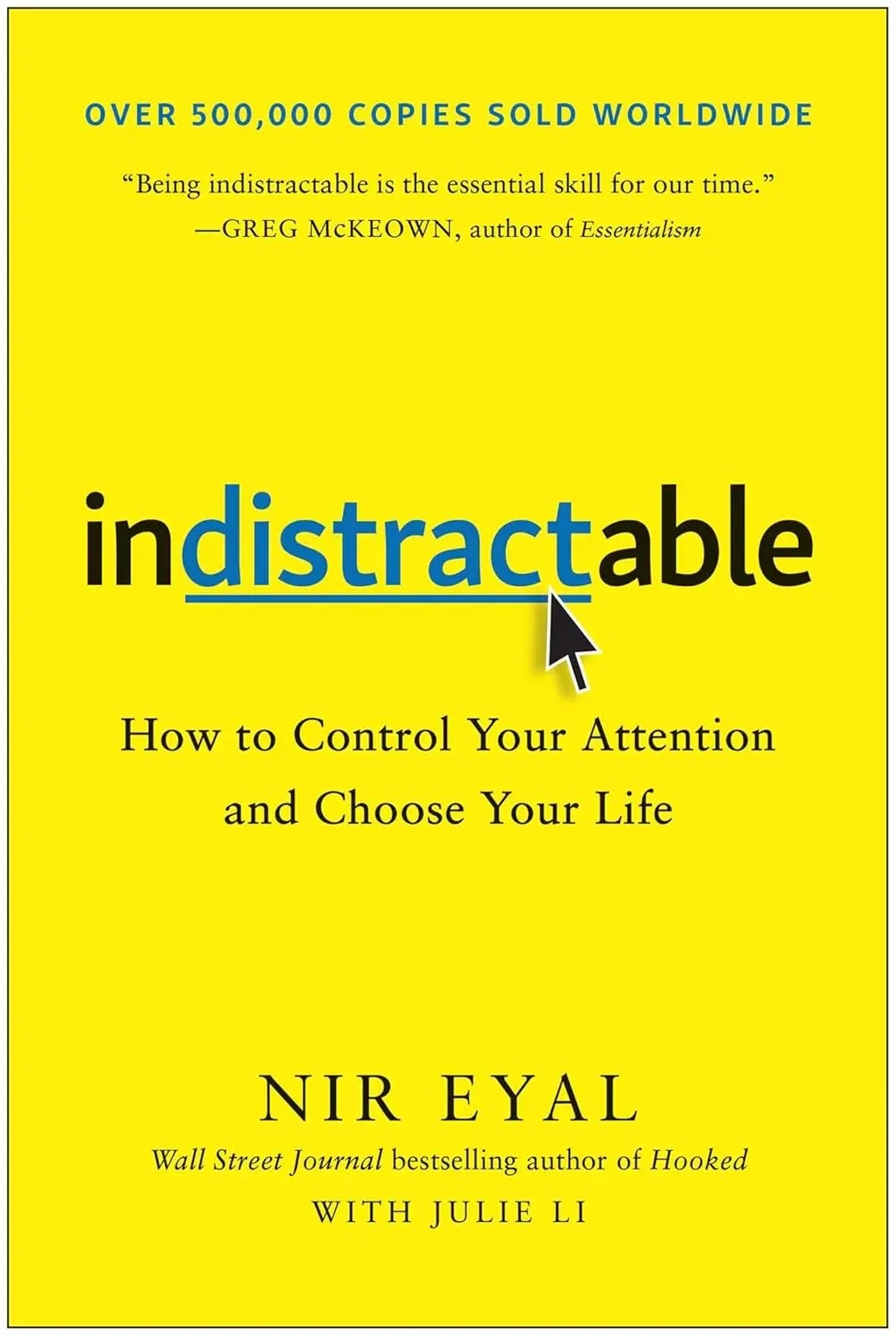
There is an interesting tension in Eyal writing both Hooked (how to make products addictive) and Indistractable (how to resist addictive products). Eyal addresses this directly: understanding how products capture attention is exactly what equips you to defend against it.
The book is organized around a four-part model. Traction is any action that moves you toward what you want. Distraction is any action that moves you away from it. The opposite of distraction is not focus. It is traction. Eyal then identifies four strategies for staying on the traction side.
First, master internal triggers. Most distraction starts inside you, not from external notifications. Boredom, anxiety, loneliness, and uncertainty are the feelings that drive you to check your phone. Eyal recommends techniques for sitting with discomfort rather than immediately seeking relief.
Second, make time for traction. If you do not schedule your priorities, other people’s priorities fill your time. Eyal advocates timeboxing: scheduling every block of your day in advance, including leisure and rest, so that you always know what you should be doing and can recognize when you are off-track.
Third, hack back external triggers. Audit every notification, every app on your home screen, and every communication channel. If it does not serve your goals, remove it or restrict it. Eyal is specific about how to configure devices and apps to reduce interruption.
Fourth, prevent distraction with pacts. These are pre-commitments that make distraction harder: leaving your phone in another room during deep work, using website blockers, or making a financial commitment that you forfeit if you get distracted.
For founders, the distraction problem is acute. The founder’s job involves constant incoming requests, and the temptation to stay in reactive mode is strong. Eyal’s framework provides structure for protecting the time that matters most.
At about 280 pages, the book is well-organized and practical. It reads as a companion to Hooked, covering the other side of the attention economy.
