
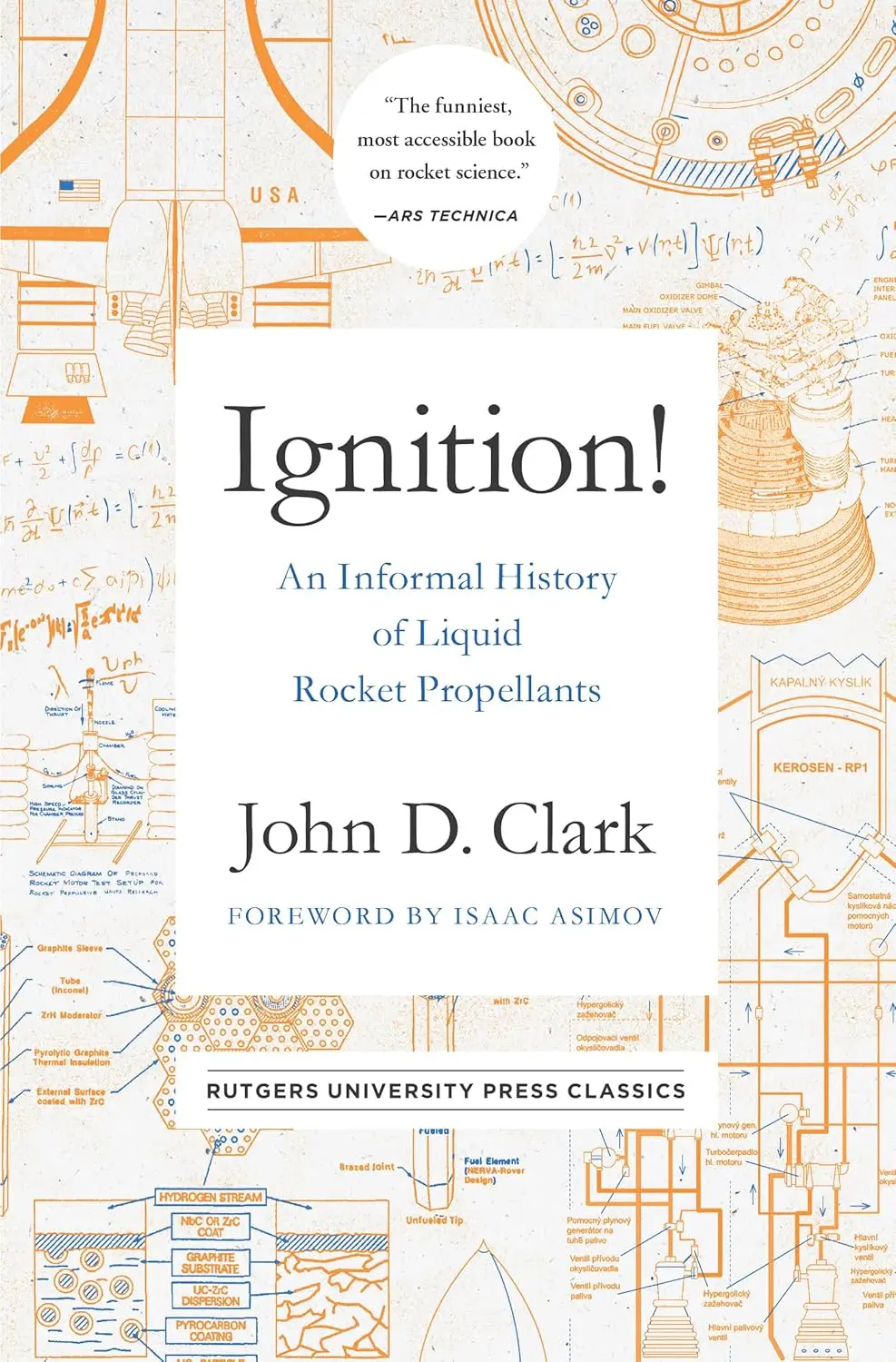
Ignition! was published in 1972 and went out of print for decades before being reissued in 2018, driven partly by Elon Musk’s recommendation. Clark was a research chemist who worked on liquid rocket propellants from the 1940s through the 1960s, a period when the field was advancing rapidly and the experiments were frequently dangerous.
The book covers the chemistry of rocket propulsion in a way that is accessible to non-chemists. Clark explains what makes a good propellant (high energy density, controllable combustion, reasonable handling properties), what makes a bad one (toxicity, instability, tendency to explode unexpectedly), and what the research process looked like in practice (mixing volatile chemicals in test cells and hoping for the best).
Clark’s writing style is what makes the book special. He describes experiments where propellants ate through their containers, ignited spontaneously when exposed to air, or produced toxic gases that cleared entire buildings. He recounts these incidents with the gallows humor of someone who survived them. The tone is conversational and irreverent, which is unusual for a technical history.
The book is also a case study in how applied research works. The propellant chemists were not working from theory down. They were mixing things together, measuring what happened, adjusting, and trying again. The process was empirical, incremental, and occasionally terrifying. Many promising propellants were abandoned not because they did not work but because they were too dangerous to handle, store, or transport.
For founders, the book is less about direct business lessons and more about the mindset of people working on hard technical problems under real constraints. The willingness to experiment, to accept failure as data, and to maintain humor in the face of genuine danger is recognizable to anyone building something new in uncertain conditions.
Elon Musk has recommended it as one of his favorite books. At about 230 pages, the book is short and entertaining. The chemistry is explained clearly enough that non-scientists can follow, and Clark’s personality carries the narrative.
