
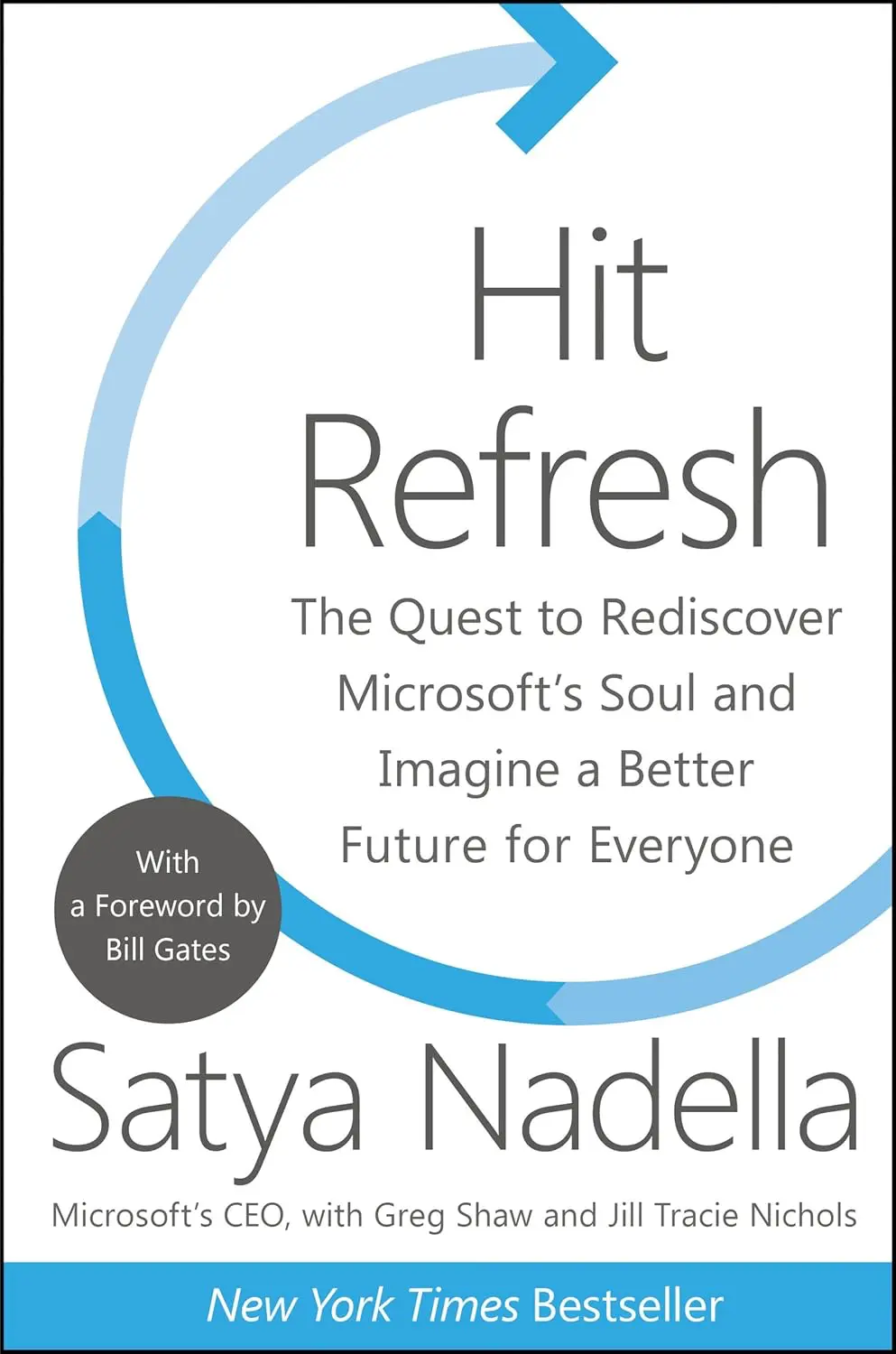
Hit Refresh is Satya Nadella’s account of taking over as CEO of Microsoft in 2014 and attempting to shift a company that had become slow, internally competitive, and culturally stuck. The book is part memoir, tracing Nadella’s childhood in Hyderabad, India, his immigration to the U.S., and the personal experiences, particularly raising a son with cerebral palsy, that shaped his leadership philosophy.
The business story is the most interesting thread. When Nadella took over, Microsoft was widely seen as a company past its prime, losing ground to Apple, Google, and Amazon. His diagnosis was that Microsoft’s biggest problem was not technical but cultural. The company had developed what he calls a “know-it-all” mindset, where internal competition and politics mattered more than learning or collaboration. Nadella’s prescription was to shift toward a “learn-it-all” culture, heavily influenced by Carol Dweck’s work on growth mindset.
The book covers specific decisions: pivoting Microsoft toward cloud computing with Azure, repairing the relationship with the open-source community, the acquisition of LinkedIn, and early bets on AI. Nadella is candid about some of the tensions involved, though the book stays polished and diplomatic, as you would expect from a sitting CEO.
For founders, the most applicable sections are about cultural change. Nadella’s argument that culture eats strategy, and that changing culture requires the CEO to model the behavior they want to see, is supported by specific examples from inside Microsoft. His discussion of empathy as a leadership tool goes beyond the usual corporate language and connects to his personal story in a way that feels genuine.
The final sections on AI, mixed reality, and quantum computing are more speculative and read as somewhat dated now. But the core of the book, the cultural turnaround story, holds up well and is relevant to anyone leading an organization through a period of change.
