
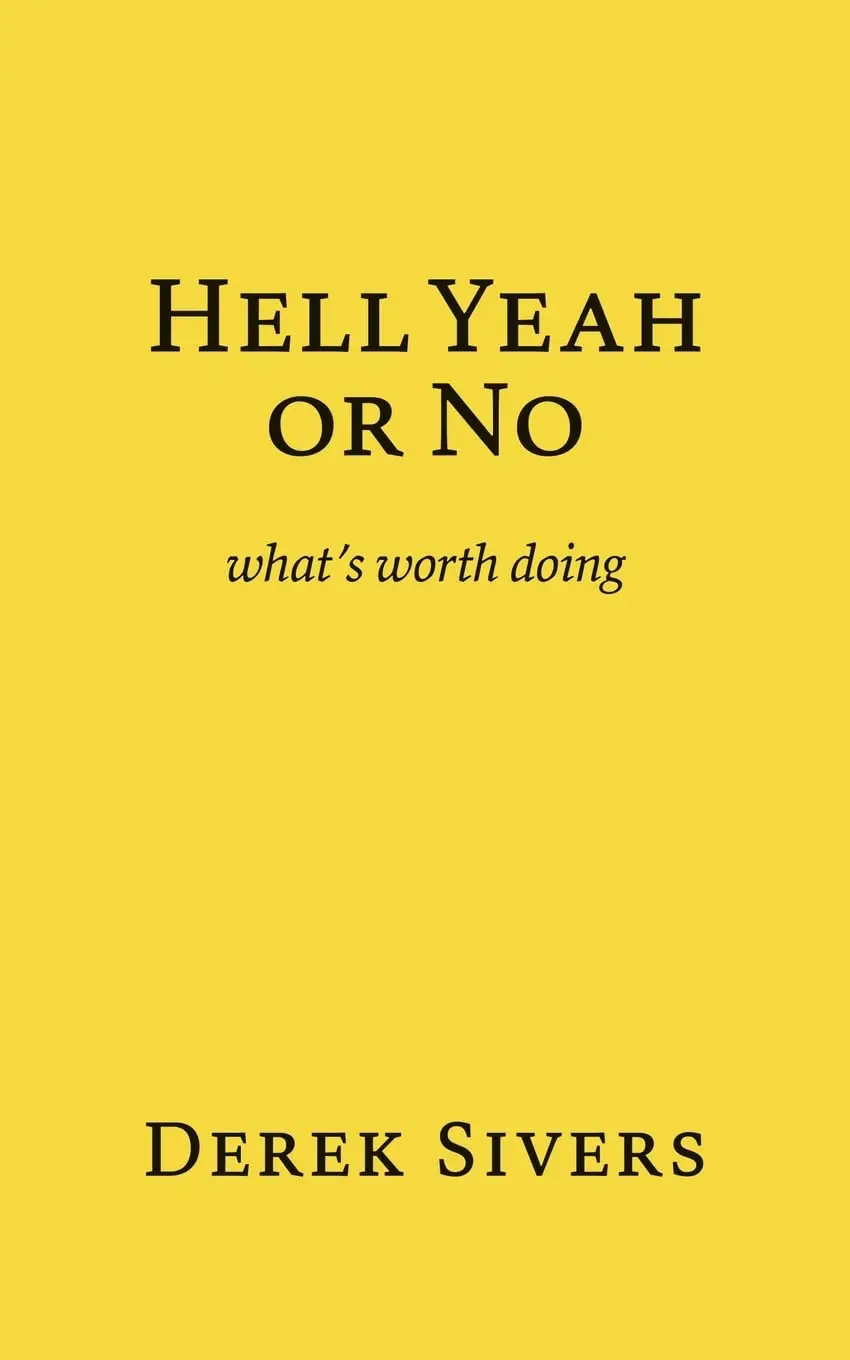
Derek Sivers started CD Baby in 1998 as a favor to friends who wanted to sell their music online. He accidentally built it into the largest seller of independent music on the internet, with $100 million in sales for 150,000 musicians. He sold it in 2008, gave the proceeds to a charitable trust for music education, and spent the next decade thinking and writing about what he had learned.
Hell Yeah or No collects the best of those writings. The chapters are short, usually one to three pages. Each one makes a single point and stops. There is no padding, no repetition, and no attempt to build a unified theory of anything. Sivers writes the way a good programmer codes: each function does one thing well.
The title essay argues that when deciding whether to commit to something, anything less than an enthusiastic yes should be treated as a no. The logic: most people say yes to too many things, which dilutes their attention and fills their lives with obligations they resent. By raising the bar to “hell yeah,” you create space for the things that actually matter.
Other essays cover adjacent territory. Why you should not announce your goals (research shows that telling people about your plans gives you a premature sense of accomplishment that reduces your motivation to follow through). Why you should have a daily practice instead of yearly goals. Why the opposite of your default approach is probably worth trying. Why saying no to almost everything is a privilege that comes from having said yes to the right things early on.
Sivers writes with a programmer’s directness. He does not use stories to illustrate his points. He states the point. If you agree, you move on. If you disagree, you think about why. The minimalism is refreshing after reading business books that take 300 pages to deliver 30 pages of content.
The weakness of the format is that ideas presented in two pages do not always hold up under scrutiny. The “hell yeah or no” framework, for instance, works well if you have the financial freedom to decline opportunities. It works less well if you are broke and need to say yes to things that keep the lights on. Sivers acknowledges this limitation in other writings but not fully in this book.
Sivers has since published additional short books in the same format, including Anything You Want and Your Music and People. Together they form a body of work that is unusually compact, honest, and practical.
