
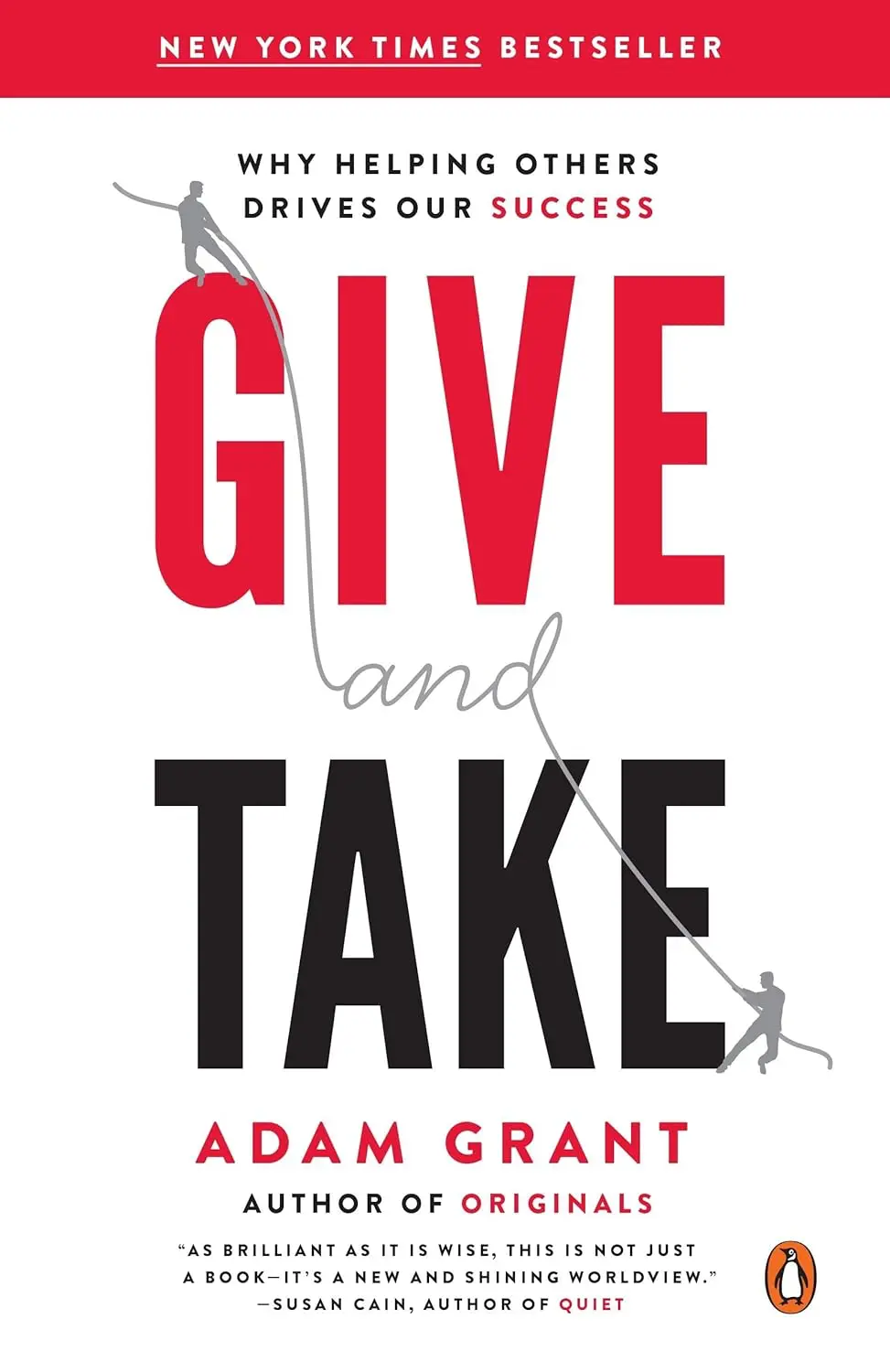
Grant’s research at Wharton found something counterintuitive: the people who give the most, who help colleagues without keeping score, who mentor others freely, are overrepresented at both extremes of success. Some givers end up exhausted and exploited. Others end up at the very top of their professions. The book investigates what makes the difference.
Grant categorizes people into three styles. Takers try to get as much as possible from others. Matchers operate on a quid pro quo basis, trading favors roughly equally. Givers contribute to others without expecting anything specific in return. Most people assume takers get ahead, but the research says otherwise: in the long run, givers who give strategically tend to build the largest networks, earn the most trust, and create the most value.
The difference between successful and unsuccessful givers comes down to boundaries. Givers who burn out tend to say yes to everything, neglect their own priorities, and let takers exploit them. Givers who succeed are what Grant calls “otherish,” they care about helping people but also protect their own interests and time. They give in ways that are high impact for the recipient but low cost to themselves. They also learn to screen for takers and avoid subsidizing people who only extract.
For founders, the applications are direct. Building a company involves constant negotiation: with cofounders, investors, employees, customers, and partners. Grant’s research suggests that a giving orientation, when combined with good boundaries and pattern recognition for takers, produces better long-term outcomes than either aggressive taking or cautious matching.
The book is filled with case studies from business, medicine, education, and sports. Grant writes clearly and supports his arguments with data rather than anecdotes alone. Sheryl Sandberg wrote the foreword, and the book has been recommended by Reid Hoffman, Brian Chesky, and Daniel Pink.
At around 300 pages, Give and Take is a reasonable length and well-organized. The most actionable chapter for founders is probably the one on “powerless communication,” which explains why asking questions and showing vulnerability in negotiations can be more persuasive than projecting dominance.
