
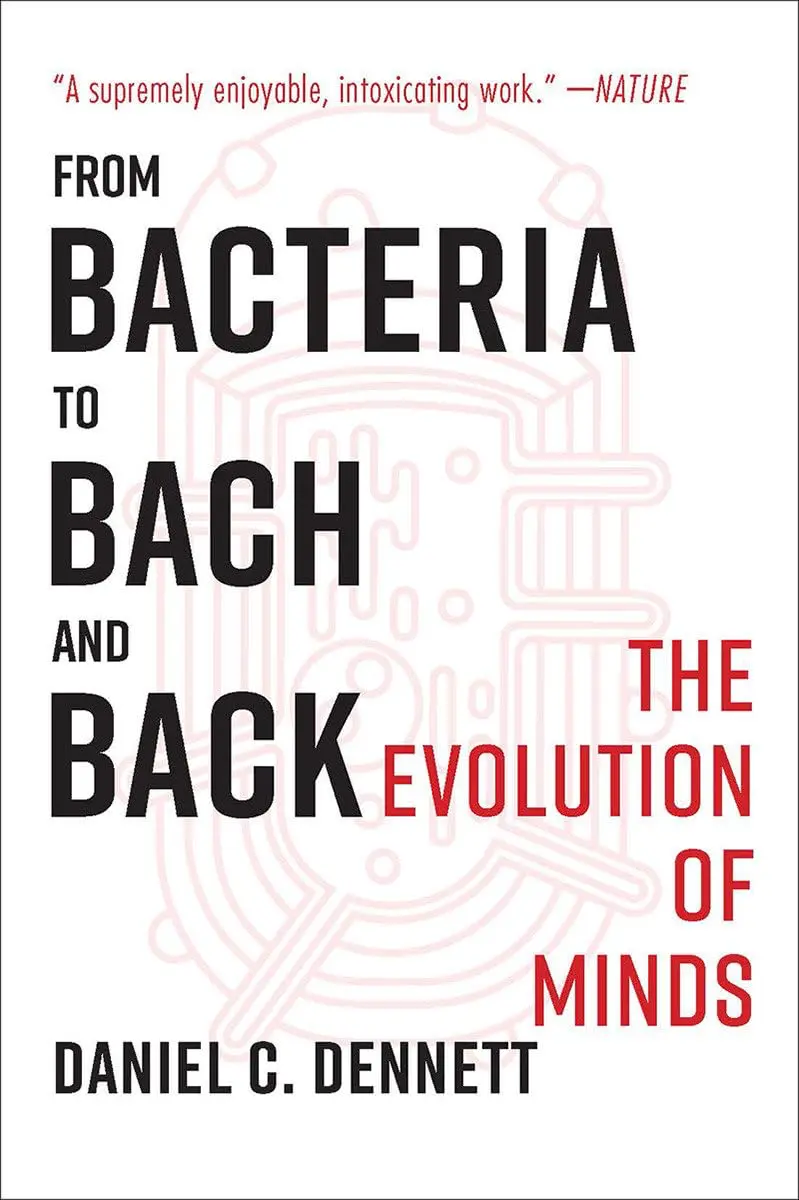
Daniel Dennett has spent his career trying to explain consciousness without invoking magic. No soul. No ghost in the machine. No special sauce that separates human minds from everything else in nature. In this book, which he has described as the summation of decades of work, he lays out his most complete attempt.
The argument starts with bacteria. Single-celled organisms do not have minds. They have competence without comprehension. A bacterium can detect sugar gradients and swim toward food without understanding what sugar is or what swimming means. Dennett calls this “competence without comprehension,” and he argues it is the foundation that everything else builds on.
Natural selection is the first great designer that requires no comprehension. It produces organisms of staggering complexity without planning, without foresight, without understanding. The eye, the wing, the immune system, all designed by a process that has no idea what it is doing. Dennett calls natural selection a “strange inversion of reasoning”: we expect design to require a designer, but Darwin showed that design can emerge from a process that is entirely mindless.
Language is the second strange inversion. When humans developed language, they created a new medium for evolution. Ideas, like genes, can replicate, mutate, and compete. Richard Dawkins called these replicating ideas “memes,” and Dennett takes the concept seriously as a framework for understanding cultural evolution. Words, stories, techniques, and beliefs spread through populations the way genes spread through gene pools, subject to selection pressures that favor some variants over others.
The combination of genetic evolution and cultural evolution eventually produces something new: organisms that can reflect on their own design process and modify it intentionally. This is where Bach comes in. Bach’s music is a product of a mind that was itself a product of billions of years of mindless evolution. The ability to compose a fugue, to grasp abstract mathematical relationships and express them as sound, emerged from the same process that produced the bacterium’s sugar detector. Dennett finds this astonishing, and his astonishment is genuine.
The book is not easy. Dennett writes for an educated general audience, but the arguments are layered, the terminology is specific, and the philosophical stakes are high. He is directly challenging the intuition that consciousness requires something beyond physical processes. Many readers, including many philosophers, disagree with him. But the disagreement itself is productive, because Dennett forces his critics to be specific about where and why they think his account fails.
Dennett was a professor at Tufts University for over fifty years. He died in April 2024 at the age of eighty-two. This book is probably his most accessible statement of a position he had been developing since the 1990s.
