
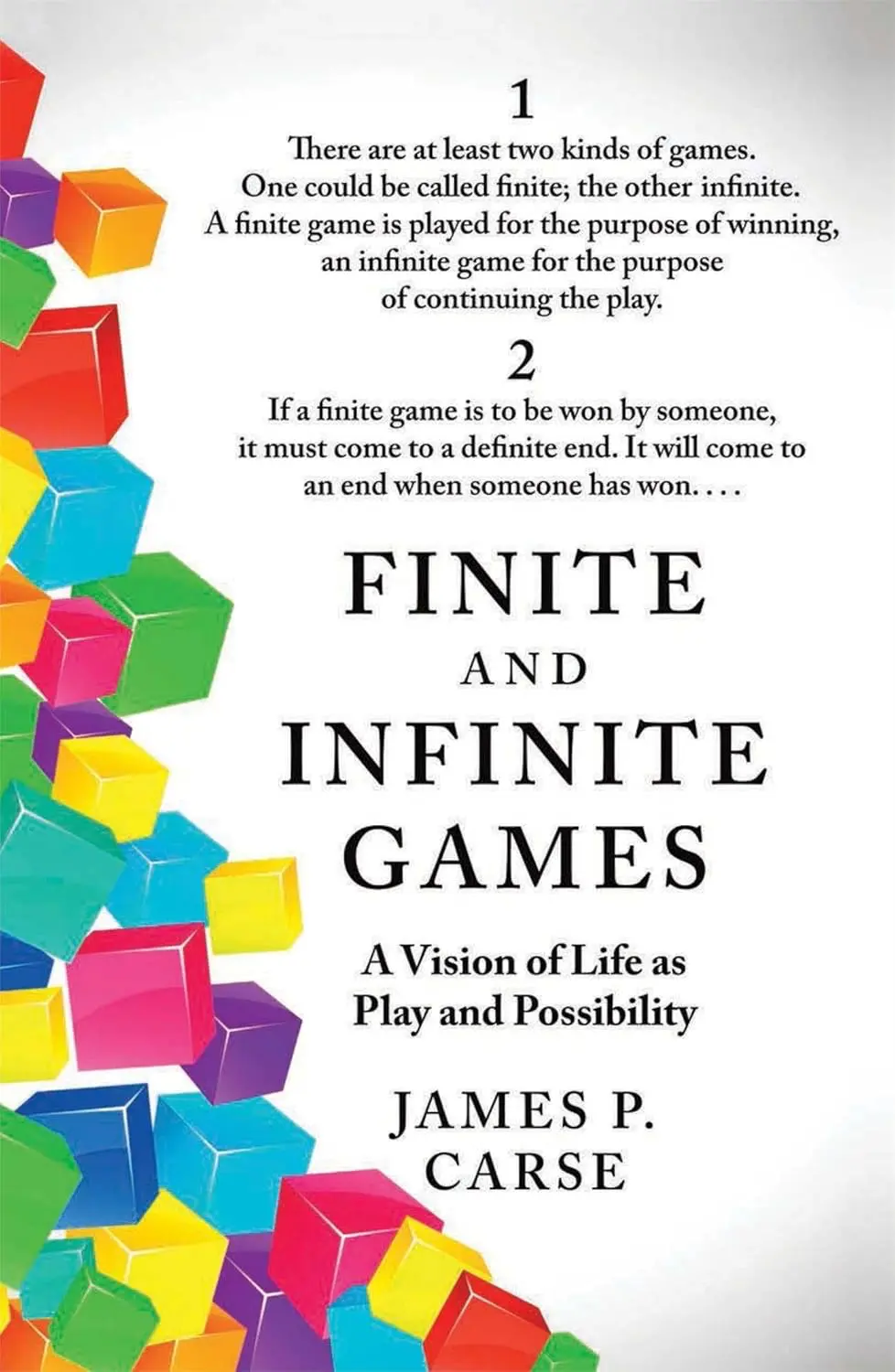
Finite and Infinite Games is a philosophy book written in short, numbered paragraphs. Each paragraph makes one observation about the nature of games, broadly defined. A finite game has known players, fixed rules, and an agreed-upon endpoint. The goal is to win. An infinite game has known and unknown players, the rules change, and there is no endpoint. The goal is to keep the game going.
Carse applies this distinction across human experience. War is a finite game. Culture is an infinite game. A corporation competing for quarterly earnings is playing a finite game. A company building something that will outlast its founders is playing an infinite game. A person trying to prove they are the best is finite. A person trying to keep learning is infinite.
The book is deliberately abstract. Carse does not offer examples from business or provide action steps. He makes observations and lets the reader draw connections. This style frustrates readers who want practical advice but rewards readers who are willing to sit with ideas and discover their own applications.
Simon Sinek later wrote an entire book (The Infinite Game) based on Carse’s distinction, applying it specifically to business and leadership. Kevin Kelly and many other thinkers have cited Finite and Infinite Games as one of the most influential books they have read.
For founders, the framework is useful as a diagnostic. Are you playing a finite or infinite game? If you are building a company to flip it in five years, your decisions will look different than if you are building something to last. Neither is wrong, but confusing the two leads to misaligned strategies, frustrated employees, and bad partnerships.
The book is short, about 150 pages, and can be read in a sitting. But it is dense enough that most readers report getting more from it on re-reads. Carse writes with precision and compression. Every sentence does work. The ideas are the kind that change how you frame other books, conversations, and decisions. It is one of those rare books that is more useful the longer you sit with it.
