
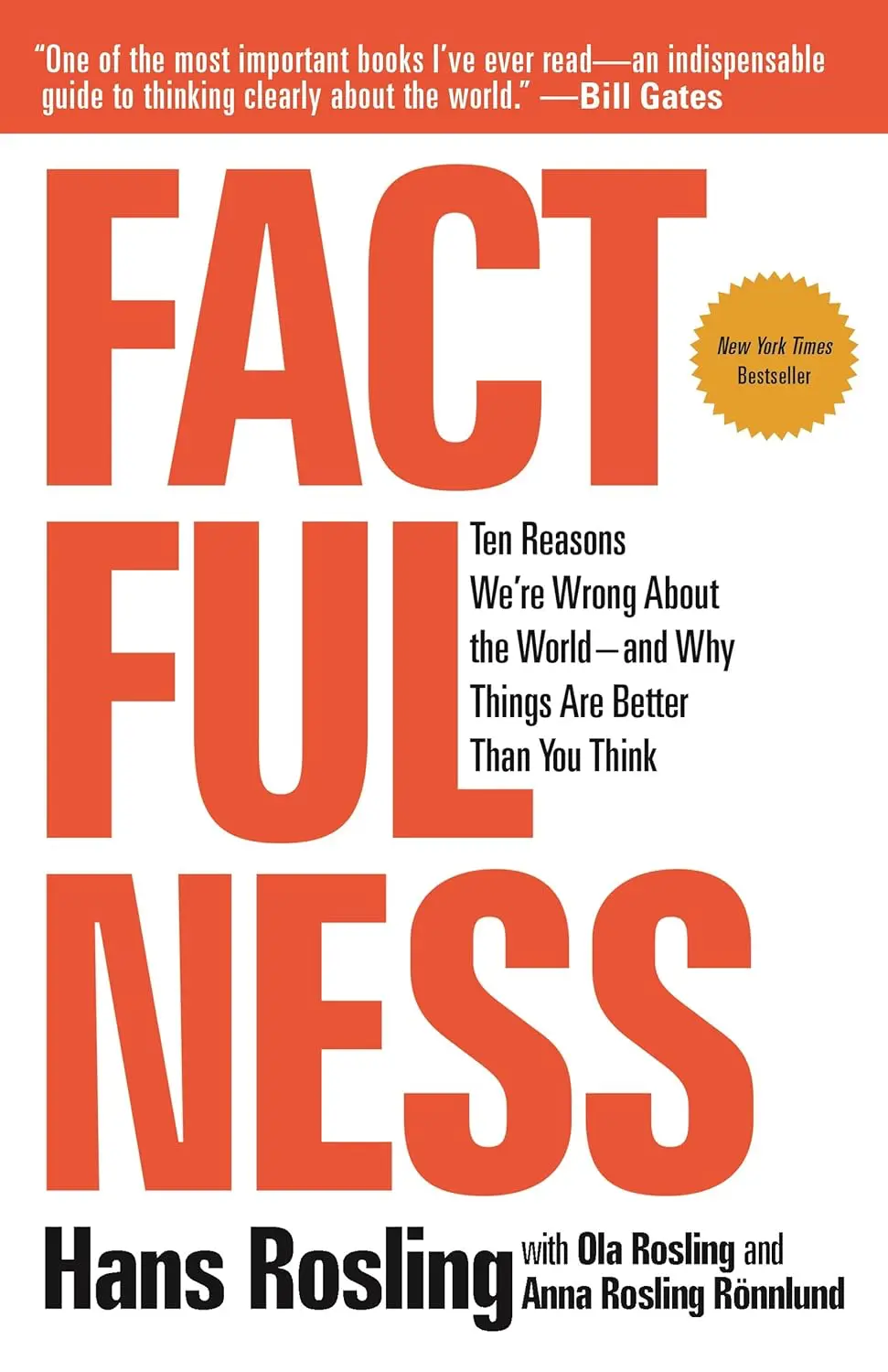
Rosling spent decades presenting global health data to audiences around the world and discovered something unsettling: most people, including doctors, politicians, and business executives, perform worse than chimpanzees on basic questions about global trends. Not because the questions are hard, but because people’s mental models of the world are decades out of date.
The book opens with a 13-question quiz about global poverty, population growth, life expectancy, education levels, and access to electricity. Most readers get fewer than three right. The answers are more positive than anyone expects: extreme poverty has halved in 20 years, most children in the world are vaccinated, and the majority of humanity now lives in middle-income countries.
Rosling identifies ten instincts that distort how people see the world: the gap instinct (dividing the world into “us” and “them”), the negativity instinct (paying more attention to bad news), the straight line instinct (assuming trends continue in the same direction), the fear instinct (overweighting dramatic risks), and others. Each chapter covers one instinct, explains why it evolved, and offers a practical rule for counteracting it.
The writing is warm and personal. Rosling, who died of pancreatic cancer shortly before the book was published, includes stories from his medical work in Mozambique, his collaborations with the UN, and his famous TED talks (which have been viewed hundreds of millions of times). His coauthors, his son Ola Rosling and daughter-in-law Anna Rosling Ronnlund, helped finish the book after his death.
For founders, the book is useful as a corrective to both pessimism and gut-feel decision-making. If your mental model of the world is wrong on basic facts, your business assumptions are probably wrong too. The habit of checking data before forming opinions, which Rosling calls “factfulness,” applies to market sizing, customer research, and competitive analysis just as much as it applies to global health.
Bill Gates gave a copy to every 2018 college graduate in the U.S. Barack Obama and Melinda Gates have also recommended it. At about 340 pages, the book reads quickly and is full of charts that actually clarify rather than confuse.
