
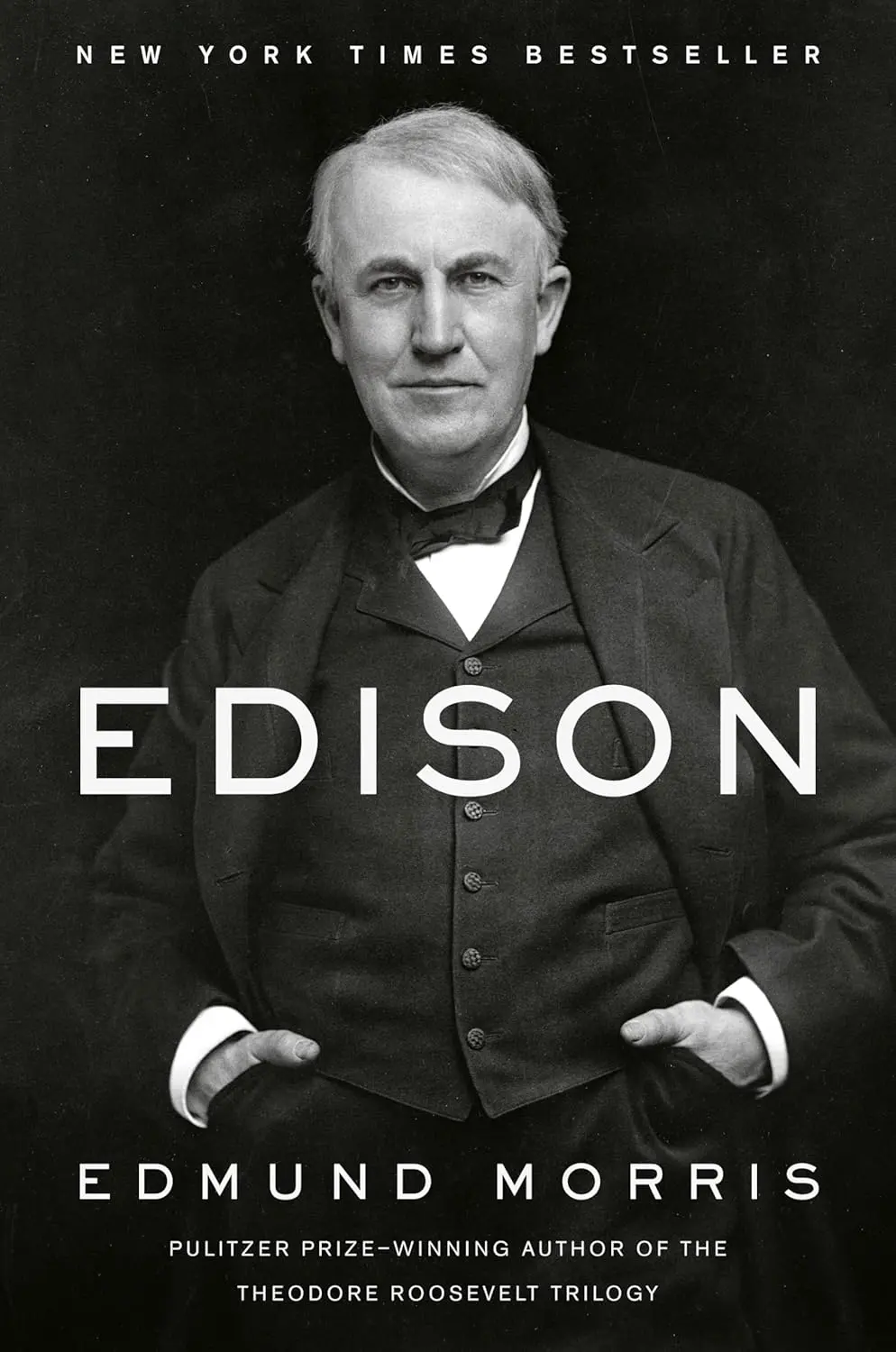
Edmund Morris chose to tell Edison’s life backward. The book opens with Edison’s death in 1931 and ends with his birth in 1847. Morris explained that he wanted the reader to encounter Edison’s greatest inventions, the phonograph, the motion picture camera, the practical incandescent bulb, as mysteries rather than as known outcomes. By starting at the end, you read about Edison’s later years first, when he was a famous but diminished figure, and then watch him get younger, sharper, and more reckless as the pages turn.
The reverse structure is the first thing every reviewer mentions, because it is either brilliant or annoying depending on your disposition. Reading a life backward means that consequences come before causes. You learn about the outcome of a business dispute before you learn what started it. You read about Edison’s relationship with his second wife before you meet the first. Morris believed this created a sense of revelation. Critics argued it created confusion.
What is not debatable is the depth of the research. Morris spent over a decade on this biography and had access to Edison’s voluminous personal papers. Edison was a compulsive note-taker and record-keeper. He left behind five million pages of documents. Morris uses them to reconstruct not just the inventions but the working process: the failed experiments, the blind alleys, the long nights in the laboratory at Menlo Park where Edison and his team tested thousands of materials searching for the right filament for the lightbulb.
The portrait of Edison that emerges is complicated. He was relentlessly inventive, holding 1,093 patents, more than any individual in American history at the time. He was also a ruthless businessman who fought dirty in the War of Currents against Westinghouse and Tesla, a negligent father who prioritized his laboratory over his family, and a man whose hearing loss, which worsened throughout his life, made him increasingly isolated even as his fame grew.
Morris died in 2019, shortly after the book’s publication. He was known for his Roosevelt biographies (The Rise of Theodore Roosevelt won the Pulitzer Prize) and his controversial biography of Reagan, Dutch, which used a fictionalized narrator. Edison uses no such device but shares the same quality of all Morris’s work: prose that is polished, literate, and attentive to physical detail in a way that makes the past feel tactile.
The reverse chronology means this is not the biography to read if you want a conventional, start-to-finish account of Edison’s life. For that, you might try other options. But if you want to understand the texture of Edison’s mind, the way a specific genius operated day to day, Morris’s book is as close as you will get.
