
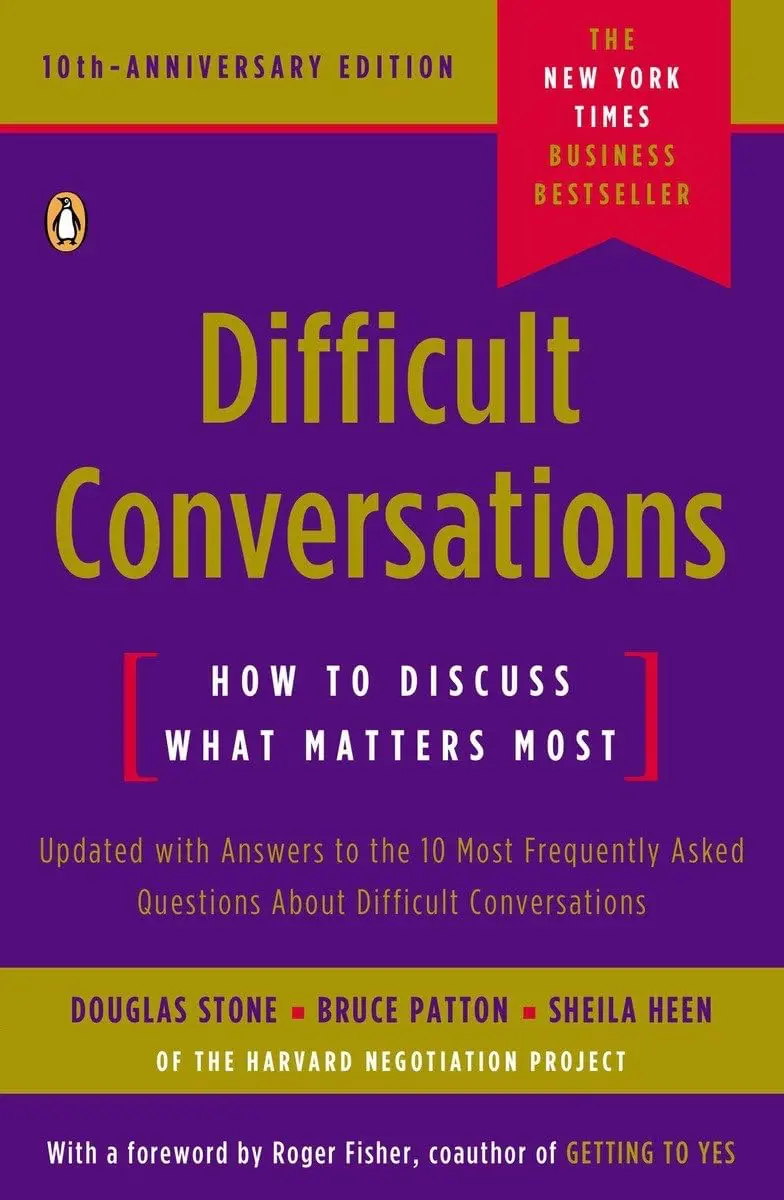
Difficult Conversations grew out of the Harvard Negotiation Project and provides a framework for handling the conversations people avoid: giving negative feedback, raising a sensitive issue, disagreeing with someone who has more power, or talking about something that feels personal and loaded.
The book’s central insight is that every difficult conversation actually contains three simultaneous conversations. The “What Happened” conversation is about the facts, where people disagree about what occurred, whose fault it was, and what should be done. The “Feelings” conversation is about the emotions both parties are experiencing, which usually go unacknowledged. The “Identity” conversation is about what the situation means for each person’s self-image, particularly around questions like “Am I competent?” or “Am I a good person?”
For each layer, the authors provide specific guidance. In the “What Happened” conversation, they argue against trying to determine who is right and instead suggest exploring each person’s story. In the “Feelings” conversation, they explain why acknowledging emotions is not the same as agreeing with them. In the “Identity” conversation, they describe how to keep your self-image from being destabilized by criticism or conflict.
The practical sections cover how to start a difficult conversation (with a “learning conversation” opening rather than a blame opening), how to listen when you disagree, how to express yourself without triggering defensiveness, and how to handle conversations that go off the rails. The examples are drawn from workplace, family, and personal situations.
For founders, who have difficult conversations almost daily, whether with co-founders, employees, investors, or customers, the framework is directly applicable. The book’s approach to separating impact from intent (what someone did affected you, but that doesn’t mean they intended to) is particularly useful for resolving the kinds of misunderstandings that escalate into real conflicts.
The writing is clear and well-organized. The book was first published in 1999 and has been updated, but the core framework has not changed because the dynamics of difficult conversations haven’t changed either. It reads well alongside Nonviolent Communication by Marshall Rosenberg, which covers overlapping territory from a different angle.
