
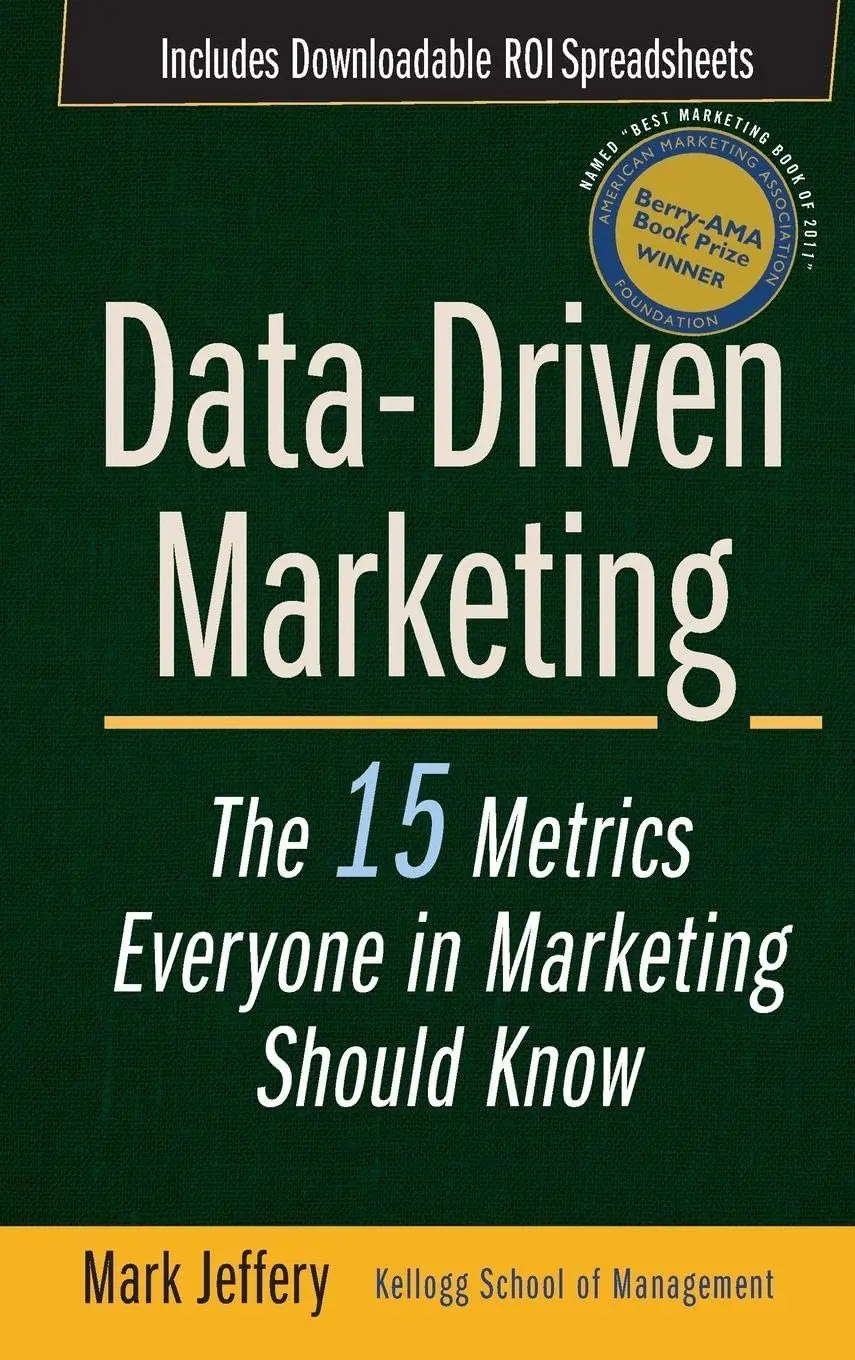
Jeffery’s research at the Kellogg School of Management found that most companies cannot measure the ROI of their marketing spending. They allocate budgets based on last year’s numbers, competitive benchmarks, or the CMO’s instincts rather than on evidence of what works. The result is that billions of dollars are spent on marketing activities that nobody can prove generate returns.
The book identifies 15 metrics organized by type. Financial metrics: ROI, customer lifetime value, cost per acquisition. Campaign metrics: click-through rate, conversion rate, bounce rate. Customer metrics: churn rate, satisfaction score, brand awareness. The metrics themselves are not new, but Jeffery’s contribution is showing how to connect them into a coherent measurement framework that ties marketing activities to business outcomes.
The practical sections cover how to run marketing experiments (A/B testing, controlled pilots, attribution modeling), how to allocate budget across channels based on performance data, and how to build dashboards that give executives visibility into what is working.
Jeffery also addresses the political challenges of data-driven marketing. In many organizations, measuring marketing effectiveness is threatening because it reveals that some campaigns and channels do not work. People who built their careers on those campaigns resist measurement. The book covers how to navigate this resistance and build a culture where data informs decisions.
For founders, the framework helps at every stage. Early on, when every dollar matters, knowing which marketing channels are producing customers and which are producing noise is the difference between survival and waste. Later, as budgets grow, the measurement framework prevents the common problem of marketing spending increasing while nobody can explain whether the increase is justified.
Jeff Bezos has cited data-driven decision-making as central to Amazon’s approach. At about 320 pages, the book is thorough. The academic grounding (Kellogg research, corporate case studies) gives it credibility. Some sections are technical, but Jeffery writes clearly enough for non-marketers to follow.
