
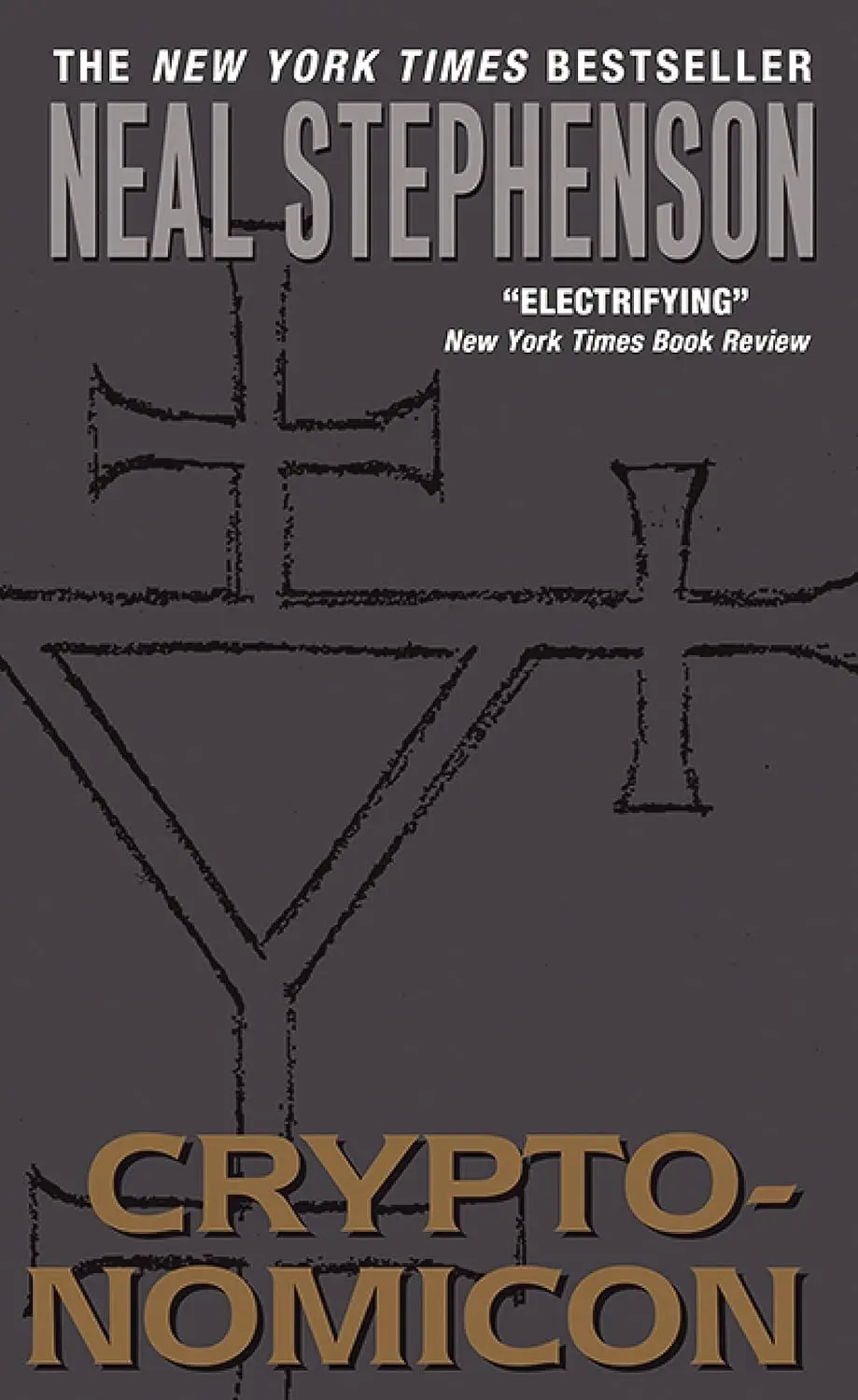
There are two timelines. In 1942, Lawrence Pritchard Waterhouse, a mathematical genius in the U.S. Navy, is assigned to Detachment 2702, an outfit so secret that Churchill and Roosevelt are among the handful who know it exists. The unit’s mission: prevent the Germans from realizing that the Allies have cracked Enigma. Every time intelligence from Enigma is used to sink a convoy or anticipate an attack, there has to be a plausible cover story. Bobby Shaftoe, a Marine Raider with a morphine habit and a gift for violence, executes those cover stories on the ground.
In the late 1990s, Waterhouse’s grandson Randy, a Unix-loving hacker, is working with a startup to build a data haven in the fictional Sultanate of Kinakuta. The goal: a place where encrypted information can be stored and exchanged beyond the reach of any government. Gold from a mysterious WWII-era stash keeps surfacing. The two timelines converge slowly and then all at once.
Stephenson writes like a man who has never been told to cut anything. Chapters go on for fifty pages. A description of eating Cap’n Crunch cereal runs for several pages and somehow remains interesting. Technical explanations of cryptographic principles, prime number theory, and Van Eck phreaking appear in the middle of action sequences. There is an appendix containing a working card-based cipher, designed by cryptographer Bruce Schneier specifically for this novel.
The book is not for everyone. It demands patience and a tolerance for digressions that other novelists would never attempt. But the digressions are often the best parts. Stephenson treats information itself as a character, tracing how the ability to encrypt, decrypt, store, and transmit data shapes wars, economies, and entire civilizations. He wrote this in 1999, before Bitcoin, before the privacy debates of the 2010s, before anyone was talking about data sovereignty, and most of it reads like prediction rather than fiction.
Peter Thiel made Cryptonomicon required reading at PayPal during the company’s early years. The connection is obvious. PayPal’s original ambition was to create a kind of digital currency free from government control, which is essentially what Randy Waterhouse is trying to build in the novel. The crypto and fintech worlds have treated this book as something between a technical manual and a founding document.
Stephenson’s later Baroque Cycle trilogy is set in the same fictional universe, following the ancestors of the Waterhouse and Shaftoe families. But Cryptonomicon works as a standalone. At 918 pages, it is a commitment, but you will not run out of things to think about.
