
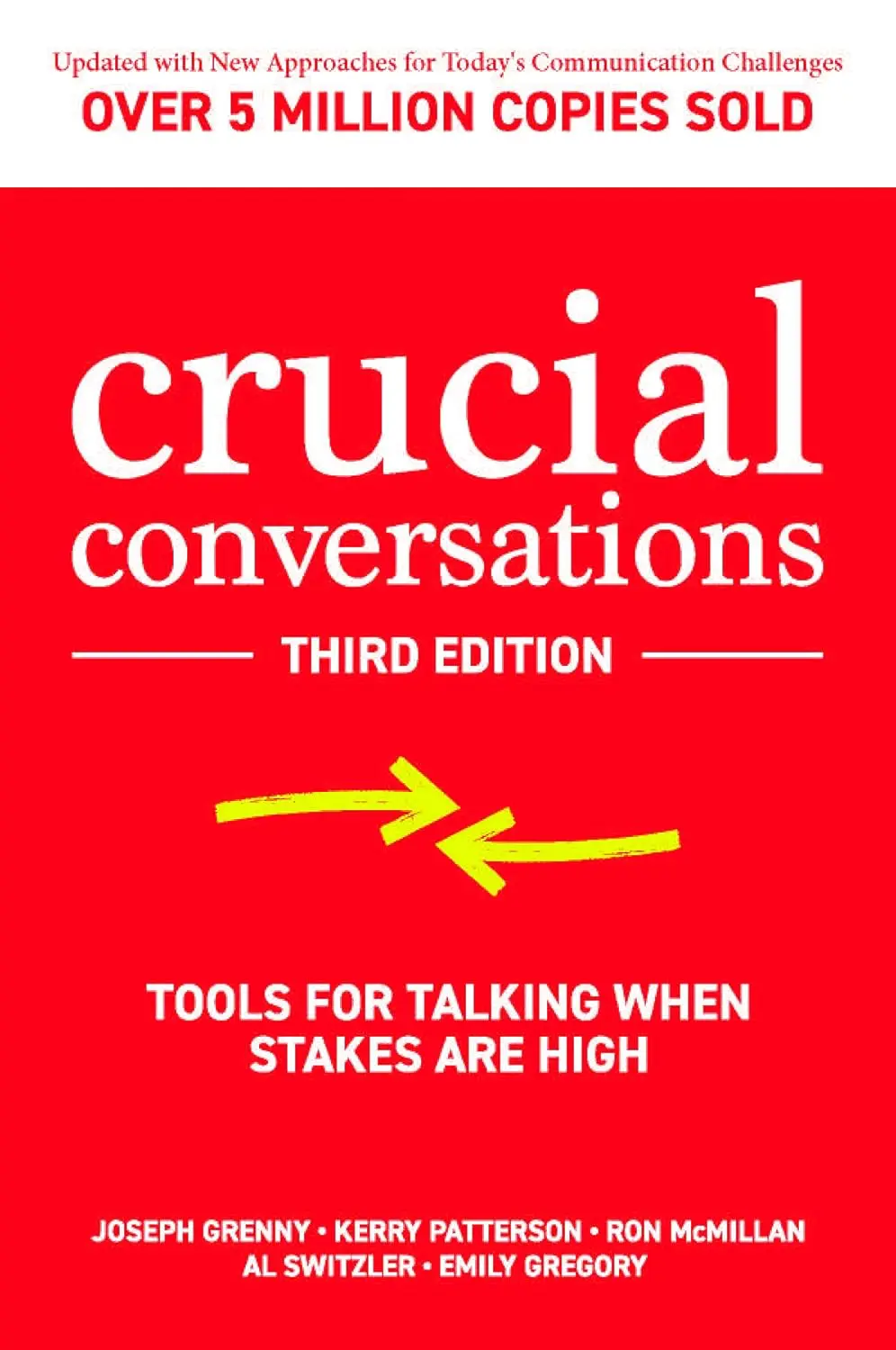
Most people handle high-stakes conversations badly. When emotions rise, they either go silent (withdrawing, avoiding, masking their real feelings) or turn violent (attacking, labeling, controlling). Both responses make the situation worse. Crucial Conversations offers a method for staying in productive dialogue when your instincts want to flee or fight.
The framework starts with “Start with Heart,” which means getting clear on what you actually want from the conversation before you open your mouth. Most people enter difficult conversations with a vague goal (I want to be right, I want them to stop, I want to vent) rather than a specific one (I want us to agree on a timeline for the project).
The next step is “Learn to Look,” which means watching for signs that the conversation has become unsafe. When people feel threatened, they stop sharing honest opinions. You can tell this is happening when they start making sarcastic comments, going quiet, or becoming defensive. At that point, the conversation is no longer productive and you need to restore safety before continuing.
“Make It Safe” involves two skills: finding mutual purpose (convincing the other person that you care about their interests, not just your own) and showing mutual respect (even when you disagree with their position, you respect them as a person).
The book covers additional techniques: how to share your own opinion without triggering defensiveness, how to draw out the other person’s real concerns, and how to move from dialogue to action (because agreeing on what to do is useless without agreeing on who does what by when).
For founders, difficult conversations are constant: feedback to a cofounder, negotiation with an investor, a tough conversation with an underperforming employee, a disagreement about strategy. Most founders avoid these conversations or handle them poorly, which creates problems that compound over time.
Sheryl Sandberg has recommended it. At about 260 pages, the book is practical and well-structured. The writing is clear if occasionally formulaic. The techniques work because they address the emotional dynamics that make conversations fail, not just the content of the disagreement.
