
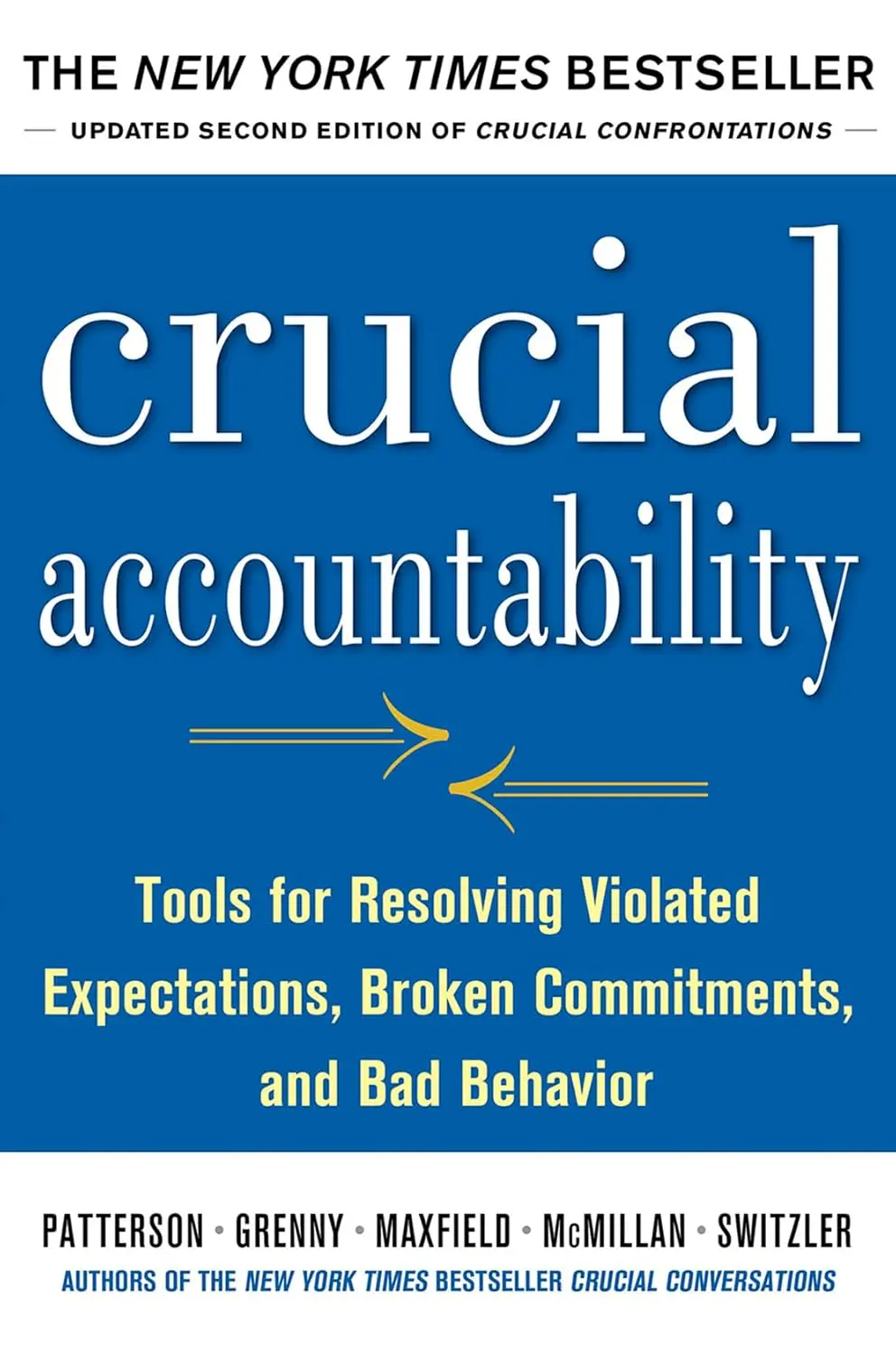
Crucial Accountability addresses a specific problem: what do you do when someone has made a commitment and failed to deliver? The authors, who also wrote their earlier book on difficult conversations, provide a structured approach to having these conversations in a way that solves the problem without damaging the relationship.
The framework starts with identifying the right problem to address. The authors argue that most accountability failures involve multiple issues layered on top of each other: the original broken commitment, the pattern of repeated failures, and the impact on trust. Choosing which of these to address first determines whether the conversation will be productive or will spiral into resentment.
The book then walks through a sequence of steps. First, make it safe for the other person to engage by establishing mutual purpose. Second, describe the gap between what was expected and what happened, using specific observations rather than judgments. Third, explore the reasons behind the failure, distinguishing between motivation problems (they didn’t want to) and ability problems (they couldn’t). Fourth, agree on a plan for moving forward with clear expectations and follow-up.
For founders, this is a practical toolkit. Accountability conversations with co-founders, employees, contractors, and partners are some of the hardest and most important conversations in business. Most people either avoid them entirely, letting resentment build, or handle them badly, creating defensiveness and conflict. The framework in this book offers a middle path.
The writing is solid but functional rather than elegant. The book uses case studies and dialogue examples that can feel somewhat scripted. But the underlying principles are sound, and the step-by-step approach makes it easy to apply. If you manage people or work closely with a business partner, this book addresses problems you will face repeatedly. The techniques apply equally well to conversations with vendors, clients, and anyone else who has made a promise they didn’t keep. If you manage people, you will use this book.
