
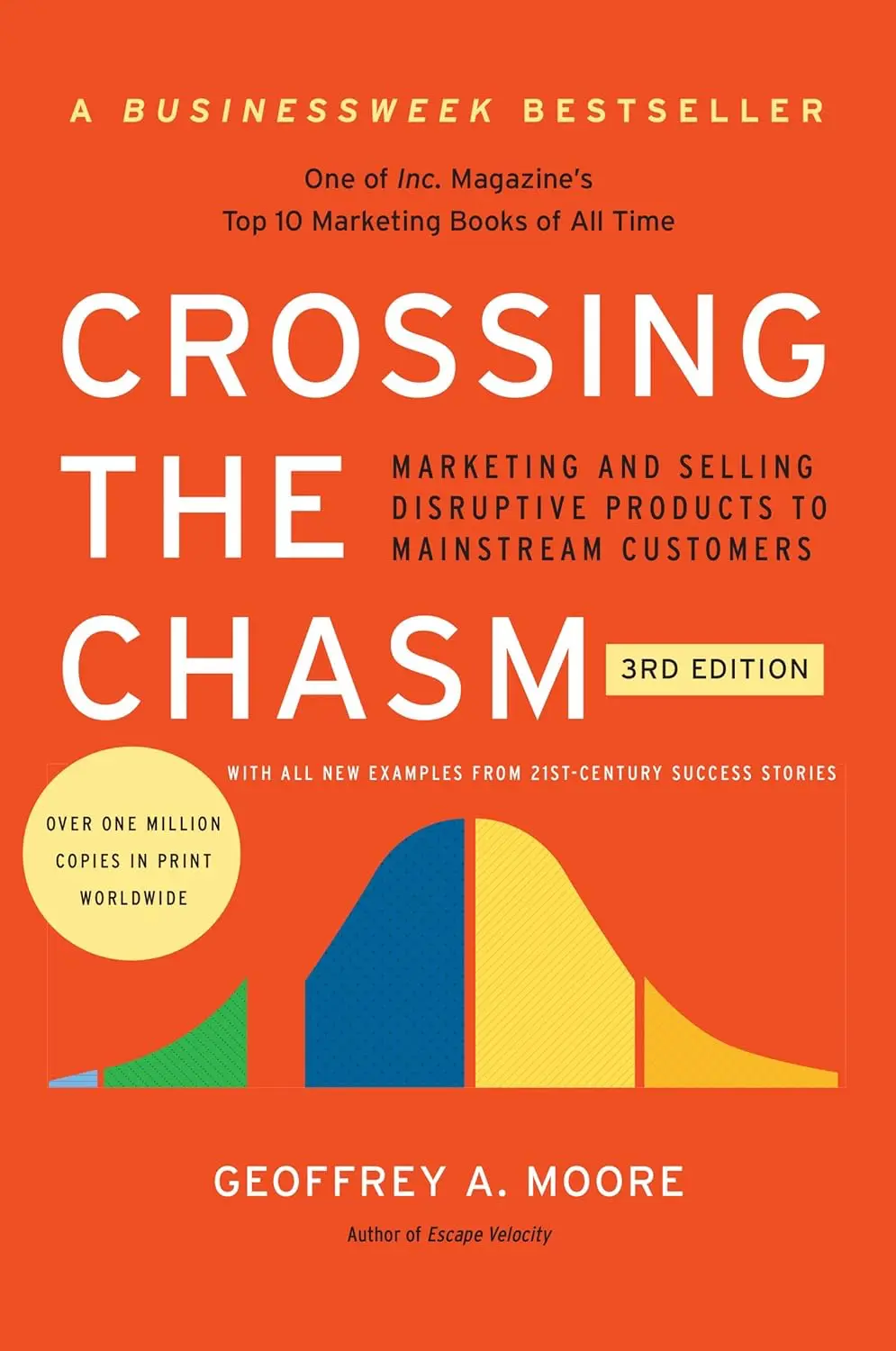
Crossing the Chasm, first published in 1991, addresses a problem that many tech startups encounter: the product gains traction with enthusiasts and visionaries (early adopters) but then growth stalls. The mainstream market, the pragmatists and conservatives who represent the bulk of revenue, is not buying.
Moore’s framework is built on the technology adoption lifecycle, a bell curve that segments customers into innovators, early adopters, early majority, late majority, and laggards. The critical insight is that there is a gap, a “chasm,” between early adopters and the early majority. These two groups buy for different reasons, evaluate products differently, and trust different references.
Early adopters are willing to tolerate incomplete products and take risks on new technology because they see strategic advantage. The early majority wants proven solutions, references from people like themselves, and complete products that work out of the box. Trying to sell to the early majority the same way you sold to early adopters fails because the motivations are fundamentally different.
Moore’s solution is what he calls the “bowling alley” strategy. Instead of targeting the entire mainstream market at once, pick one narrow segment (a “beachhead”), dominate it completely, and use that success as a reference to expand into adjacent segments. Each conquered segment knocks down the next one, like bowling pins.
The book also covers positioning, competitive strategy, and distribution choices, all framed around the challenge of moving from early market to mainstream. Some of the specific examples (from the 1990s tech industry) are dated, but the framework itself has held up well. The third edition (2014) updates the examples and adds material about cloud computing and subscription business models.
For founders building technology products, this book is close to required reading. The chasm problem is real, and many startups die in it. Marc Andreessen, Rand Fishkin, and Neil Patel have all recommended it. At about 250 pages, it is a manageable read. The core ideas can be summarized in a few pages, but the detail Moore provides on execution is what makes the book valuable beyond the concept.
