
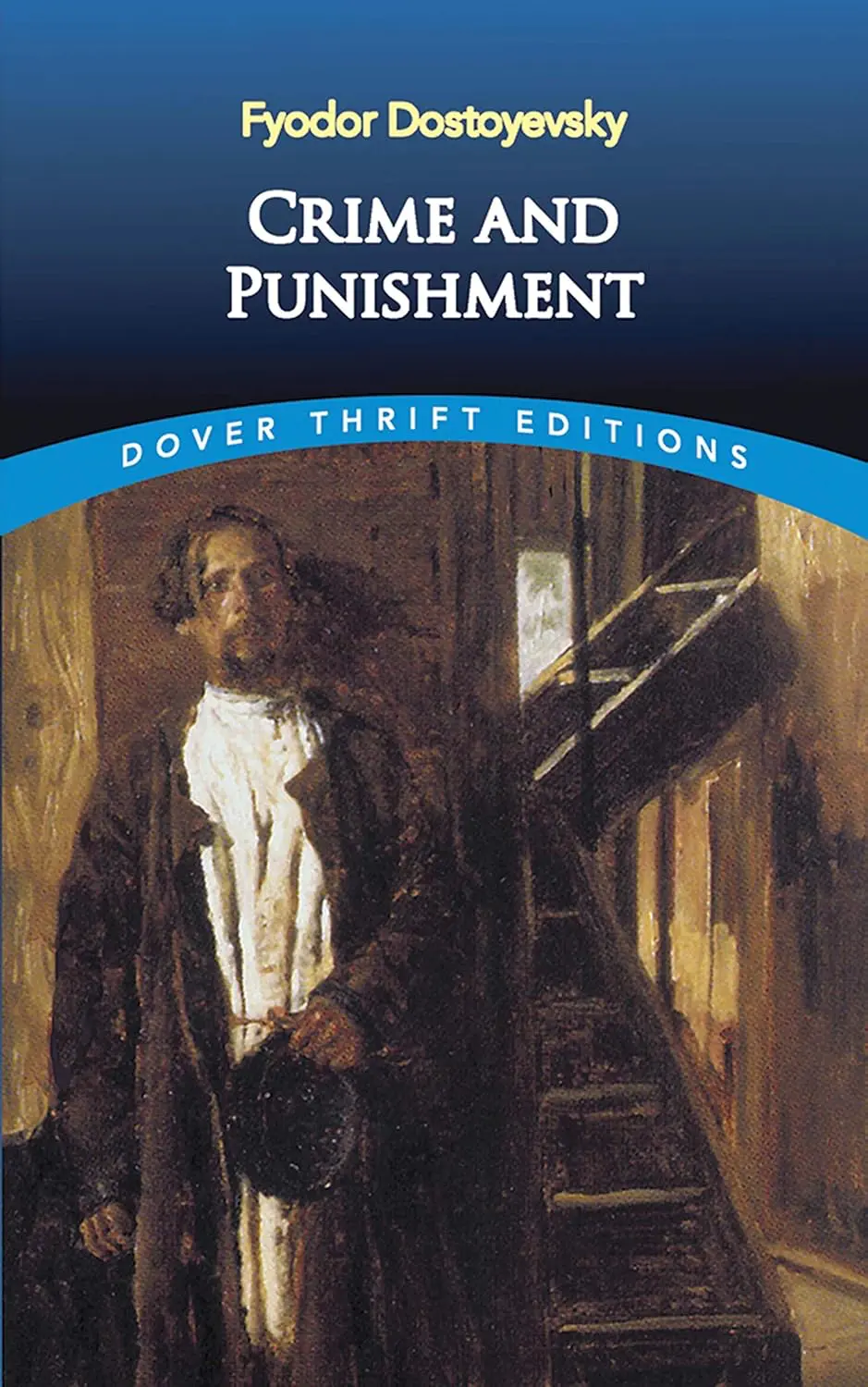
Crime and Punishment follows Raskolnikov, a former law student living in poverty in St. Petersburg, who develops a theory that certain extraordinary people have the right to transgress moral law for the greater good. To prove his theory to himself, he murders an elderly pawnbroker. What follows is not a detective story about whether he will be caught, but a psychological story about what the crime does to him.
Dostoevsky tracks Raskolnikov’s mental disintegration with clinical precision. After the murder, Raskolnikov swings between paranoia, confession, and a desperate attempt to convince himself that he was justified. He picks fights, pushes away people who care about him, and falls into feverish states that blur the line between physical illness and moral crisis. The psychological realism is the book’s greatest achievement; Dostoevsky understood guilt, self-deception, and the way the mind tries to protect itself from truths it cannot accept.
The other characters are drawn with equal care. Sonia, a young woman forced into prostitution to support her family, becomes Raskolnikov’s mirror, someone who suffers without rationalizing her suffering. Porfiry, the detective investigating the murder, is one of literature’s great antagonists, not because he is threatening but because he is patient, intelligent, and sees through Raskolnikov’s pretenses.
For founders and ambitious people, the book is relevant in ways that might not be obvious at first. Raskolnikov’s error is not just moral but intellectual: he talks himself into believing that his intelligence exempts him from ordinary rules. The pattern of using rationalization to justify harmful actions because you believe the outcome will be worth it is not limited to murderers. It shows up, in much milder forms, in business decisions, leadership failures, and personal relationships.
The translation matters. The Pevear and Volokhonsky translation is widely recommended for its accuracy, while the Constance Garnett version remains readable if somewhat dated. The book is long and the Russian names can be disorienting at first, but Dostoevsky’s pacing pulls you through once Raskolnikov commits the crime and the real story begins.
