
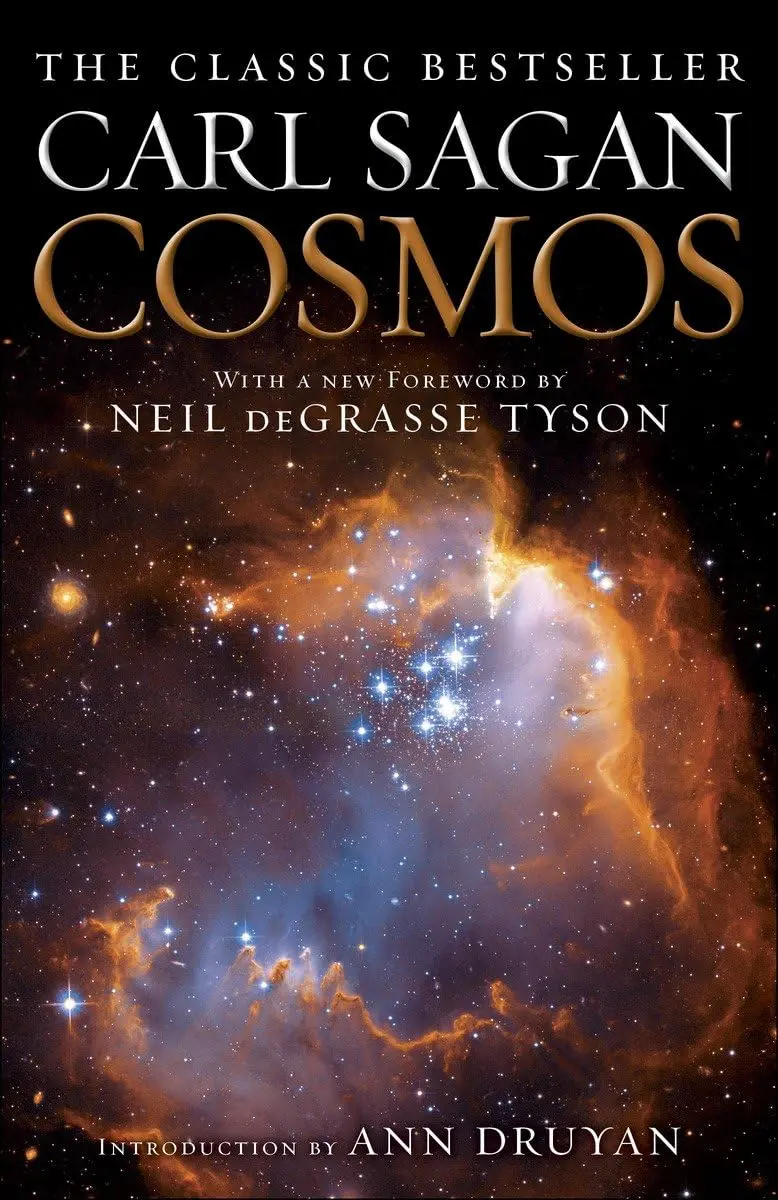
Cosmos is Carl Sagan’s most famous book, published alongside the television series of the same name in 1980. It covers an enormous range of topics, from the origin of the universe to the evolution of life on Earth, from ancient Alexandrian science to modern space exploration, all connected by Sagan’s argument that understanding the cosmos is both a scientific and a deeply human undertaking.
Sagan writes about astronomy, biology, chemistry, and physics, but the book is not really a science textbook. It is closer to a philosophical meditation on what science means and why it matters. Sagan traces the history of scientific thought, spending time with the ancient Greeks, the Library of Alexandria, Kepler, Newton, and Einstein, always connecting the science to the people who discovered it and the cultures that either supported or suppressed their work.
The chapters on the search for extraterrestrial life reflect Sagan’s particular passion. He co-designed the golden records aboard the Voyager spacecraft, and his enthusiasm for the possibility of life elsewhere in the universe runs through the book without tipping into speculation beyond what the evidence supports.
What makes Cosmos different from most popular science books is its tone. Sagan writes with a sense of wonder that feels genuine rather than performed. He can move from a technical explanation of stellar nucleosynthesis to a reflection on human insignificance in the scale of the universe without the transition feeling forced. His famous line about Earth being “a pale blue dot” in the vastness of space captures the spirit of the entire book.
For founders and ambitious readers, Cosmos offers something most business books don’t: perspective. Sagan’s ability to zoom out from daily concerns and see the bigger picture, to hold both the smallness and the importance of human effort in mind at the same time, is a useful corrective to the narrow focus that building a company can produce. The book has aged well despite being over 40 years old, though some of the specific scientific details have been updated by newer discoveries.
